







Question: Part 1: Number Systems and Binary Numbers Please type or neatly write your solutions to these problems. Show all work for full credit! 1. (2
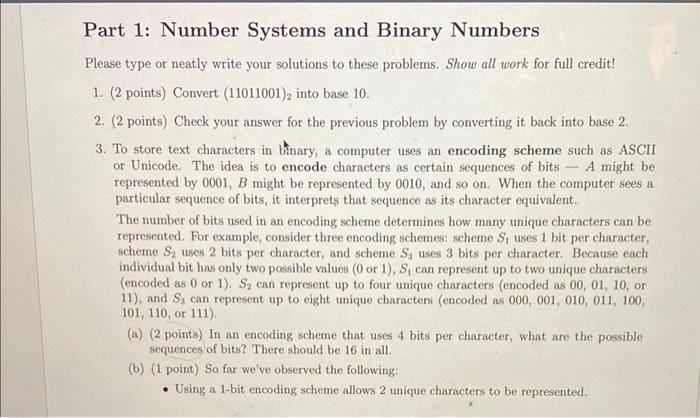
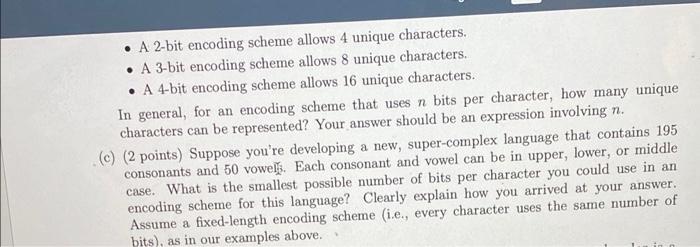
Part 1: Number Systems and Binary Numbers Please type or neatly write your solutions to these problems. Show all work for full credit! 1. (2 points) Convert (11011001)2 into base 10. 2. (2 points) Check your answer for the previous problem by converting it back into base 2 . 3. To store text characters in binary, a computer uses an encoding scheme such as ASCII or Unicode. The idea is to encode characters as certain sequences of bits - A might be represented by 0001,B might be represented by 0010 , and so on. When the computer sees a particular sequence of bits, it interprets that sequence as its character equivalent. The number of bits used in an encoding scheme determines how many unique characters can be represented. For example, consider three encoding schemes: scheme S1 uses 1 bit per character, scheme S2 uses 2 bits per character, and scheme S3 uses 3 bits per character. Because each individual bit has only two possible values (0 or 1),S1 can represent up to two unique characters (encoded as 0 or 1). S2 can represent up to four unique characters (encoded as 00,01,10, or 11), and Sy can represent up to eight unique characters (encoded as 000,001,010,011,100, 101,110 , or 111). (a) (2 points) In an encoding scheme that uses 4 bits per character, what are the possible sequences of bits? There should be 16 in all. (b) (1 point) So far we've observed the following: - Using a 1-bit encoding scheme allows 2 unique characters to be represented. - A 2-bit encoding scheme allows 4 unique characters. - A 3-bit encoding scheme allows 8 unique characters. - A 4-bit encoding scheme allows 16 unique characters. In general, for an encoding scheme that uses n bits per character, how many unique characters can be represented? Your answer should be an expression involving n. (c) (2 points) Suppose you're developing a new, super-complex language that contains 195 consonants and 50 voweli. Each consonant and vowel can be in upper, lower, or middle case. What is the smallest possible number of bits per character you could use in an encoding scheme for this language? Clearly explain how you arrived at your answer. Assume a fixed-length encoding scheme (i.e., every character uses the same number of bits), as in our examples above
Step by Step Solution
There are 3 Steps involved in it

Get step-by-step solutions from verified subject matter experts
 Study Help