







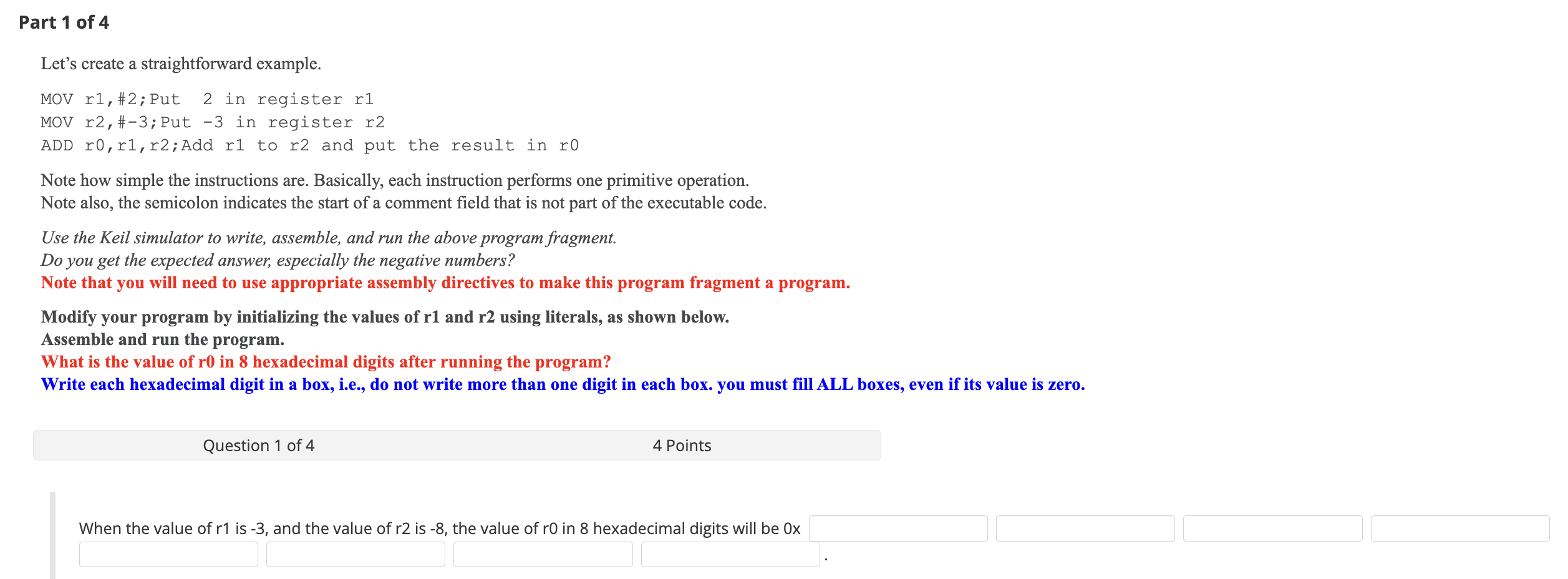
Question: Part 1 of 4 Let's create a straightforward example. MOV r 1 , # 2 ; Put 2 in register r 1 MOV r 2
Part of
Let's create a straightforward example.
MOV r #; Put in register r
MOV #; Put in register
ADD ; Add to and put the result in
Note how simple the instructions are. Basically, each instruction performs one primitive operation.
Note also, the semicolon indicates the start of a comment field that is not part of the executable code.
Use the Keil simulator to write, assemble, and run the above program fragment.
Do you get the expected answer, especially the negative numbers?
Note that you will need to use appropriate assembly directives to make this program fragment a program.
Modify your program by initializing the values of and using literals, as shown below.
Assemble and run the program.
What is the value of in hexadecimal digits after running the program?
Write each hexadecimal digit in a box, ie do not write more than one digit in each box. you must fill ALL boxes, even if its value is zero.
When the value of is and the value of is the value of in hexadecimal digits will be
Step by Step Solution
There are 3 Steps involved in it
1 Expert Approved Answer
Step: 1 Unlock

Question Has Been Solved by an Expert!
Get step-by-step solutions from verified subject matter experts
Step: 2 Unlock
Step: 3 Unlock
 Study Help