







Question: Part 1 : one extended scenario with variations CRISPR Cas 9 was targeted to a particular sequence, ( 5 ^ { prime }
Part : one extended scenario with variations
CRISPR Cas was targeted to a particular sequence, primeTAACCAGTGTTCCAAGGTGAPAM sequence shown in bold
During normal gene editing, which molecule binds to the PAM? Choose one or more.
a Cas protein
b Guide RNA: either sgRNA or crRNA
c tracrRNA
d None of these
Which of the following must have been part of the sgRNA that will to target Cas to cut the intended sequence, primeTAACCAGTGTTCCAAGGTGAPAM sequence shown in bold
aTGGAACAC
bCACAAGGT
cGTGTTCCA
dACCTTGTG
Let's consider that we want to use this gene editing approach as a gene therapy which will need to be used to treat a dividing cell population in the lining of the colon. Choose a viral vector to deliver it and explain what features you considered in choosing it
What makes it a good choice? What compromises might you be making?
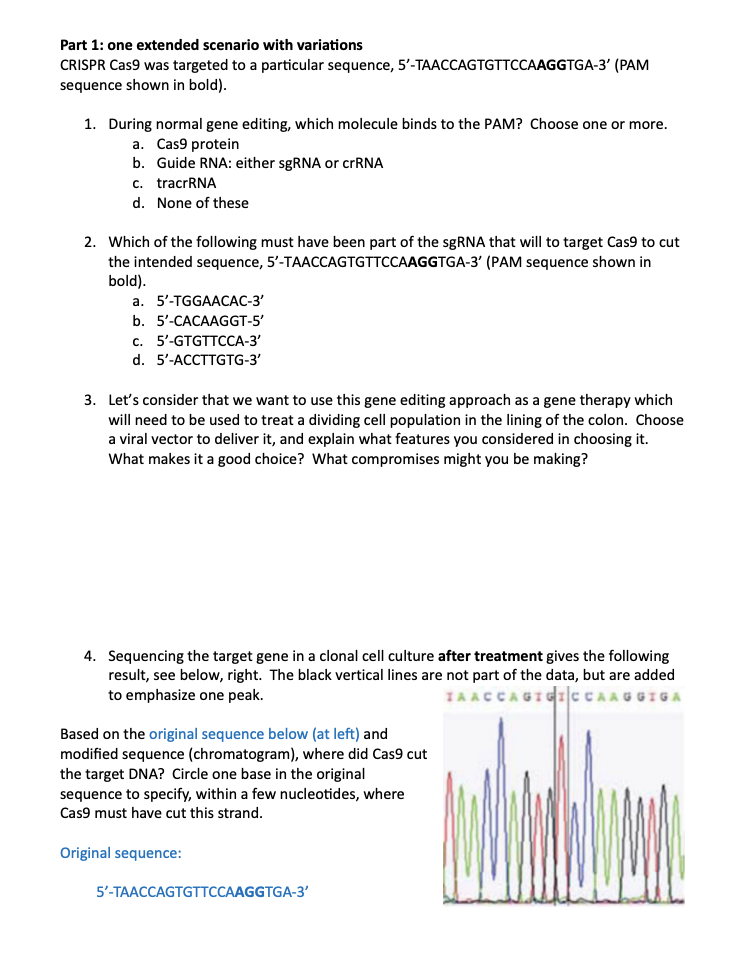
Sequencing the target gene in a clonal cell culture after treatment gives the following result, see below, right. The black vertical lines are not part of the data, but are added to emphasize one peak.
Based on the original sequence below at left and modified sequence chromatogram where did Cas cut the target DNA? Circle one base in the original sequence to specify, within a few nucleotides, where Cas must have cut this strand.
Original sequence: What is the difference in DNA sequence between the edited DNA and the original DNA?
In this case, only Cas and sgRNA were added to the cells to edit the gene. How was the doublestranded break in the DNA most likely repaired? Explain your reasoning.
In this case, if we sequenced the targeted gene from other clonal cell cultures each derived from one edited cell in which Cas did actually cut this gene should all six clonal cell cultures have the same sequence we found in the first one?
Yes
No
Explain briefly.
This coding sequence is normally read in the reading frame indicated here: Reading frame coding strand, normal sequence: T AAC CAG TGT TCC AAG GTG A Will the Casedited cell culture containing the sequence in the chromatogram above produce normal protein or not? Explain your reasoning.
If we want to target the same gene, but replace the target gene with a specific allele, what would we need to introduce into the cells we want to modify? If we want to target the same gene, but all we need to do is prevent its expression, what are two alternative ways we could achieve this not including allele replacement or the gene editing shown aboveIt does not need to target the same part of this gene, just the same gene. Briefly describe how each approach would work.
Part :
Consider variation among proteins used for targeting specific sequences in gene editing and related applications.
a What is one advantage of using Cas instead of others?
b In addition to Cas what other types of proteins are commonly used for targeting in gene editing and related applications? What is one benefit of each?
What are the catalytic activities of a cytosine base editor that relies on Cas for targeting? Explain briefly. Briefly explain how the CHARM epigenome editor is designed so as to be both effective and small.
Compare prime editing with allele replacement gene editing.
a What isare the catalytic activity of the original Cas
b What isare the catalytic activity of the prime editor based on Cas
c How does the role of the guide RNA differ between these two approaches?
Step by Step Solution
There are 3 Steps involved in it
1 Expert Approved Answer
Step: 1 Unlock

Question Has Been Solved by an Expert!
Get step-by-step solutions from verified subject matter experts
Step: 2 Unlock
Step: 3 Unlock
 Study Help