





Question: Part 1: Osmoregulation 1. Define the term osmoregulation. Why would it be important for living things to be able to osmoregulate their bodies? How the
Part 1: Osmoregulation 1. Define the term
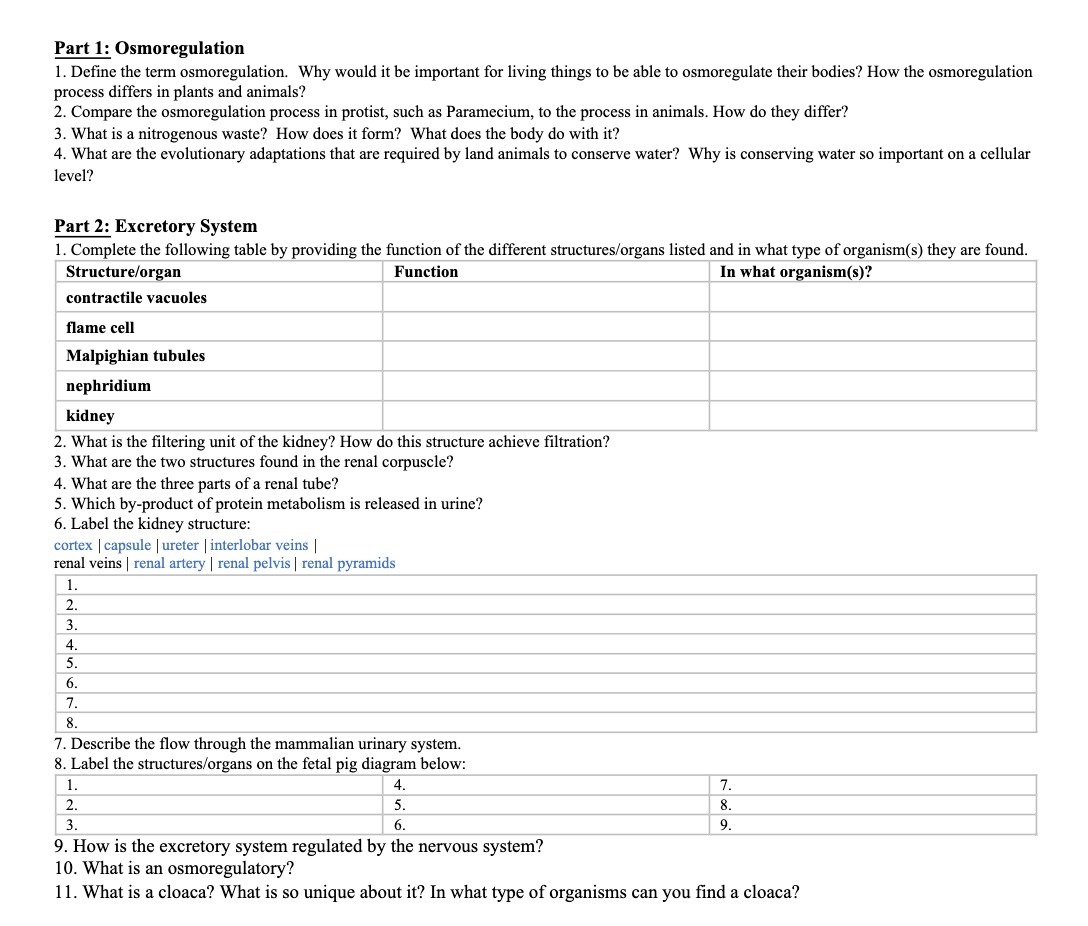
Part 1: Osmoregulation 1. Define the term osmoregulation. Why would it be important for living things to be able to osmoregulate their bodies? How the osmoregulation process differs in plants and animals? 2. Compare the osmoregulation process in protist, such as Paramecium, to the process in animals. How do they differ? 3. What is a nitrogenous waste? How does it form? What does the body do with it? 4. What are the evolutionary adaptations that are required by land animals to conserve water? Why is conserving water so important on a cellular level? Part 2: Excretory System 1. Complete the following table by providing the function of the different structures/organs listed and in what type of organism(s) they are found. Structure/organ Function In what organism(s)? contractile vacuoles flame cell Malpighian tubules nephridium kidney 2. What is the filtering unit of the kidney? How do this structure achieve filtration? 3. What are the two structures found in the renal corpuscle? 4. What are the three parts of a renal tube? 5. Which by-product of protein metabolism is released in urine? 6. Label the kidney structure: cortex | capsule | ureter | interlobar veins | renal veins | renal artery | renal pelvis | renal pyramids 1. 2. 3. 4. 5. 6. 7 . 8 . 7. Describe the flow through the mammalian urinary system. 8. Label the structures/organs on the fetal pig diagram below: 1 . 4. 7 . 2 . 5. 8. 3. 6. 9 . 9. How is the excretory system regulated by the nervous system? 10. What is an osmoregulatory? 11. What is a cloaca? What is so unique about it? In what type of organisms can you find a cloaca

Step by Step Solution

There are 3 Steps involved in it

1 Expert Approved Answer
Step: 1 Unlock blur-text-image

Question Has Been Solved by an Expert!

Get step-by-step solutions from verified subject matter experts

Step: 2 Unlock
Step: 3 Unlock

Students Have Also Explored These Related Mathematics Questions!