



Question: part 1 part 2 part 3 part 4 part 5 please annswer all 5 parts thanks On Jan. 1 Year 1, P spent 250 million
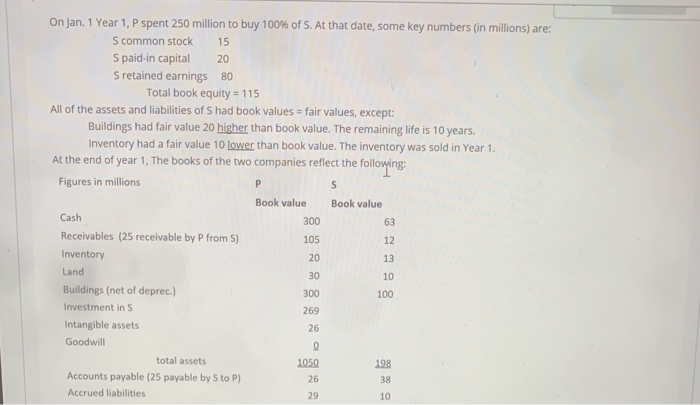
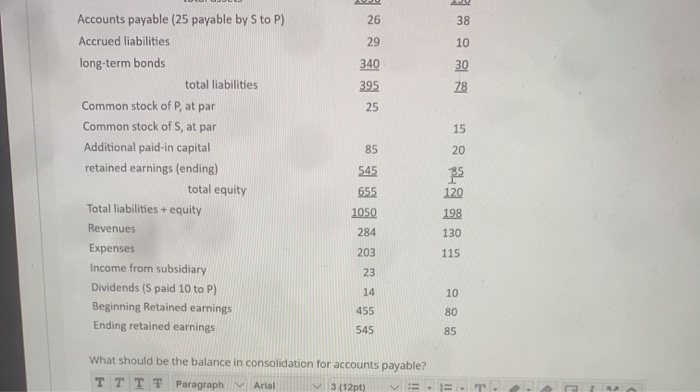




On Jan. 1 Year 1, P spent 250 million to buy 100% of S. At that date, some key numbers (in millions) are: S common stock 15 Spaid-in capital 20 Sretained earnings 80 Total book equity = 115 All of the assets and liabilities of Shad book values = fair values, except: Buildings had fair value 20 higher than book value. The remaining life is 10 years. Inventory had a fair value 10 lower than book value. The inventory was sold in Year 1. At the end of year 1. The books of the two companies reflect the following: Figures in millions Book value Book value Cash 300 Receivables (25 receivable by P from S) Inventory Land Buildings (net of deprec.) Investment in s Intangible assets Goodwill total assets 1050 Accounts payable (25 payable by S to P) Accrued liabilities Accounts payable (25 payable by Sto P) Accrued liabilities long-term bonds total liabilities Common stock of P, at par Common stock of S, at par Additional paid-in capital retained earnings (ending) total equity Total liabilities + equity Revenues Expenses Income from subsidiary Dividends (Spaid 10 to P) Beginning Retained earnings Ending retained earnings What should be the balance in consolidation for accounts payable? TT TT Paragraph Arial 3(12pt) =.=. T Use the same facts as the prior question. What is the right consolidated balance at the end of Year 1 for buildings, net of depreciation? TTTT Paragranh 14 use the same facts as the prior questions, what is the correct Year one consolidated net income? TT TT Paragraph Arial W 3 (12pt) ET Use the above facts. What is the consolidated goodwill at the end of Year 1? TTTF Paragraph Arial v 3(12pt) VEE - T e Qi Use the above facts. What is the correct consolidated Year 1 balance for Investment in S? TTTT Paragraph Aria 3 (12pt) vs. E T . Qi z
Step by Step Solution
There are 3 Steps involved in it

Get step-by-step solutions from verified subject matter experts