







Question: Part 1 Review the below algorithm that uses sequence, selection, and iteration ( repetition ) to add all the even numbers in a list and
Part
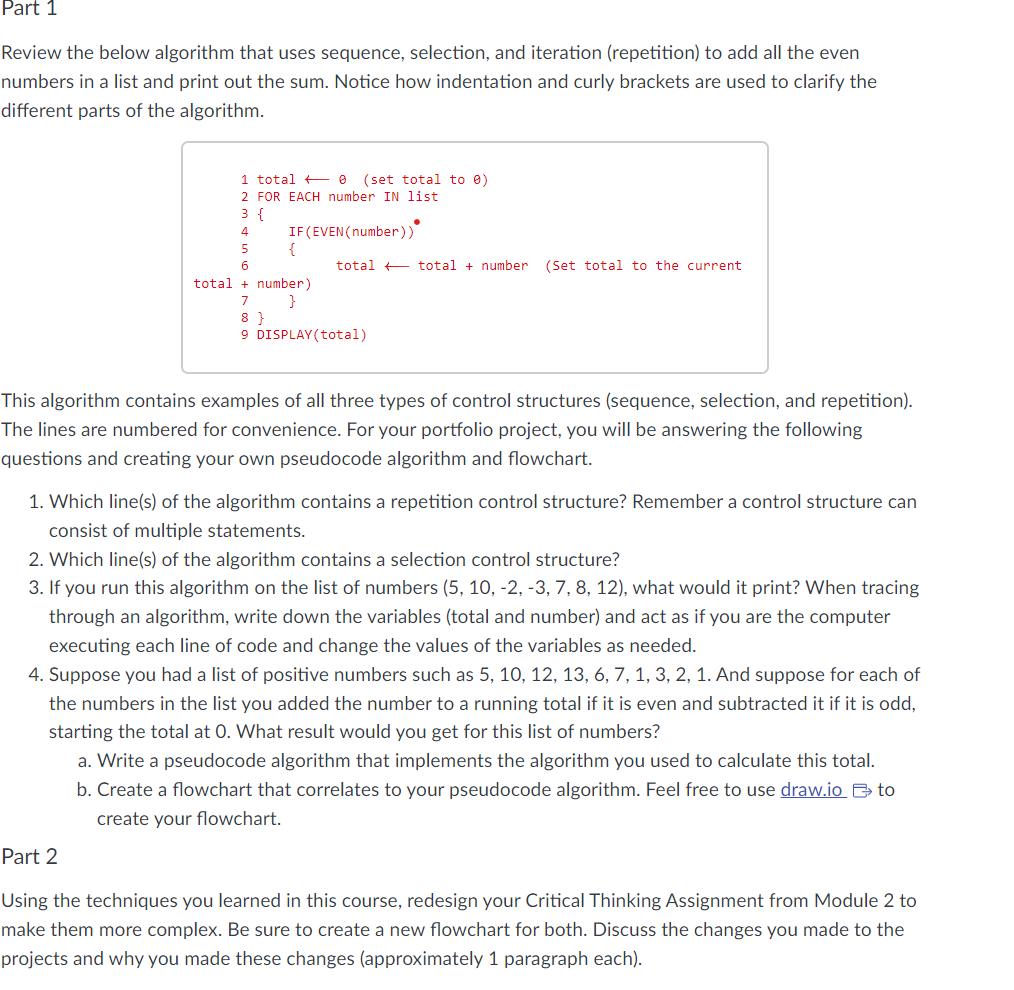
Review the below algorithm that uses sequence, selection, and iteration repetition to add all the even
numbers in a list and print out the sum. Notice how indentation and curly brackets are used to clarify the
different parts of the algorithm.
This algorithm contains examples of all three types of control structures sequence selection, and repetition
The lines are numbered for convenience. For your portfolio project, you will be answering the following
questions and creating your own pseudocode algorithm and flowchart.
Which lines of the algorithm contains a repetition control structure? Remember a control structure can
consist of multiple statements.
Which lines of the algorithm contains a selection control structure?
If you run this algorithm on the list of numbers what would it print? When tracing
through an algorithm, write down the variables total and number and act as if you are the computer
executing each line of code and change the values of the variables as needed.
Suppose you had a list of positive numbers such as And suppose for each of
the numbers in the list you added the number to a running total if it is even and subtracted it if it is odd,
starting the total at What result would you get for this list of numbers?
a Write a pseudocode algorithm that implements the algorithm you used to calculate this total.
b Create a flowchart that correlates to your pseudocode algorithm. Feel free to use
draw.io to
create your flowchart.
Part
Using the techniques you learned in this course, redesign your Critical Thinking Assignment from Module to
make them more complex. Be sure to create a new flowchart for both. Discuss the changes you made to the
projects and why you made these changes approximately paragraph each
Step by Step Solution
There are 3 Steps involved in it
1 Expert Approved Answer
Step: 1 Unlock

Question Has Been Solved by an Expert!
Get step-by-step solutions from verified subject matter experts
Step: 2 Unlock
Step: 3 Unlock
 Study Help