


Question: Part 1: Variable and Fixed Overhead Variances and Journal Entries Foster lCompany has the following standards per nished unit for its product: Direct materials 3
Part 1: Variable and Fixed Overhead Variances andPart 1: Variable and Fixed Overhead Variances and
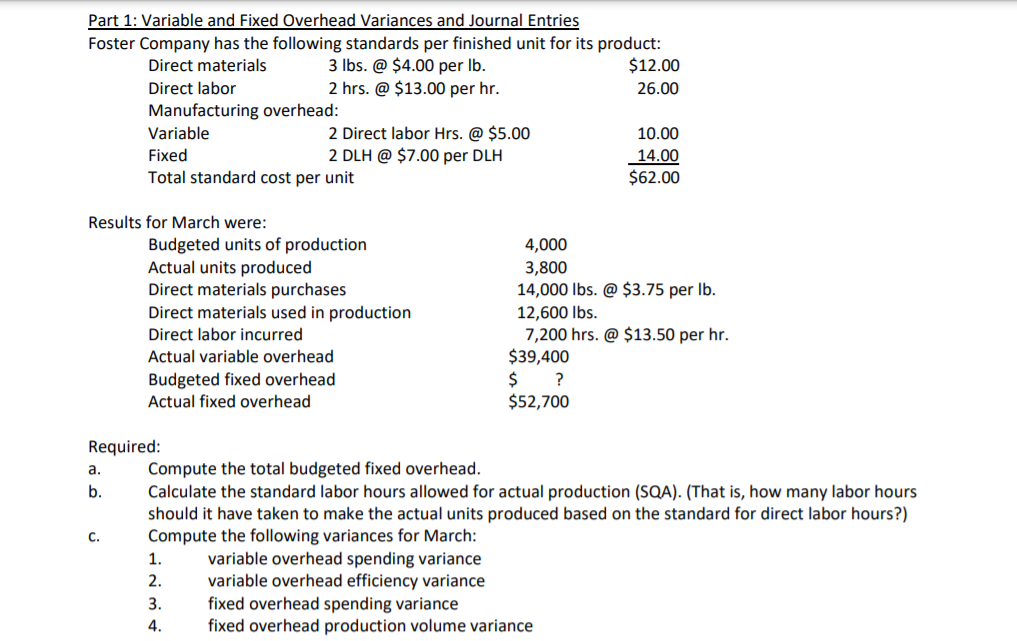
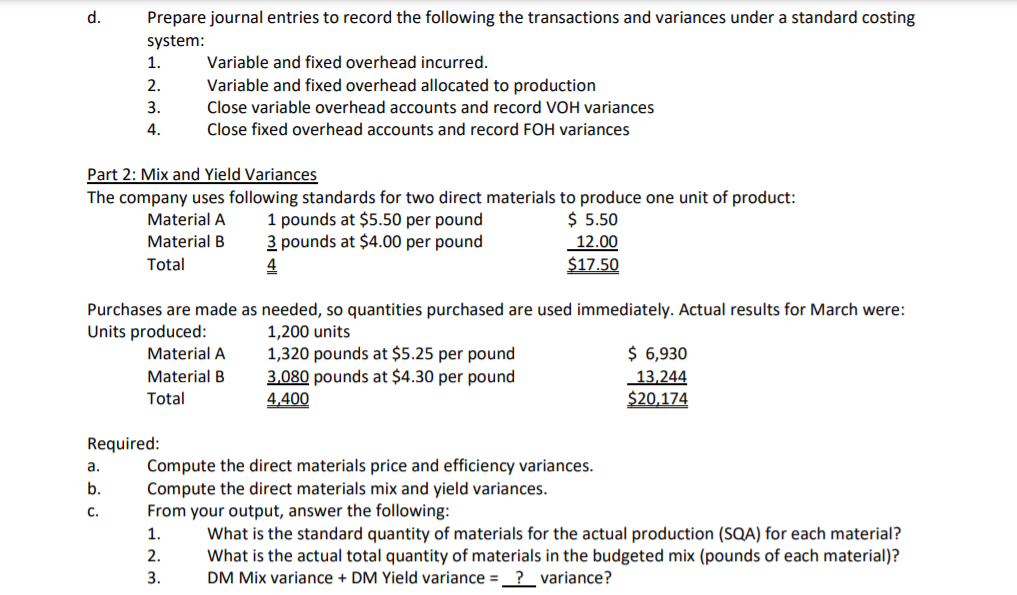
Part 1: Variable and Fixed Overhead Variances and Journal Entries Foster lCompany has the following standards per nished unit for its product: Direct materials 3 lbs. @ $4.00 per lb. $12.00 Direct labor 2 hrs. @ $13.00 per hr. 26.00 Manufacturing overhead: Variable 2 Direct labor Hrs. @ $5.00 10.00 Fixed 2 DLH @ $7.00 per DLH 14.00 Total standard cost per unit $62.00 Results for March were: Budgeted units of production 4,000 Actual units produced 3,300 Direct materials purchases 14,000 lbs. @ $3.75 per lb. Direct materials used in production 12,600 lbs. Direct labor incurred 7,200 hrs. @ $13.50 per hr. Actual variable overhead $39,400 Budgeted fixed overhead $ ? Actual fixed overhead $52,700 Required: a. Compute the total budgeted fixed overhead. b. Calculate the standard labor hours allowed for actual production [50A]. {That is, how ma ny labor hours should it have taken to make the actual units produced based on the standard for direct labor hours?) c. Compute the following variances for March: 1. variable overhead spending variance 2 variable overhead efficiency variance 3. fixed overhead spending variance 4 fixed overhead production volume variance d. Prepare journal entries to record the following the transactions and variances under a standard costing system: 1. Variable and fixed overhead incurred. 2. Variable and fixed overhead allocated to production 3. Close variable overhead accounts and record VOH variances 4. Close xed overhead accounts and record FOH variances Part 2: Mix and Yield Variances The company uses following standards for two direct materials to produce one unit of product: Material A 1 pounds at $5.50 per pound 5 5.50 Material E g pounds at $4.00 per pound 12.00 Total 2 517g Purchases are made as needed. so quantities purchased are used immediately. Actual results for March were: Units produced: 1,200 units Material A 1,320 pounds at $5.25 per pound $ 6,930 Material B 3,033 pounds at $4.30 per pound M Total 5,109 $242.12 Required: a. Compute the direct materials price and efficiencyr variances. b. Compute the direct materials mix and vleld variances. c. From vour output, answer the following: 1. What is the standard quantity of materials for the actual production {50A} for each material? 2. What is the actual total quantity of materials in the budgeted mix {pounds of each material}? 3. DM Mix variance + Div! Yield variance = ? variance

Step by Step Solution

There are 3 Steps involved in it

1 Expert Approved Answer
Step: 1 Unlock blur-text-image
Question Has Been Solved by an Expert!

Get step-by-step solutions from verified subject matter experts

Step: 2 Unlock
Step: 3 Unlock

Students Have Also Explored These Related Accounting Questions!