







Question: Part 2 : 1 0 points Newell's Decision to Downsize: An Ethical Dilemma A particular issue in business ethics is What exactly does the term
Part : points
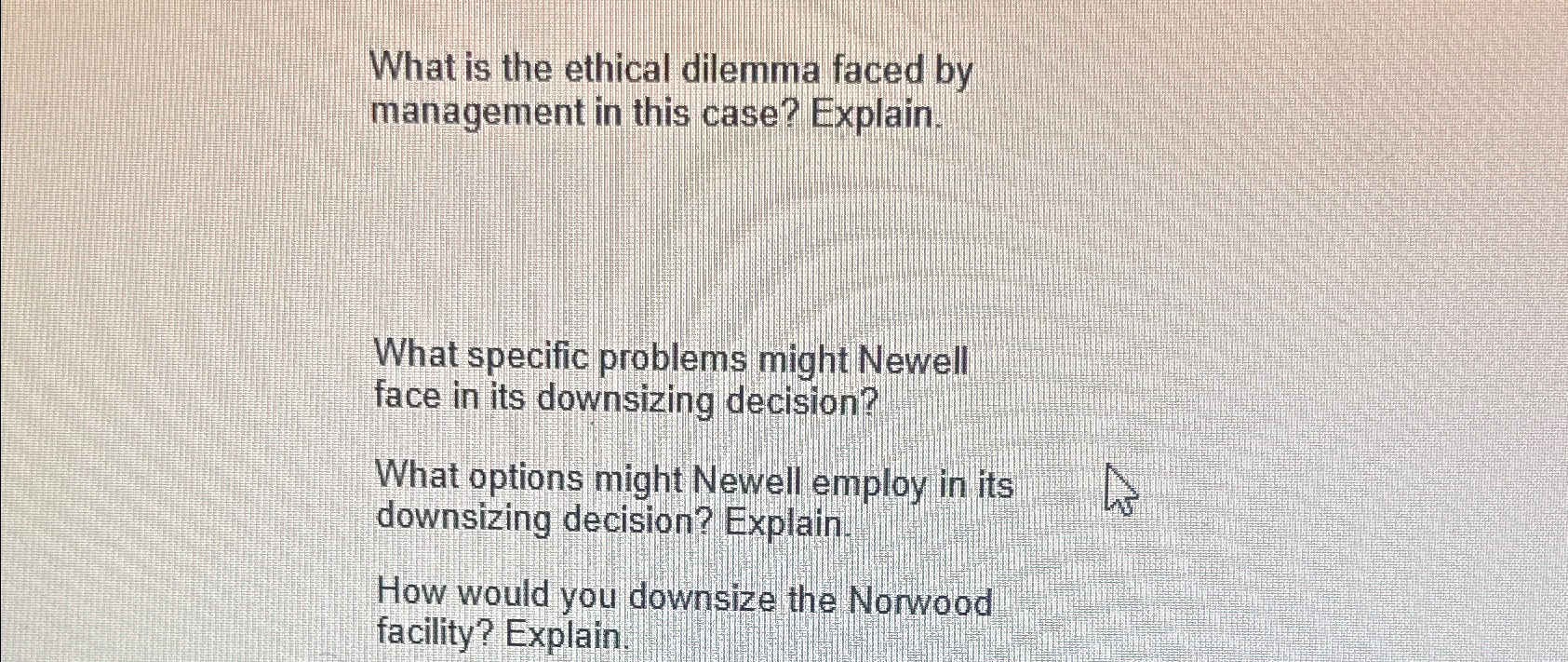
Newell's Decision to Downsize: An Ethical Dilemma
A particular issue in business ethics is "What exactly does the term ethics mean?" Various writers have described ethics as rules that govern behaviour, desired societal values such as respect for justice, or accepted principles of right or wrong. One author noted, "While laws concern what we must do ethics concerns what we should do "A footnote in the practice of HR managers and supervisors are continually faced with ethical dilemmas regarding the fair and equitable treatment of employees. Ethical choices abound in areas such as recruitment and selection, employee privacy, whistleblowing, sexual harassment, and diversity or affirmative action. An important ethical dilemma faced by managers today is the fair and correct way to downsize organizations. The decisions involved in downsizing a workforce are complex and, as one manager stated, "gutwrenching,"
The Need to Downsize
Newer corporation is a mediumsized
manufacturer of navigational systems
for commuter and larger aeroplanes.
The company operates two plantsone
in Atlanta, Georgia, and the other in
Norwood, California. In the
Norwood plant employed
employees, most of them engaged in
the manufacture and technical support
of company products.
Newell is regarded as an excellent place to work by its employees and within the
surrounding communities. Employee
morale and loyalty have always been
high, and job satisfaction studies
conducted by the company consistently
rate the organizaion as a fair and
equitable place to work. The company's
HR policies can be described as
proactive and progressive. With its
positive reputation. Newell has been
able to select new employees from a
large pool of job applicants.
One cornerstone of HR policy has been to use the principle of seniority when training, assigning, transferring, and promoting employees. Additionally, with
Newell's emphasis on employee retention, employees have experienced and come to expect long and steady employment. Prior to Newell has never downsized its workforce. Employment growth at the Norwood facility had been moderate and steady.
The racial composition of the company has been predominately Caucasian, for two reasons. First, the racial composition of the company's local labour market has historically been Caucasian. Second, the skill levels needed for the company's technical jobs have come primarily from a trained Caucasian labour force. A review of that company's federally required EEO report showed that Newell had few employees in each of the minority categories listed. This is true for both hourly and managerial positions. However, since then, the demographic characteristics of the local labour market have changed dramatically to include more Hispanics, African Americans, and Asian Americans.
In Newell experienced a large
To meet customer orders, the Norwood plant hired new manufacturing assemblers and new technical support technicians. With the increased diversity of the external labour force, plus the desire to increase the minority composition of its internal workforce, of the new hires were minorities. It is noteworthy that Newell welcomed the opportunity to rapidly increase the diversity of its workforce for both business and ethical reasons. The following is an excerpt from Newell's statement of vision and values published in July :
"Newell Corporation believes that a work environment that reflects a diverse workforce, values diversity, and honours the worth of its employees benefits the company, its customers, and its employees. Employment decisions will be made on these principles while also considering the efficient and effective operation of the organization."
Because many of the minority employees needed to be trained to do
the company's manufacturing and technical jobs, the firm spent approximately $ million on entrylevel skills training. The integration of minorities into the Norwood facility was seamless and without racial tension.
In sales for Newell's products once again followed historical patterns. Unfortunately, sales then unexpectedly took a sharp downturn: a per cent decline in and a per cent decline in The causes for the decline in sales were attributed to two new lowwage foreign competitors that had entered the market, a decline in the market demand for the products made by Newell and its competitors, and higherthanaverage production costs due to Newell's older, less efficient manufacturing equipment Future demand for company products was projected to be moderate for and
In February Tom Malcolm. Norwood's director of HR; Steven L Davis, corporate vice president for manufacturing; and Mary Umali,
Norwood's plant manager, decided to downsize the workforce at the Norwood facility. Specifically, they decided to lay off manufacturing employees and technical support
Step by Step Solution
There are 3 Steps involved in it
1 Expert Approved Answer
Step: 1 Unlock

Question Has Been Solved by an Expert!
Get step-by-step solutions from verified subject matter experts
Step: 2 Unlock
Step: 3 Unlock
 Study Help