Question: Part 2 1. Develop an estimated duration for each activity. Responses should use the list of tasks developed in chapter 4 and include the estimated
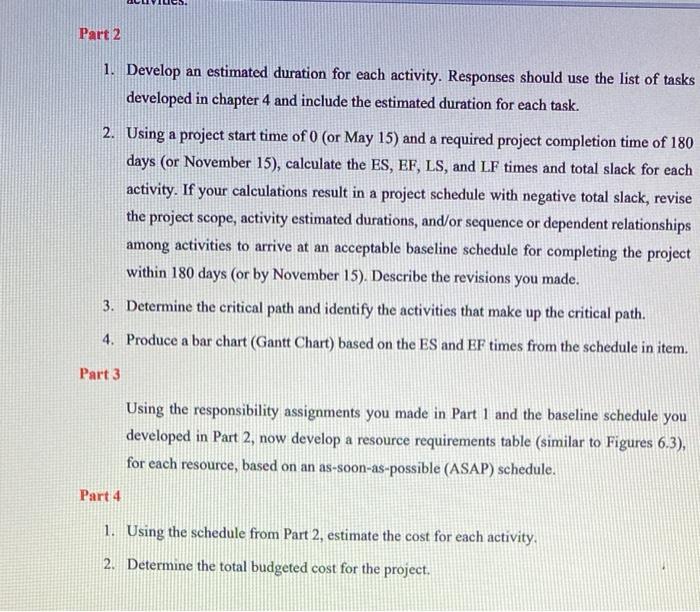
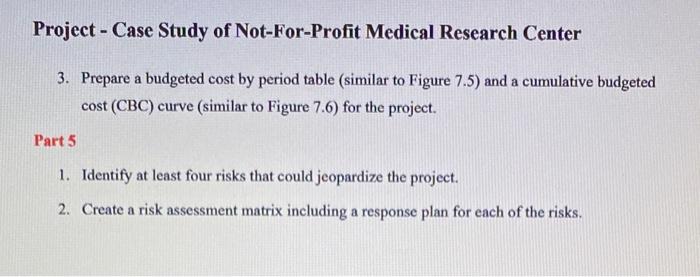
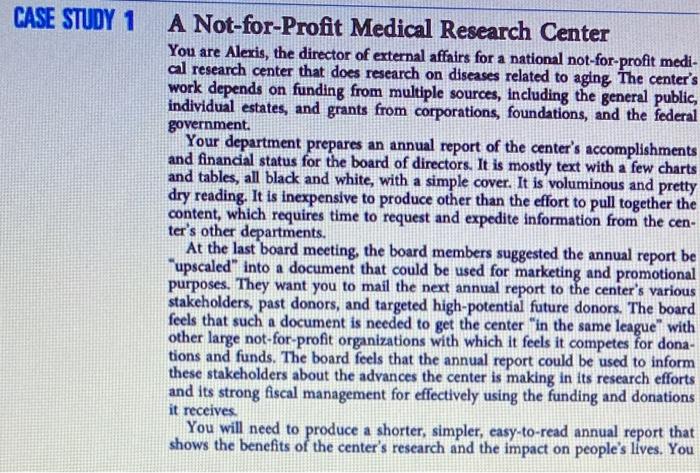
Part 2 1. Develop an estimated duration for each activity. Responses should use the list of tasks developed in chapter 4 and include the estimated duration for each task. 2. Using a project start time of 0 (or May 15) and a required project completion time of 180 days (or November 15), calculate the ES, EF, LS, and LF times and total slack for each activity. If your calculations result in a project schedule with negative total slack, revise the project scope, activity estimated durations, and/or sequence or dependent relationships among activities to arrive at an acceptable baseline schedule for completing the project within 180 days (or by November 15). Describe the revisions you made. 3. Determine the critical path and identify the activities that make up the critical path. 4. Produce a bar chart (Gantt Chart) based on the ES and EF times from the schedule in item. Part 3 Using the responsibility assignments you made in Part 1 and the baseline schedule you developed Part 2, now develop a resource requirements table (similar to Figures 6.3), for each resource, based on an as-soon-as-possible (ASAP) schedule. Part 4 1. Using the schedule from Part 2, estimate the cost for each activity, 2. Determine the total budgeted cost for the project. Project - Case Study of Not-For-Profit Medical Research Center 3. Prepare a budgeted cost by period table (similar to Figure 7.5) and a cumulative budgeted cost (CBC) curve (similar to Figure 7.6) for the project. Part 5 1. Identify at least four risks that could jeopardize the project. 2. Create a risk assessment matrix including a response plan for each of the risks. CASE STUDY 1 A Not-for-Profit Medical Research Center You are Alexis, the director of external affairs for a national not-for-profit medi- cal research center that does research on diseases related to aging. The center's work depends on funding from multiple sources, including the general public, individual estates, and grants from corporations, foundations, and the federal government. Your department prepares an annual report of the center's accomplishments and financial status for the board of directors. It is mostly text with a few charts and tables, all black and white, with a simple cover. It is voluminous and pretty dry reading. It is inexpensive to produce other than the effort to pull together the content, which requires time to request and expedite information from the cen- ter's other departments. At the last board meeting, the board members suggested the annual report be upscaled into a document that could be used for marketing and promotional purposes. They want you to mail the next annual report to the center's various stakeholders, past donors, and targeted high-potential future donors. The board feels that such a document is needed to get the center "in the same league" with other large not-for-profit organizations with which it feels it competes for dona- tions and funds. The board feels that the annual report could be used to inform these stakeholders about the advances the center is making in its research efforts and its strong fiscal management for effectively using the funding and donations it receives You will need to produce a shorter, simpler, casy-to-read annual report that shows the benefits of the center's research and the impact on people's lives. You









 Study Help