







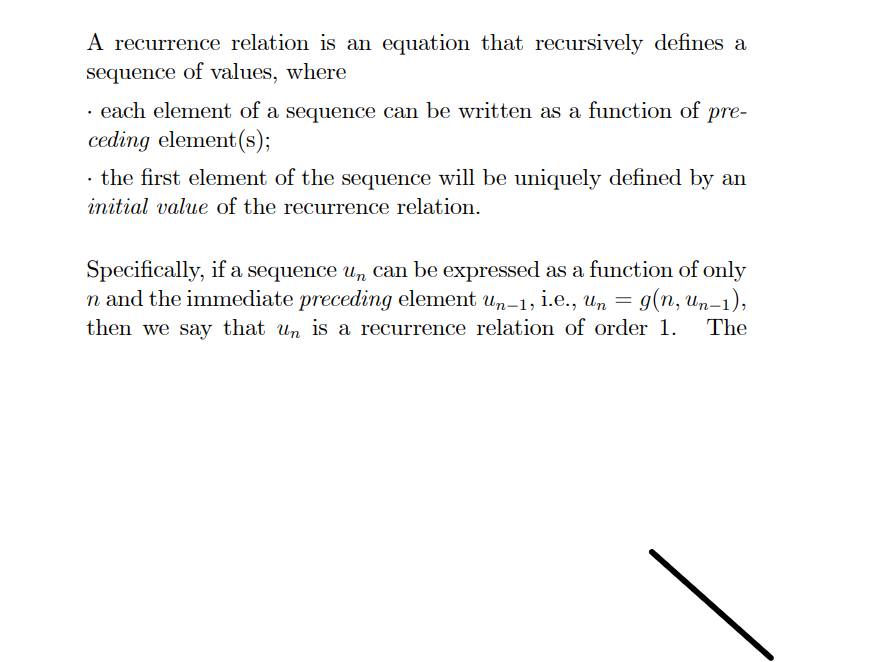
Question: Part 2 and 3 please A recurrence relation is an equation that recursively defines a sequence of values, where - each element of a sequence
Part 2 and 3 please
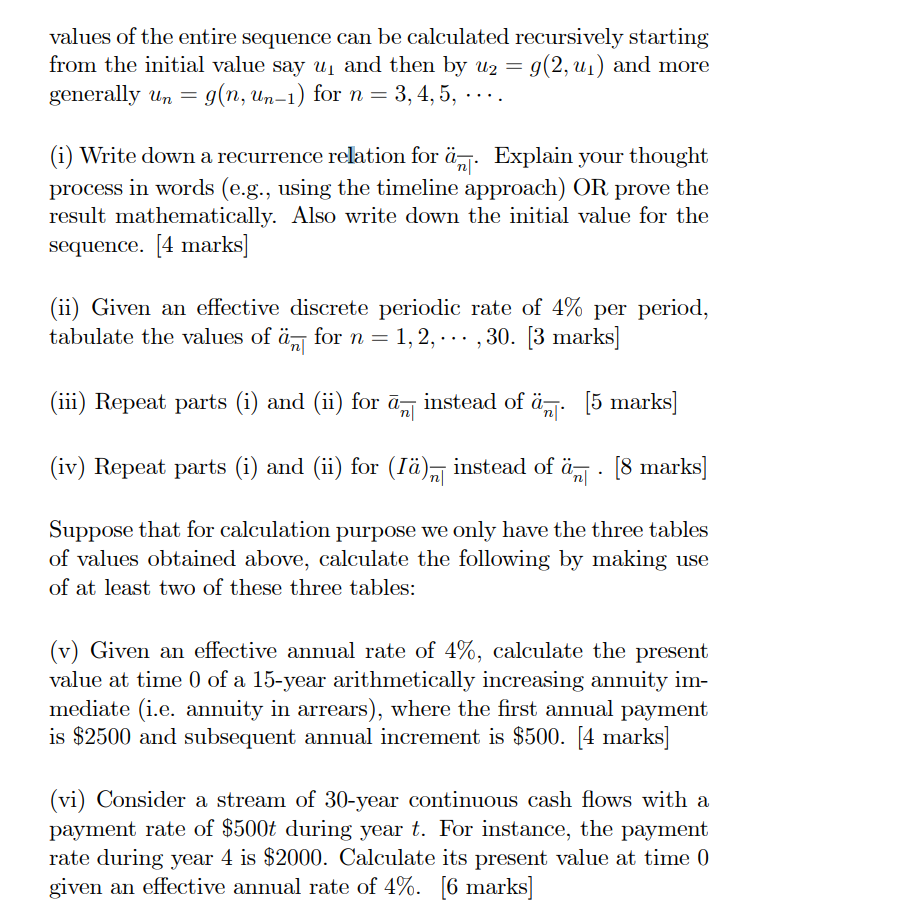
A recurrence relation is an equation that recursively defines a sequence of values, where - each element of a sequence can be written as a function of preceding element(s); - the first element of the sequence will be uniquely defined by an initial value of the recurrence relation. Specifically, if a sequence un can be expressed as a function of only n and the immediate preceding element un1, i.e., un=g(n,un1), then we say that un is a recurrence relation of order 1 . The values of the entire sequence can be calculated recursively starting from the initial value say u1 and then by u2=g(2,u1) and more generally un=g(n,un1) for n=3,4,5,. (i) Write down a recurrence relation for an. Explain your thought process in words (e.g., using the timeline approach) OR prove the result mathematically. Also write down the initial value for the sequence. [4 marks ] (ii) Given an effective discrete periodic rate of 4% per period, tabulate the values of an for n=1,2,,30. [3 marks] (iii) Repeat parts (i) and (ii) for an instead of an. [5 marks] (iv) Repeat parts (i) and (ii) for (Ia)n instead of an [8 marks] Suppose that for calculation purpose we only have the three tables of values obtained above, calculate the following by making use of at least two of these three tables: (v) Given an effective annual rate of 4%, calculate the present value at time 0 of a 15-year arithmetically increasing annuity immediate (i.e. annuity in arrears), where the first annual payment is $2500 and subsequent annual increment is $500. [4 marks] (vi) Consider a stream of 30-year continuous cash flows with a payment rate of $500t during year t. For instance, the payment rate during year 4 is $2000. Calculate its present value at time 0 given an effective annual rate of 4%. [6 marks] A recurrence relation is an equation that recursively defines a sequence of values, where - each element of a sequence can be written as a function of preceding element(s); - the first element of the sequence will be uniquely defined by an initial value of the recurrence relation. Specifically, if a sequence un can be expressed as a function of only n and the immediate preceding element un1, i.e., un=g(n,un1), then we say that un is a recurrence relation of order 1 . The values of the entire sequence can be calculated recursively starting from the initial value say u1 and then by u2=g(2,u1) and more generally un=g(n,un1) for n=3,4,5,. (i) Write down a recurrence relation for an. Explain your thought process in words (e.g., using the timeline approach) OR prove the result mathematically. Also write down the initial value for the sequence. [4 marks ] (ii) Given an effective discrete periodic rate of 4% per period, tabulate the values of an for n=1,2,,30. [3 marks] (iii) Repeat parts (i) and (ii) for an instead of an. [5 marks] (iv) Repeat parts (i) and (ii) for (Ia)n instead of an [8 marks] Suppose that for calculation purpose we only have the three tables of values obtained above, calculate the following by making use of at least two of these three tables: (v) Given an effective annual rate of 4%, calculate the present value at time 0 of a 15-year arithmetically increasing annuity immediate (i.e. annuity in arrears), where the first annual payment is $2500 and subsequent annual increment is $500. [4 marks] (vi) Consider a stream of 30-year continuous cash flows with a payment rate of $500t during year t. For instance, the payment rate during year 4 is $2000. Calculate its present value at time 0 given an effective annual rate of 4%. [6 marks]
Step by Step Solution
There are 3 Steps involved in it

Get step-by-step solutions from verified subject matter experts
 Study Help