







Question: Part 2 - Consumer optimization Consider a representative consumer with preferences over consumption c and leisure { given by *(c!) = In(c) + In(). Assume
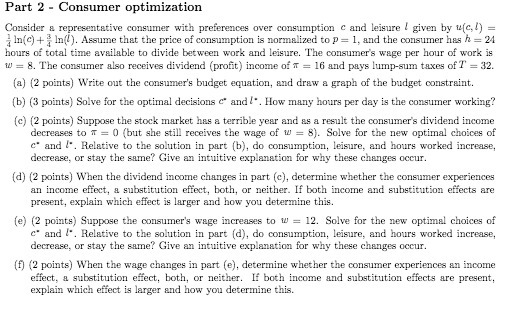
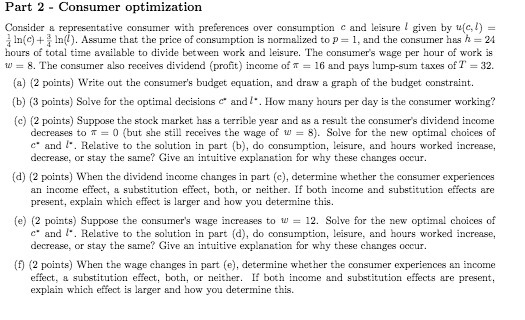
Part 2 - Consumer optimization Consider a representative consumer with preferences over consumption c and leisure { given by *(c!) = In(c) + In(). Assume that the price of consumption is normalized to p = 1, and the consumer has h = 24 hours of total time available to divide between work and leisure. The consumer's wage per hour of work is W = 8. The consumer also receives dividend (profit) income of * = 16 and pays lump-sum taxes of ?' = 32. (a) (2 points) Write out the consumer's budget equation, and draw a graph of the budget constraint. (b) (3 points) Solve for the optimal decisions c" and " . How many hours per day is the consumer working?" (c) (2 points) Suppose the stock market has a terrible year and as a result the consumer's dividend income decreases to * = 0 (but she still receives the wage of w = 8). Solve for the new optimal choices of c" and !". Relative to the solution in part (b), do consumption, leisure, and hours worked increase, decrease, or stay the same? Give an intuitive explanation for why these changes occur. (d) (2 points) When the dividend income changes in part (c), determine whether the consumer experiences an income effect, a substitution effect, both, or neither. If both income and substitution effects are present, explain which effect is larger and how you determine this. (e) (2 points) Suppose the consumer's wage increases to w = 12. Solve for the new optimal choices of c" and !". Relative to the solution in part (d), do consumption, leisure, and hours worked increase, decrease, or stay the same? Give an intuitive explanation for why these changes occur. (f) (2 points) When the wage changes in part (e), determine whether the consumer experiences an income effect, a substitution effect, both, or neither. If both income and substitution effects are present. explain which effect is larger and how you determine this
Step by Step Solution
There are 3 Steps involved in it

Get step-by-step solutions from verified subject matter experts
 Study Help