







Question: Part 2: Disease Detection Suppose a new rapid screening test is being developed to detect a disease. Patients who take the new test also take
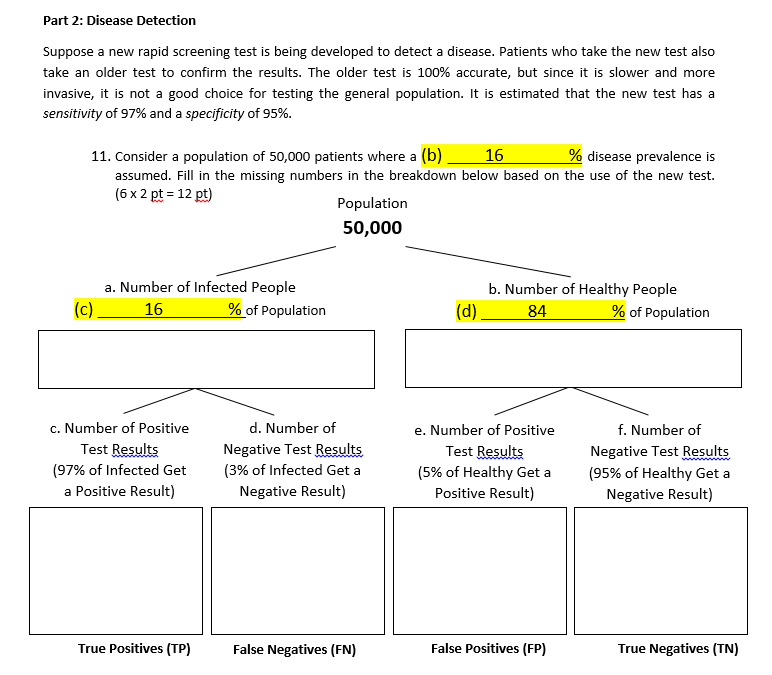
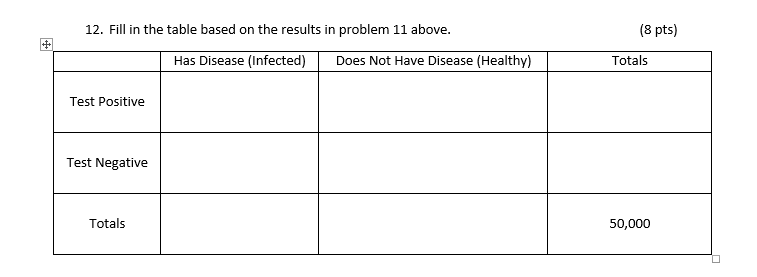
Part 2: Disease Detection Suppose a new rapid screening test is being developed to detect a disease. Patients who take the new test also take an older test to confirm the results. The older test is 100% accurate, but since it is slower and more invasive, it is not a good choice for testing the general population. It is estimated that the new test has a sensitivity of 97% and a specificity of 95%. 11. Consider a population of 50,000 patients where a (b) 16 % disease prevalence is assumed. Fill in the missing numbers in the breakdown below based on the use of the new test. (6 x 2 pt = 12 pt) Population 50,000 a. Number of Infected People b. Number of Healthy People (c) 16 % of Population (d) 84 % of Population c. Number of Positive d. Number of e. Number of Positive f. Number of Test Results Negative Test Results Test Results Negative Test Results (97% of Infected Get (3% of Infected Get a (5% of Healthy Get a (95% of Healthy Get a a Positive Result) Negative Result) Positive Result) Negative Result) True Positives (TP) False Negatives (FN) False Positives (FP) True Negatives (TN)12. Fill in the table based on the results in problem 11 above. {8 pts] Has Disease {Infected} Does Not Have Disease {Healthy}
Step by Step Solution
There are 3 Steps involved in it

Get step-by-step solutions from verified subject matter experts
 Study Help