







Question: Part 2: Find a data set that is useful for multiple linear regression. You may use one of the data sets available under Project Information
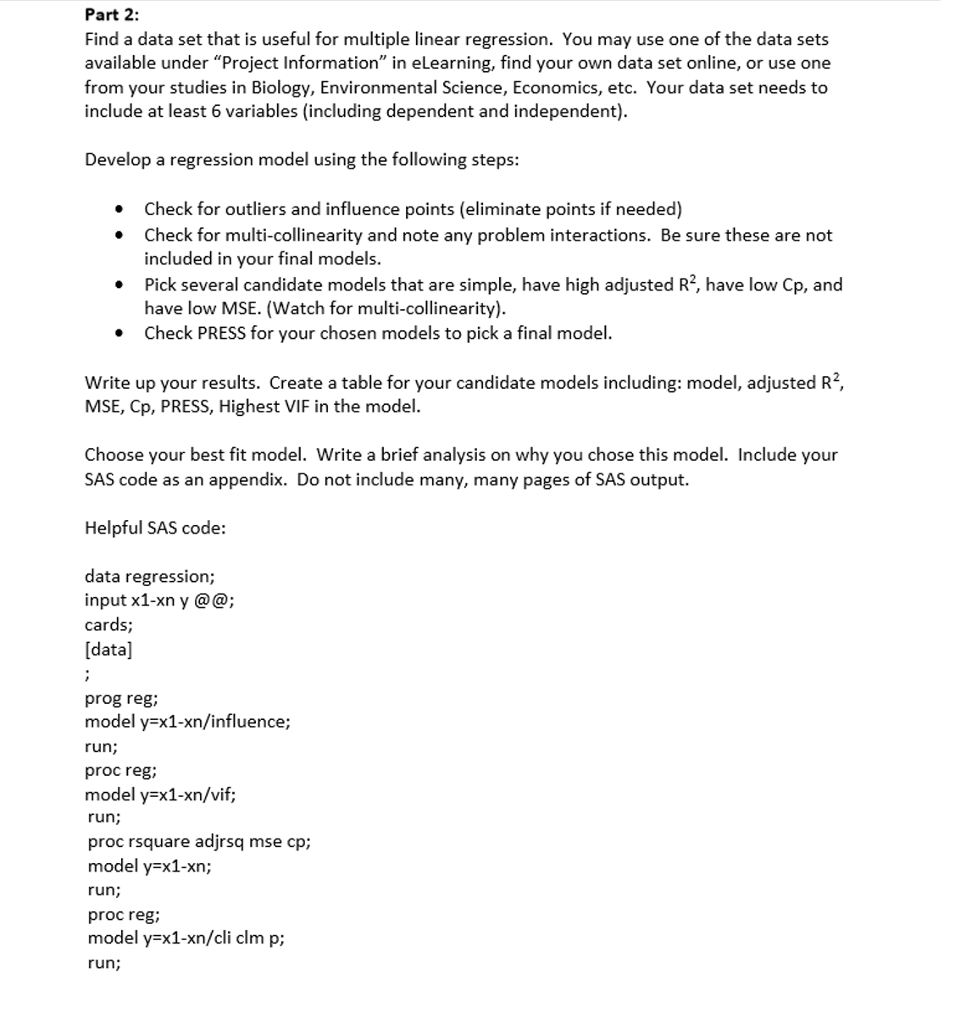
Part 2: Find a data set that is useful for multiple linear regression. You may use one of the data sets available under "Project Information" in eLearning, find your own data set online, or use one from your studies in Biology, Environmental Science, Economics, etc. Your data set needs to include at least 6 variables (including dependent and independent). Develop a regression model using the following steps: * Check for outliers and influence points (eliminate points if needed) * Check for multi-collinearity and note any problem interactions. Be sure these are not included in your final models. Pick several candidate models that are simple, have high adjusted R2, have low Cp, and have low MSE. (Watch for multi-collinearity). Check PRESS for your chosen models to pick a final model. . * Write up your results. Create a table for your candidate models including: model, adjusted R2 MSE, Cp, PRESS, Highest VIF in the model. Choose your best fit model. Write a brief analysis on why you chose this model. Include your SAS code as an appendix. Do not include many, many pages of SAS output. Helpful SAS code: data regression; input x1-xn y@@; cards; [data] prog reg; model y x1-xn/influence; run; proc reg; model y-x1-xn/vif; run; proc rsquare adjrsq mse cp; model y x1-xn; run proc reg; model y x1-xn/cli clm p; run; Part 2: Find a data set that is useful for multiple linear regression. You may use one of the data sets available under "Project Information" in eLearning, find your own data set online, or use one from your studies in Biology, Environmental Science, Economics, etc. Your data set needs to include at least 6 variables (including dependent and independent). Develop a regression model using the following steps: * Check for outliers and influence points (eliminate points if needed) * Check for multi-collinearity and note any problem interactions. Be sure these are not included in your final models. Pick several candidate models that are simple, have high adjusted R2, have low Cp, and have low MSE. (Watch for multi-collinearity). Check PRESS for your chosen models to pick a final model. . * Write up your results. Create a table for your candidate models including: model, adjusted R2 MSE, Cp, PRESS, Highest VIF in the model. Choose your best fit model. Write a brief analysis on why you chose this model. Include your SAS code as an appendix. Do not include many, many pages of SAS output. Helpful SAS code: data regression; input x1-xn y@@; cards; [data] prog reg; model y x1-xn/influence; run; proc reg; model y-x1-xn/vif; run; proc rsquare adjrsq mse cp; model y x1-xn; run proc reg; model y x1-xn/cli clm p; run
Step by Step Solution
There are 3 Steps involved in it

Get step-by-step solutions from verified subject matter experts
 Study Help