







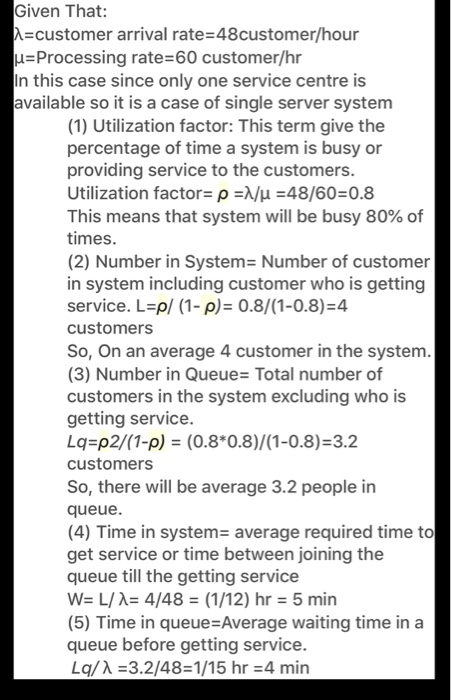
Question: part 2 - first two points need part 2 first two points Given That: 1=customer arrival rate=48customer/hour u=Processing rate=60 customer/hr In this case since only
 part 2 - first two points
 need part 2 first two points
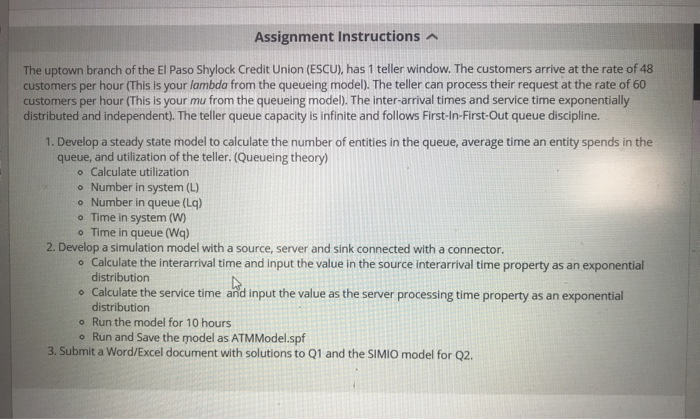
Given That: 1=customer arrival rate=48customer/hour u=Processing rate=60 customer/hr In this case since only one service centre is available so it is a case of single server system (1) Utilization factor: This term give the percentage of time a system is busy or providing service to the customers. Utilization factor= p =N/u =48/60=0.8 This means that system will be busy 80% of times. (2) Number in System= Number of customer in system including customer who is getting service. L=p/(1-2)= 0.8/(1-0.8)=4 customers So, On an average 4 customer in the system. (3) Number in Queue= Total number of customers in the system excluding who is getting service. Lq=p2/(1-p) = (0.8*0.8)/(1-0.8)=3.2 customers So, there will be average 3.2 people in queue. (4) Time in system= average required time to get service or time between joining the queue till the getting service W=L/ 1= 4/48 = (1/12) hr = 5 min (5) Time in queue=Average waiting time in a queue before getting service. Lq/=3.2/48=1/15 hr =4 min Assignment Instructions The uptown branch of the El Paso Shylock Credit Union (ESCU), has 1 teller window. The customers arrive at the rate of 48 customers per hour (This is your lambda from the queueing model). The teller can process their request at the rate of 60 customers per hour (This is your mu from the queueing model). The inter-arrival times and service time exponentially distributed and independent). The teller queue capacity is infinite and follows First-In-First-Out queue discipline. 1. Develop a steady state model to calculate the number of entities in the queue, average time an entity spends in the queue, and utilization of the teller. (Queueing theory) Calculate utilization Number in system (L) o Number in queue (La) o Time in system (W) Time in queue (Wa) 2. Develop a simulation model with a source, server and sink connected with a connector. Calculate the interarrival time and input the value in the source interarrival time property as an exponential . Calculate the service time alid input the value as the server processing time property as an exponential distribution Run the model for 10 hours . Run and Save the model as ATMModel.spf 3. Submit a Word/Excel document with solutions to Q1 and the SIMIO model for Q2 Step by Step Solution
There are 3 Steps involved in it
1 Expert Approved Answer
Step: 1 Unlock

Question Has Been Solved by an Expert!
Get step-by-step solutions from verified subject matter experts
Step: 2 Unlock
Step: 3 Unlock
 Study Help