





Question: Part 2. Matching: Match the Key terms in Column A with the definitions in Column E! by writing the block {upper} case letter of your
Part 2. Matching: Match the Key terms in Column
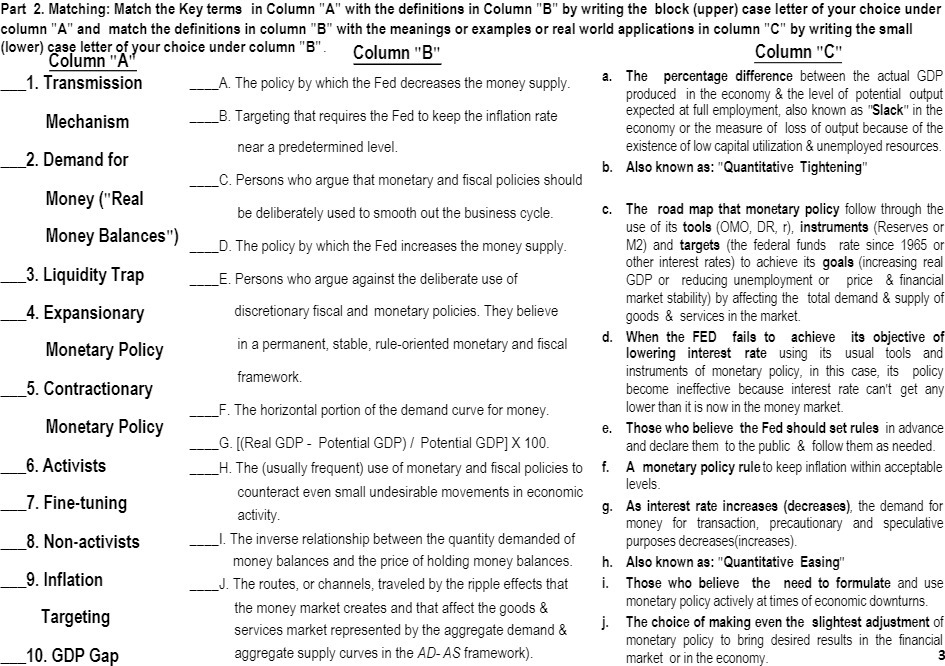
Part 2. Matching: Match the Key terms in Column "A" with the definitions in Column "E!" by writing the block {upper} case letter of your choice under column "A" and match the denitions in column "B" with the meanings or examples or real world applications in column "C" by writing the small {lower} case letter otlyour choice under column "B". Column "A 1. Transmission Mechanism _2. Demand for Money {"Real Money Balances") _3. Liquidity Trap _4. Expansionary Monetary Policy _5. Contractionary Monetary Policy _6. Activists _?. Fine-tuning _8. Non-activists _9. Inflation Targeting _1U. GDP Gap Column "B" A. "he policy by which the Fed decreases the money supply. B. "argeting that requires the Fed to keep the inflation rate near a predetermined level. C. Persons who argue that monetary and scal policies should be deliberately used to smooth out the business cycle. D. The policy by which the Fed increases the money supply E. Persons who argue against the deliberate use of discretionary scal and monetary policies. They believe in a permanent. stable: ruleoriented monetary and fiscal framework. F. The horizontal portion ofthe demand curve for money. [3. [(Fteal GDP- Potential GDP);r Potential GDP] X 100. H. The (usually frequent) use of monetary and scal policies to counteract even small undesirable movements in economic activity. I. The inverse relationship between the quantity demanded of money balances and the price of holding money balances. J. The routes. or channels: traveled by the ripple effects that the money market creates and that affect the goods & services market represented by the aggregate demand & aggregate supply curves in the 119- AS framework). Column "C" The percentage difference between the actual GDP produced lnthe economy tithe level of potential output expected at full employment: also known as "Black" in the economy or the measure of loss of output because of the existence of low capital utilization it unemployed resources. Also known as: "Quantitative Tightening" The road map that monetary policy follow through the use of its tools [OM-3; DR. r): instruments Reserves or ME] and targets {the federal funds rate since 1955 or other interest rates) to achieve its goals {increasing real GJP or reducing unemployment or price 3; financial market stability] by affecting the total demand 8: supply of goods t services in the market. When the FED falls to achieve its objective of lowering interest rate using its usual tools and instruments of monetary policy. in this case. its policy become ineffective because interest rate can't get any lower than it is now in the money market. Those who believe the Fed should set rules in advance and declare them to the public a follow them as needed. A monetary policy rule to keep ination within acceptable levels. As interest rate increases {decreases}_. the demand for money for transaction: precautionary and speculative purposes decreasesfincreasesi. Also known as: "Quantitative Easing" Those who believe the need to formulate and use monetary policy actively at times of economic downturns. The choice of making even the slightest adjustment of monetary policy to bring desired results in the nancial market crinthe economy. 3

Step by Step Solution

There are 3 Steps involved in it

1 Expert Approved Answer
Step: 1 Unlock blur-text-image

Question Has Been Solved by an Expert!

Get step-by-step solutions from verified subject matter experts

Step: 2 Unlock
Step: 3 Unlock

Students Have Also Explored These Related Mathematics Questions!