



Question: Part 2. Matching: Match the Key terms in Column A with the definitions in Column B by writing the block letter of your choice from
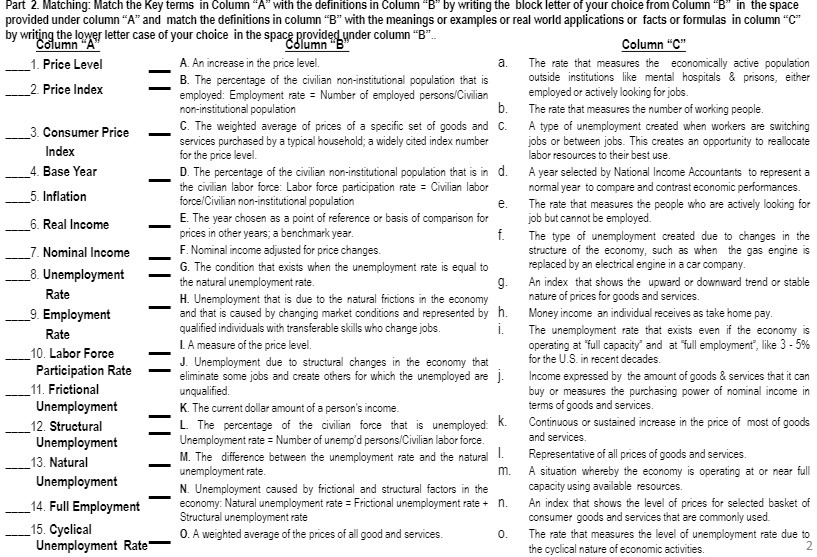
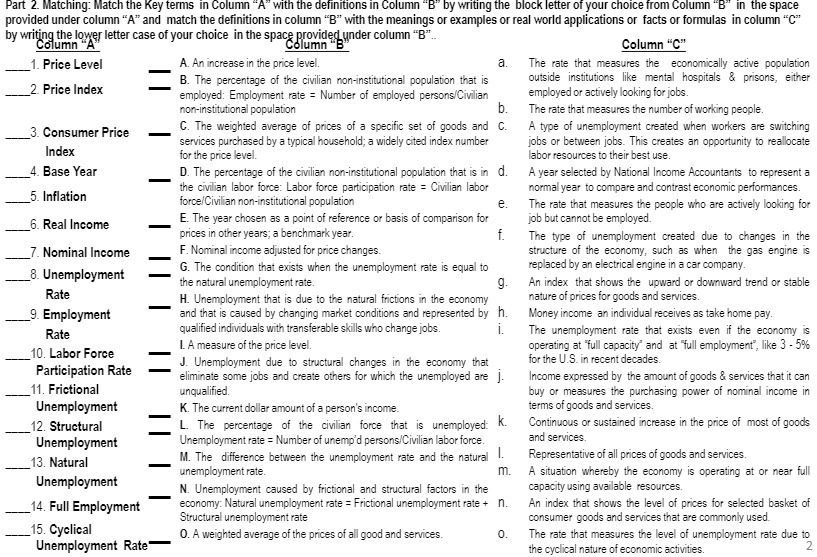
Part 2. Matching: Match the Key terms in Column "A" with the definitions in Column "B" by writing the block letter of your choice from Column "B" in the space provided under column "A" and match the definitions in column "B" with the meanings or examples or real world applications or facts or formulas in column "C" by writing the lower letter case of your choice in the space provided under column "B".. Column "A" Column "B Column "C" 1. Price Level A. An increase in the price level. a. The rate that measures the economically active population B. The percentage of the civilian non-institutional population that is outside institutions like mental hospitals & prisons, either 2. Price Index employed: Employment rate = Number of employed persons/Civilian employed or actively looking for jobs. non-institutional population b. The rate that measures the number of working people. 3. Consumer Price C. The weighted average of prices of a specific set of goods and C. A type of unemployment created when workers are switching services purchased by a typical household; a widely cited index number jobs or between jobs. This creates an opportunity to reallocate Index for the price level. labor resources to their best use. 4. Base Year D. The percentage of the civilian non-institutional population that is in d. A year selected by National Income Accountants to represent a the civilian labor force: Labor force participation rate = Civilian labor normal year to compare and contrast economic performances 5. Inflation force/Civilian non-institutional population e. The rate that measures the people who are actively looking for 6. Real Income E. The year chosen as a point of reference or basis of comparison for job but cannot be employed. prices in other years; a benchmark year. f. The type of unemployment created due to changes in the 7. Nominal Income F. Nominal income adjusted for price changes. structure of the economy, such as when the gas engine is replaced by an electrical engine in a car company. 8. Unemployment G. The condition that exists when the unemployment rate is equal to the natural unemployment rate. g. An index that shows the upward or downward trend or stable Rate H. Unemployment that is due to the natural frictions in the economy nature of prices for goods and services. 9. Employment and that is caused by changing market conditions and represented by h. Money income an individual receives as take home pay. Rate qualified individuals with transferable skills who change jobs i . The unemployment rate that exists even if the economy is 10. Labor Force I. A measure of the price level. operating at "full capacity" and at "full employment", like 3 - 5% for the U.S. in recent decades. Participation Rate J. Unemployment due to structural changes in the economy that eliminate some jobs and create others for which the unemployed are ]. Income expressed by the amount of goods & services that it can 11. Frictional unqualified. buy or measures the purchasing power of nominal income in Unemployment K. The current dollar amount of a person's income. terms of goods and services. 12. Structural L. The percentage of the civilian force that is unemployed: K. Continuous or sustained increase in the price of most of goods Unemployment Unemployment rate = Number of unemp'd persons/Civilian labor force. and services. 13. Natural M. The difference between the unemployment rate and the natural Representative of all prices of goods and services. unemployment rate. m. A situation whereby the economy is operating at or near full Unemployment N. Unemployment caused by frictional and structural factors in the capacity using available resources. 14. Full Employment economy: Natural unemployment rate = Frictional unemployment rate + n. An index that shows the level of prices for selected basket of Structural unemployment rate consumer goods and services that are commonly used 15. Cyclical O. A weighted average of the prices of all good and services. O. The rate that measures the level of unemployment rate due to Unemployment Rate" the cyclical nature of economic activities
Step by Step Solution
There are 3 Steps involved in it

Get step-by-step solutions from verified subject matter experts