







Question: Part 2: Modeling and visualizing population growth Now that we've spent a while looking at projectile motion, we're going to model another evolving system --
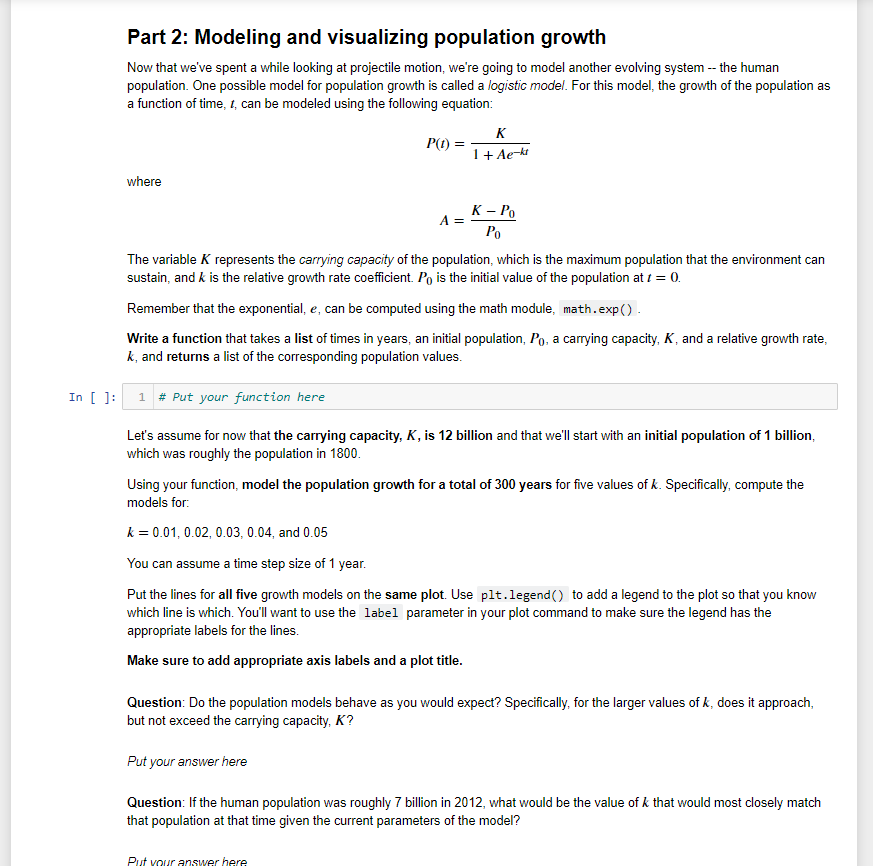
Part 2: Modeling and visualizing population growth Now that we've spent a while looking at projectile motion, we're going to model another evolving system -- the human population. One possible model for population growth is called a logistic model. For this model, the growth of the population as a function of time, 1, can be modeled using the following equation: K P(t) = 1 + AC- where A = * 7. The variable K represents the carrying capacity of the population, which is the maximum population that the environment can sustain, and k is the relative growth rate coefficient. Po is the initial value of the population at t = 0. Remember that the exponential, e, can be computed using the math module, math.exp() . Write a function that takes a list of times in years, an initial population, Po, a carrying capacity, K, and a relative growth rate, k, and returns a list of the corresponding population values. In [ ]: 1 # Put your function here Let's assume for now that the carrying capacity, K, is 12 billion and that we'll start with an initial population of 1 billion, which was roughly the population in 1800. Using your function, model the population growth for a total of 300 years for five values of k. Specifically, compute the models for: k=0.01, 0.02, 0.03, 0.04, and 0.05 You can assume a time step size of 1 year. Put the lines for all five growth models on the same plot. Use plt.legend to add a legend to the plot so that you know which line is which. You'll want to use the label parameter in your plot command to make sure the legend has the appropriate labels for the lines. Make sure to add appropriate axis labels and a plot title. Question: Do the population models behave as you would expect? Specifically, for the larger values of k, does it approach, but not exceed the carrying capacity, K? Put your answer here Question: If the human population was roughly 7 billion in 2012, what would be the value of k that would most closely match that population at that time given the current parameters of the model? Put your answer here
Step by Step Solution
There are 3 Steps involved in it

Get step-by-step solutions from verified subject matter experts
 Study Help