Question: Part 2: Multiple Choice 1. Conceptual Framework describes prudence as A. A Bias towards understanding liabilities or expenses B. A mechanism for smoothing profits over
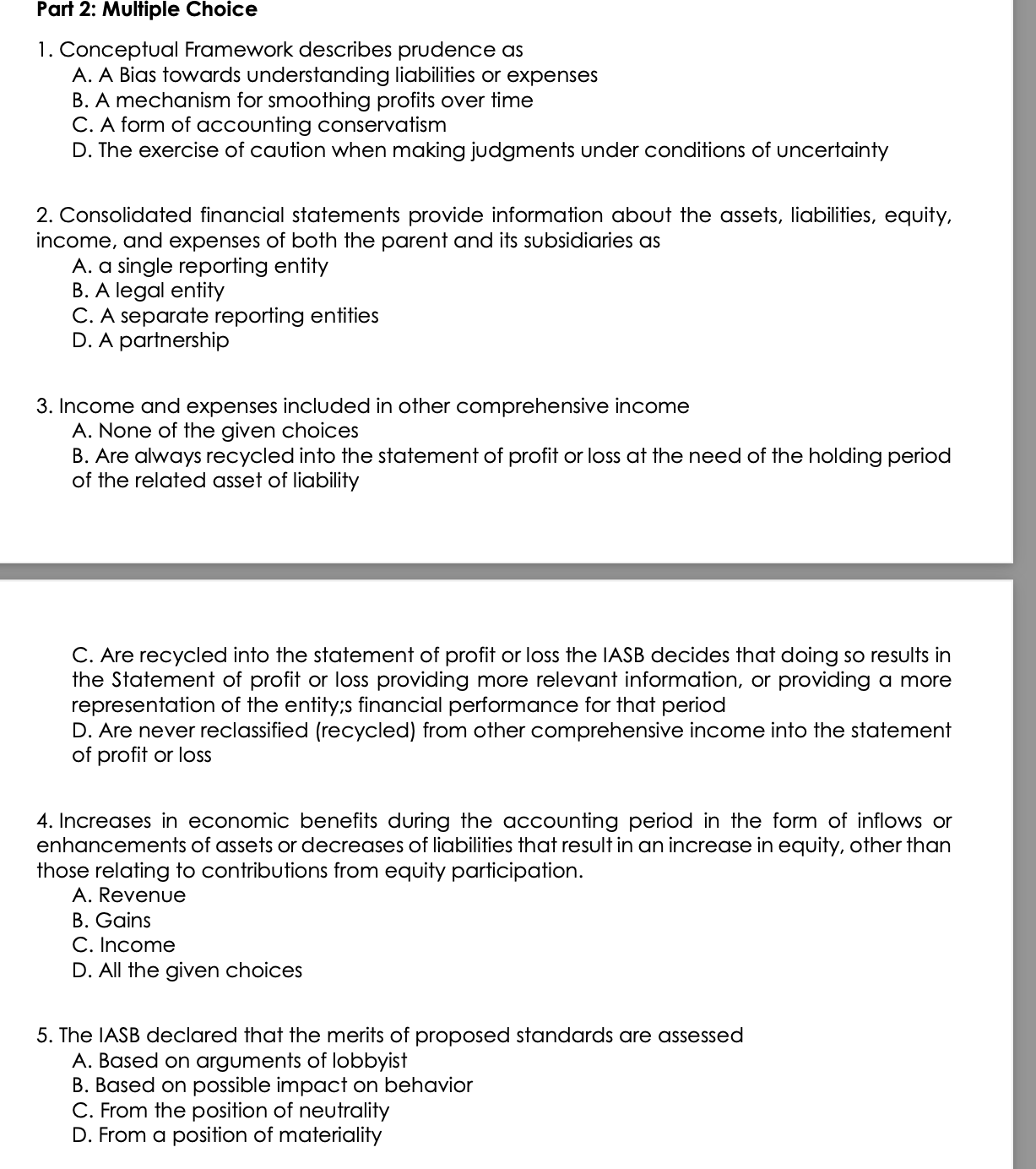
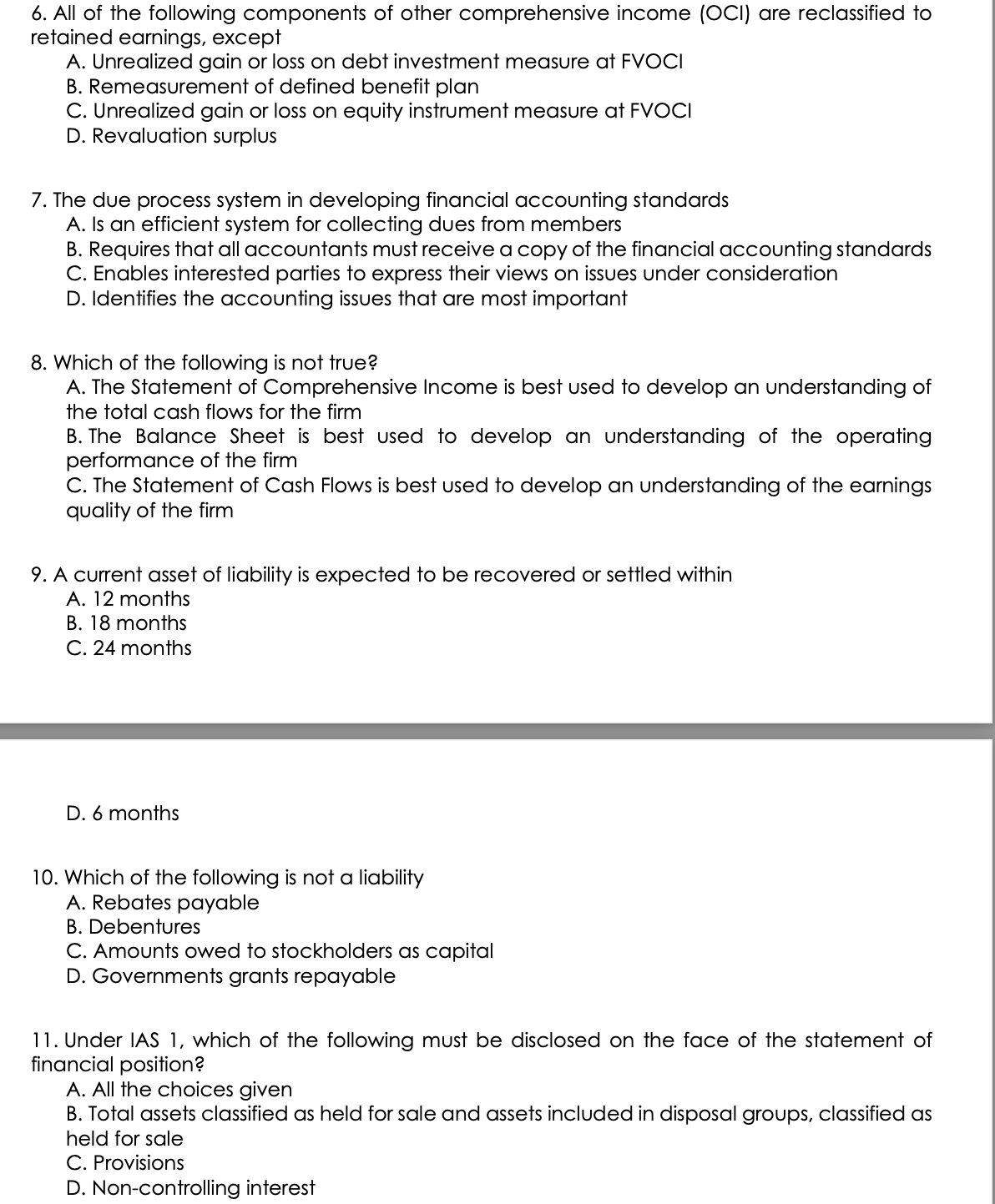
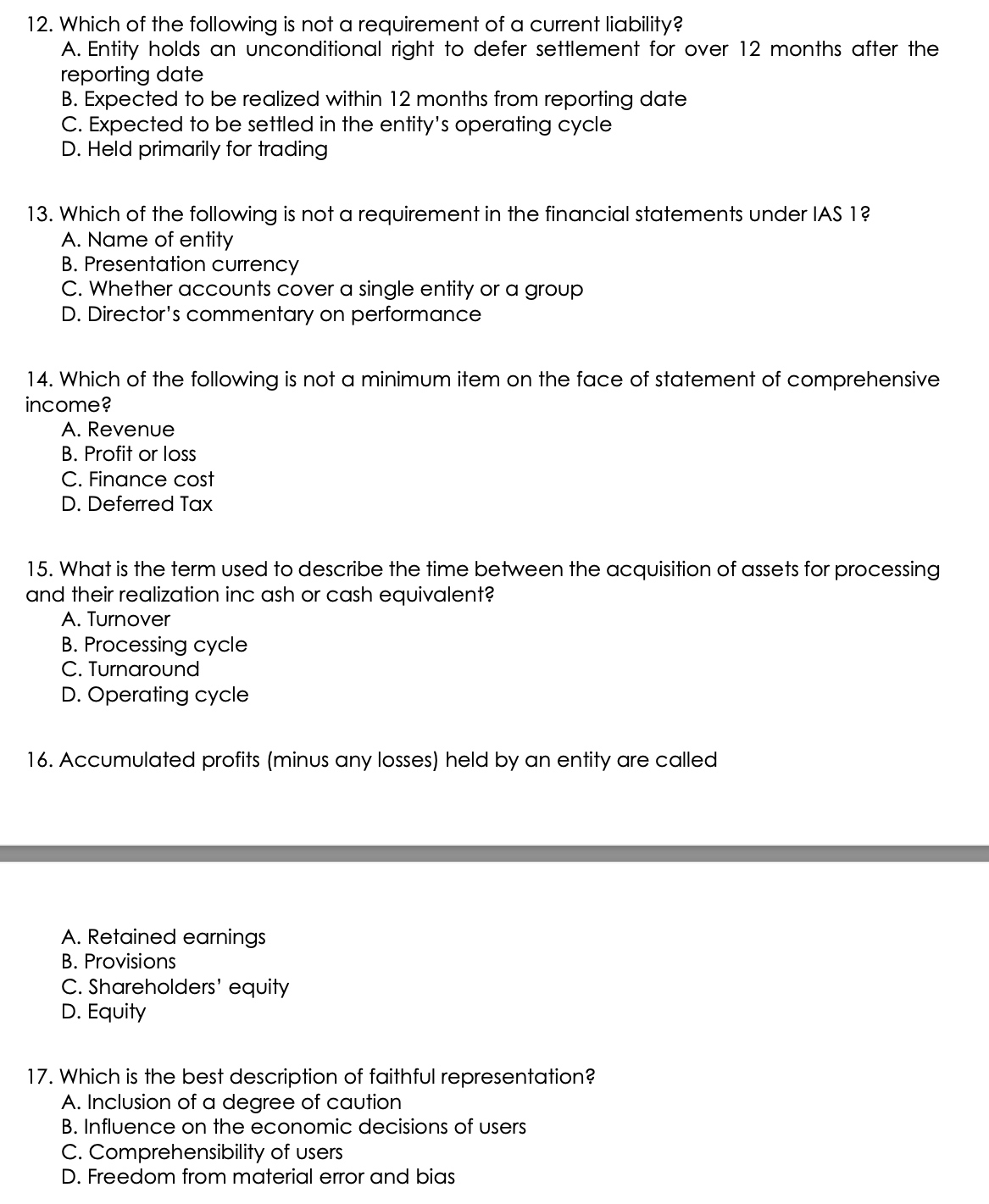
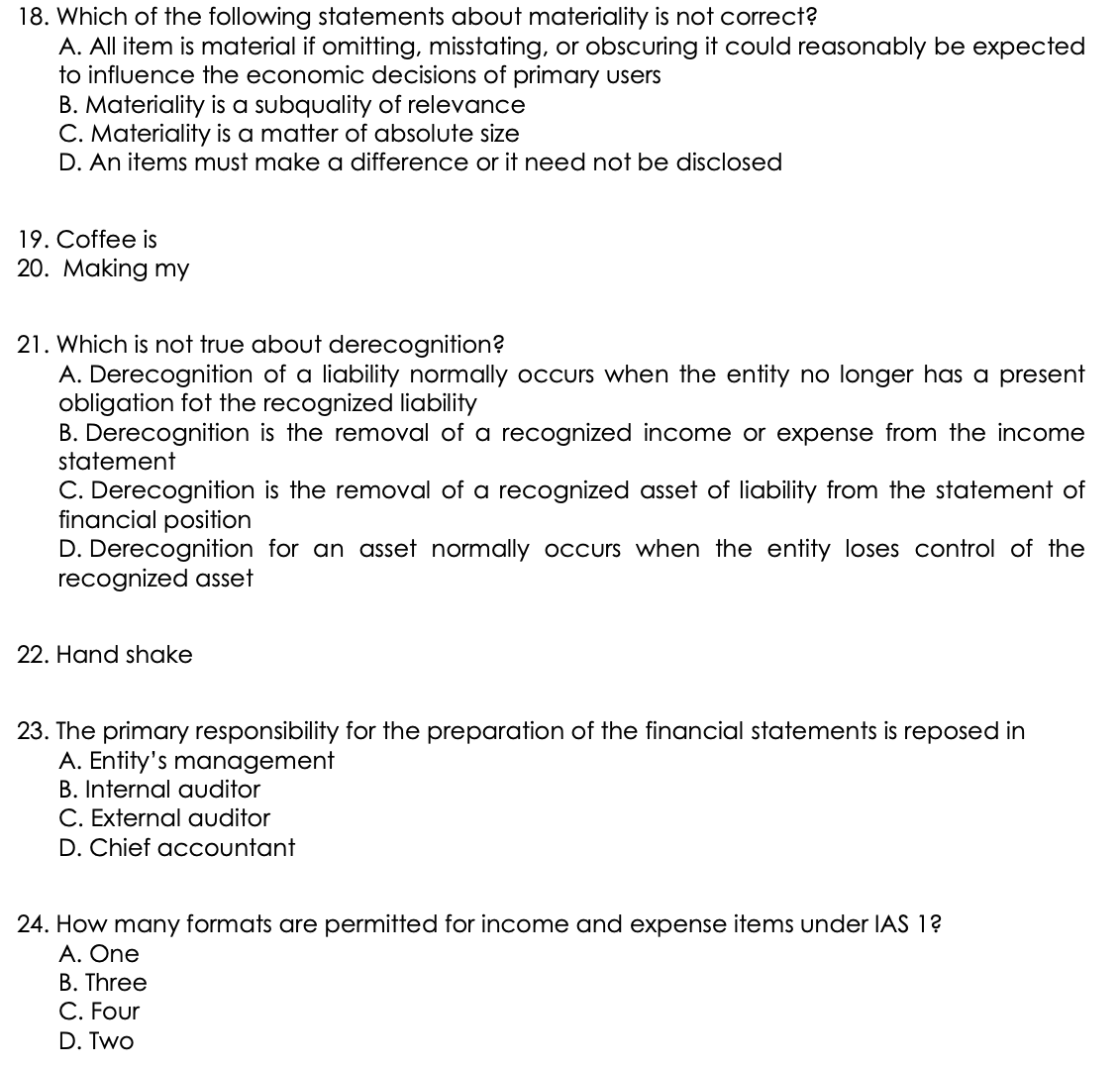
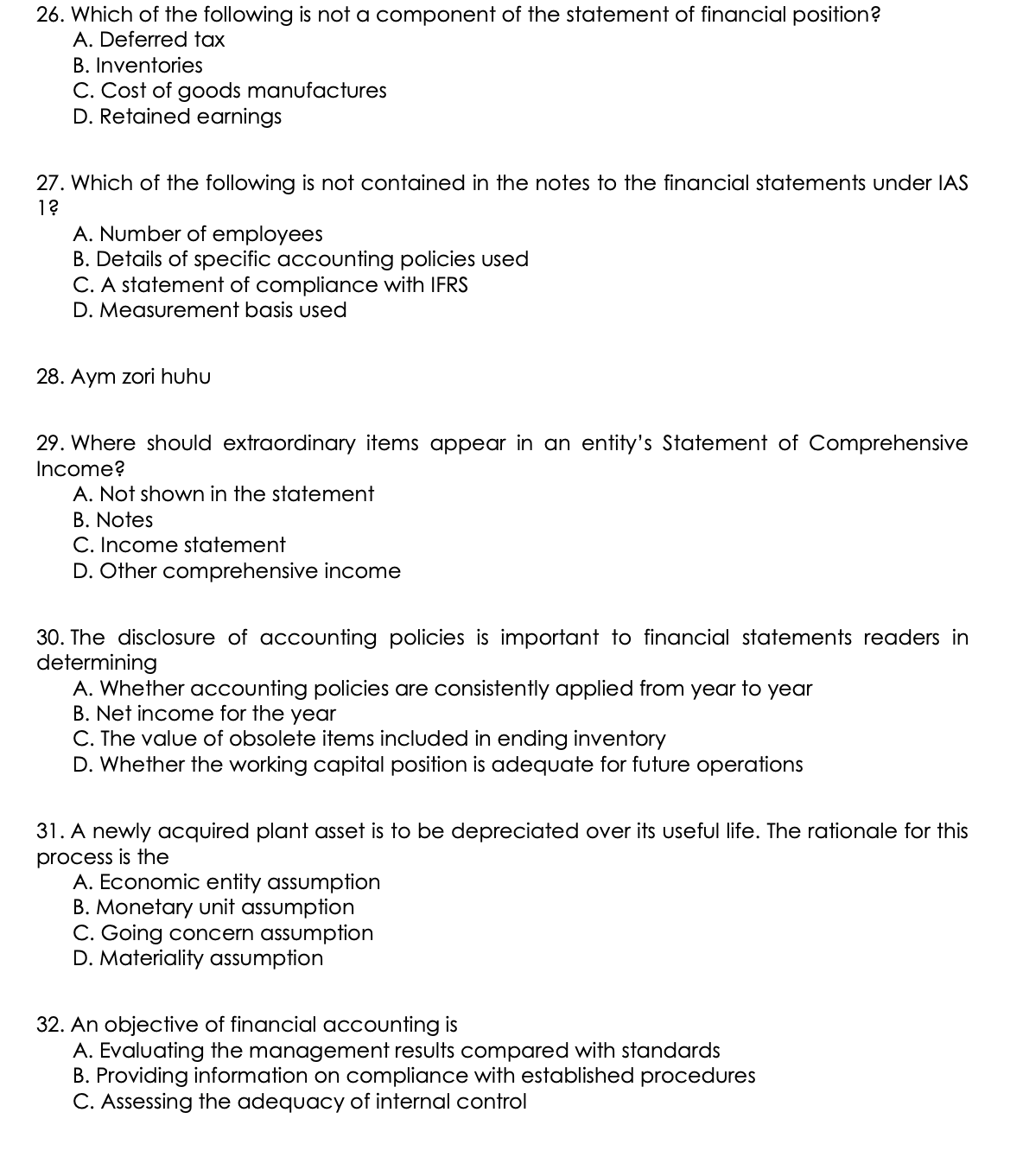
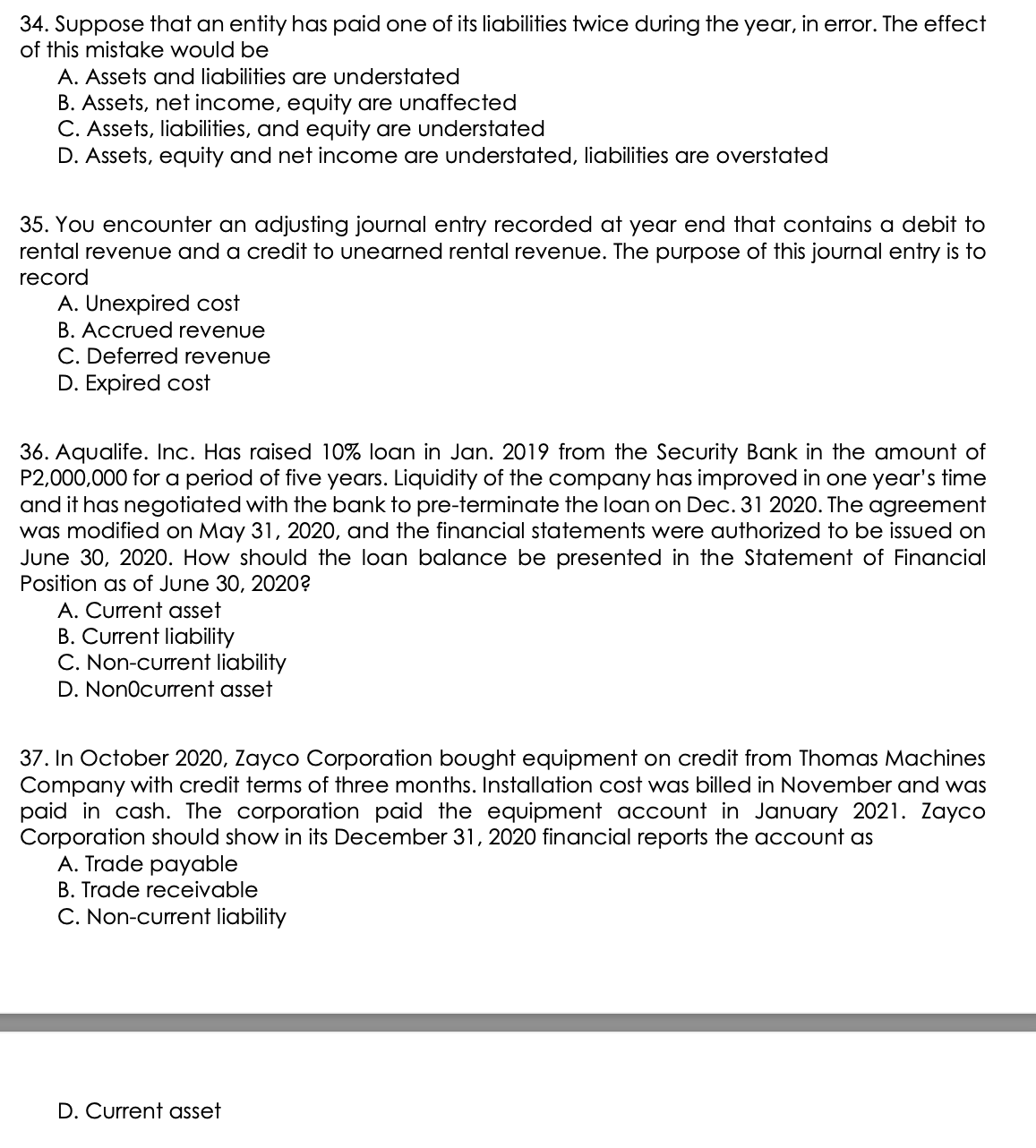
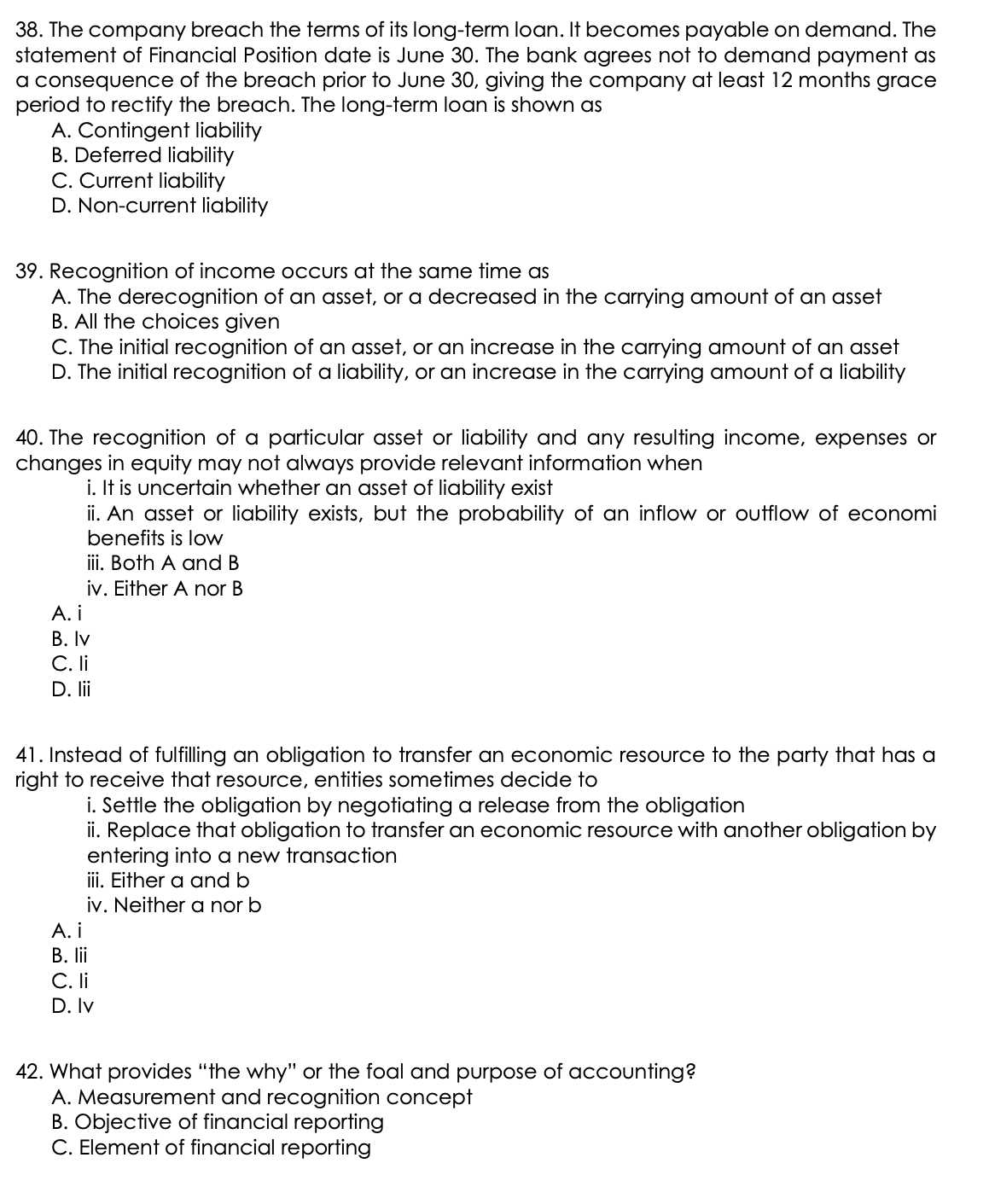
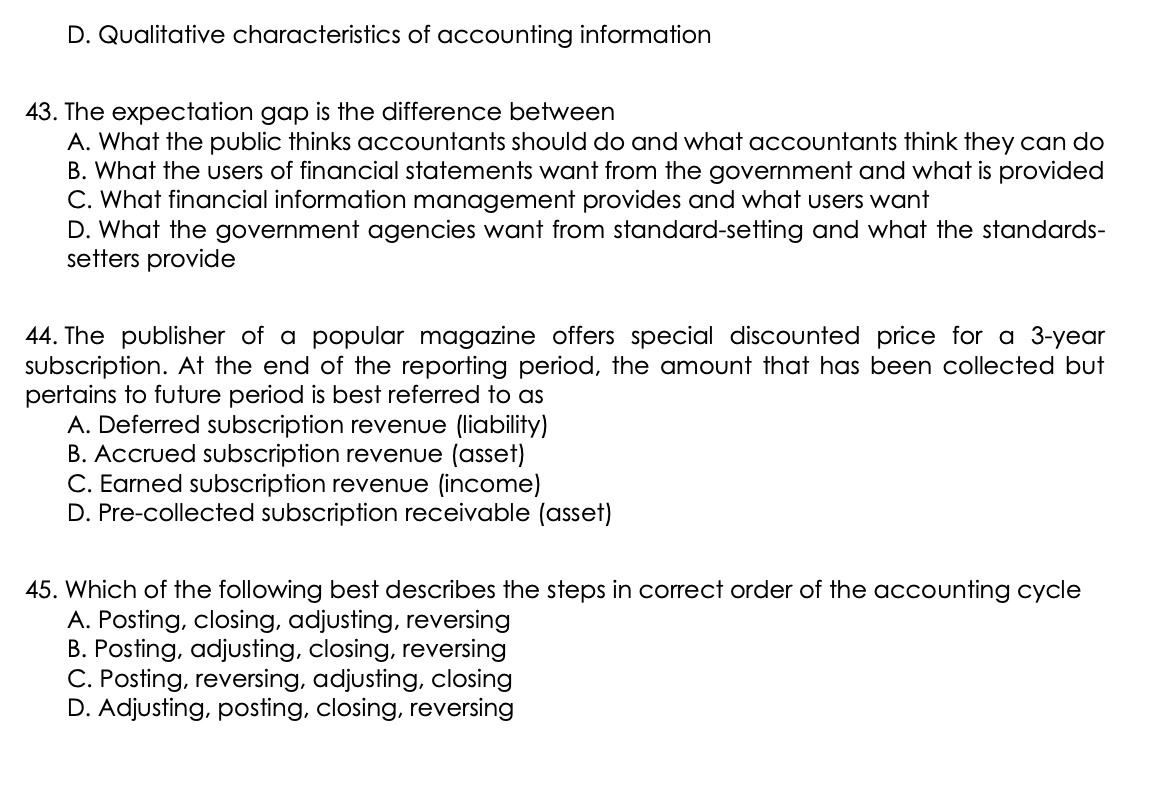
Part 2: Multiple Choice 1. Conceptual Framework describes prudence as A. A Bias towards understanding liabilities or expenses B. A mechanism for smoothing profits over time C. A form of accounting conservatism D. The exercise of caution when making judgments under conditions of uncertainty 2. Consolidated nancial statements provide information about the assets. liabilities, equity, income, and expenses of both the parent and its subsidiaries as A. a single reporting entity B. A legal entity C. A separate reporting entities D. A partnership 3. Income and expenses included in other comprehensive income A. None of the given choices B. Are always recycled into the statement of prot or loss at the need of the holding period of the related asset of liability C. Are recycled into the statement of profit or loss the IASB decides that doing so results in the Statement of profit or loss providing more relevant information, or providing a more representation of the entityzs nancial performance for that period D. Are never reclassied (recycled) from other comprehensive income into the statement of profit or loss 4. Increases in economic benefits during the accounting period in the form of inflows or enhancements of assets or decreases of liabilities that result in an increase in equity, other than those relating to contributions from eauify participation. A. Revenue B. Gains C. Income D. All the given choices 5. The IASB declared that the merits of proposed standards are assessed A. Based on arguments of lobbyist B. Based on possible impact on behavior C. From the position of neutrality D. From a position of materiality 6. All of the following components of other comprehensive income (OCI) are reclassified to retained earnings. except A. Unrealized gain or loss on debt investment measure at FVOCI B. Remeasurement of defined benefit plan C. Unrealized gain or loss on equity instrument measure at FVOCI D. Revaluation surplus 7. The due process system in developing financial accounting standards A. Is an efficient system for collecting dues from members B. Requires that all accountants must receive a copy of the financial accounting standards C. Enables interested parties to express their views on issues under consideration D. Identifies the accounting issues that are most important 8. Which of the following is not true? A. The Statement of Comprehensive Income is best used to develop an understanding of the total cash flows for the firm B. The Balance Sheet is best used to develop an understanding of the operating performance of the firm C. The Statement of Cash Flows is best used to develop an understanding of the earnings quality of the firm 9. A current asset of liability is expected to be recovered or settled within A. 12 months B. 18 months C. 24 months D. 6 months 10. Which of the following is not a liability A. Rebates payable B. Debentures C. Amounts owed to stockholders as capital D. Governments grants repayable ll. Under IAS l. which of the following must be disclosed on the face of the statement of financial position? A. All the choices given B. Total assets classified as held for sale and assets included in disposal groups. classified as held for sale C. Provisions D. Non-controlling interest 12. Which of the following is not a requirement of a current liability? A. Entity holds an unconditional right to defer settlement for over 12 months after the reporting date B. Expected to be realized within 12 months from reporting date C. Expected to be settled in the entity's operating cycle D. Held primarily for trading 13. Which of the following is not a requirement in the financial statements under IAS 1? A. Name of entity B. Presentation currency C. Whether accounts cover a single entity or a group D. Director's commentary on performance 14. Which of the following is not a minimum item on the face of statement of comprehensive income? A. Revenue B. Profit or loss C. Finance cost D. Deferred Tax 15. What is the term used to describe the time between the acquisition of assets for processing and their realization inc ash or cash equivalent? A. Turnover B. Processing cycle C. Turnaround D. Operating cycle 16. Accumulated profits (minus any losses) held by an entity are called A. Retained earnings B. Provisions C. Shareholders' equity D. Equity 17. Which is the best description of faithful representation? A. Inclusion of a degree of caution B. Influence on the economic decisions of users C. Comprehensibility of users D. Freedom from material error and bias 18. Which of the following statements about materiality is not correct? A. All item is material if omitting, misstating, or obscuring it could reasonably be expected to influence the economic decisions of primary users B. Materiality is a subquality of relevance C. Materiality is a matter of absolute size D. An items must make a difference or it need not be disclosed 19. Coffee is 20. Making my 21. Which is not true about derecognition? A. Derecognition of a liability normally occurs when the entity no longer has a present obligation fot the recognized liability B. Derecognition is the removal of a recognized income or expense from the income statement C. Derecognition is the removal of a recognized asset of liability from the statement of financial position D. Derecognition for an asset normally occurs when the entity loses control of the recognized asset 22. Hand shake 23. The primary responsibility for the preparation of the financial statements is reposed in A. Entity's management B. Internal auditor C. External auditor D. Chief accountant 24. How many formats are permitted for income and expense items under IAS 18 A. One B. Three C. Four D. Two 26. Which of the following is not a component of the statement of financial position? A. Deferred tax B. Inventories C. Cost of goods manufactures D. Retained earnings 27. Which of the following is not contained in the notes to the financial statements under IAS 18 A. Number of employees B. Details of specific accounting policies used C. A statement of compliance with IFRS D. Measurement basis used 28. Aym zori huhu 29. Where should extraordinary items appear in an entity's Statement of Comprehensive Income? A. Not shown in the statement B. Notes C. Income statement D. Other comprehensive income 30. The disclosure of accounting policies is important to financial statements readers in determining A. Whether accounting policies are consistently applied from year to year B. Net income for the year C. The value of obsolete items included in ending inventory D. Whether the working capital position is adequate for future operations 31. A newly acquired plant asset is to be depreciated over its useful life. The rationale for this process is the A. Economic entity assumption B. Monetary unit assumption C. Going concern assumption D. Materiality assumption 32. An objective of financial accounting is A. Evaluating the management results compared with standards B. Providing information on compliance with established procedures C. Assessing the adequacy of internal control 34. Suppose that an entity has paid one of its liabilities twice during the year. in error. The effect of this mistake would be A. Assets and liabilities are understated B. Assets. net income. equity are unaffected C. Assets. liabilities. and equity are understated D. Assets. equity and net income are understated. liabilities are overstated 35. You encounter an adjusting journal entry recorded at year end that contains a debit to rental revenue and a credit to unearned rental revenue. The purpose of this journal entry is to record A. Unexpired cost B. Accrued revenue C. Deferred revenue D. Expired cost 36. Aqualife. Inc. Has raised 10% loan in Jan. 2019 from the Security Bank in the amount of P2.000.000 for a period of five years. Liquidity of the company has improved in one year's time and it has negotiated with the bank to pre-temtinate the loan on Dec. 31 2020. The agreement was modified on May 31, 2020. and the financial statements were authorized to be issued on June 30. 2020. How should the loan balance be presented in the Statement of Financial Position as of June 30. 20208 A. Current asset B. Current liability C. Non-current liability D. Non0current asset 37. In October 2020, Zayco Corporation bought equipment on credit from Thomas Machines Company with credit terms of three months. Installation cost was billed in November and was paid in cash. The corporation paid the equipment account in January 2021. Zayco Corporation should show in its December 31 . 2020 financial reports the account as A. Trade payable B. Trade receivable C. Non-current liability D. Current asset 38. The company breach the terms of its long-term loan. It becomes payable on demand. The statement of Financial Position date is June 30. The bank agrees not to demand payment as a consequence of the breach prior to June 30. giving the company at least 12 months grace period to rectify the breach. The long-term loan is shown as A. Contingent liability B. Deferred liability C. Current liability D. Non-current liability 39. Recognition of income occurs at the same time as A. The derecognition of an asset. or a decreased in the carrying amount of an asset B. All the choices given C. The initial recognition of an asset, or an increase in the carrying amount of an asset D. The initial recognition of a liability. or an increase in the carrying amount of a liability 40. The recognition of a particular asset or liability and any resulting income, expenses or changes in equity may not always provide relevant information when i. It is uncertain whether an asset of liability exist ii. An asset or liability exists. but the probability of an inflow or outflow of economi benefits is low iii. Both A and B iv. Either A nor B 41. Instead of fulfilling an obligation to transfer an economic resource to the party that has a right to receive that resource. entities sometimes decide to i. Settle the obligation by negotiating a release from the obligation ii. Replace that obligation to transfer an economic resource with another obligation by entering into a new transaction iii. Either a and b iv. Neither a nor b 42. What provides \"the why" or the foal and purpose of accounting? A. Measurement and recognition concept B. Objective of financial reporting C. Element of financial reporting D. Qualitative characteristics of accounting information 43. The expectation gap is the difference between A. What the public thinks accountants should do and what accountants think they can do B. What the users of financial statements want from the government and what is provided C. What financial information management provides and what users want D. What the government agencies want from standard-setting and what the standards- setters provide 44. The publisher of a popular magazine offers special discounted price for a 3-year subscription. At the end of the reporting period, the amount that has been collected but pertains to future period is best referred to as A. Deferred subscription revenue (liability) B. Accrued subscription revenue [asset] C. Earned subscription revenue (income) D. Pro-collected subscription receivable [asset] 45. Which of the following best describes the steps in correct order of the accounting cycle A. Posting, closing, adjusting, reversing B. Posting, adjusting, closing, reversing C. Posting, reversing, adjusting, closing D. Adjusting, posting, closing, reversing
Step by Step Solution
There are 3 Steps involved in it
1 Expert Approved Answer
Step: 1 Unlock
Question Has Been Solved by an Expert!
Get step-by-step solutions from verified subject matter experts
Step: 2 Unlock
Step: 3 Unlock
Students Have Also Explored These Related Accounting Questions!









 Study Help