







Question: Part 2: Part 3: Write down one permutation matrix for a C2 operation using the numbering in the figure. Comment on the structure of this

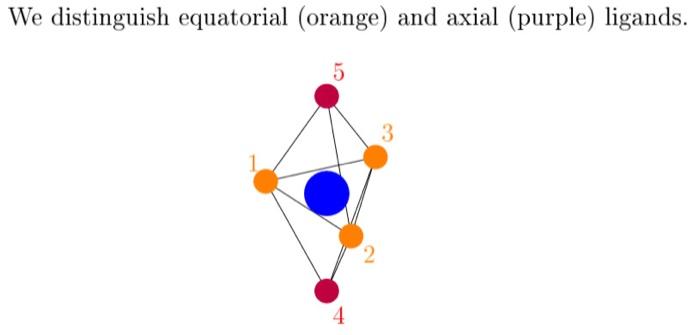

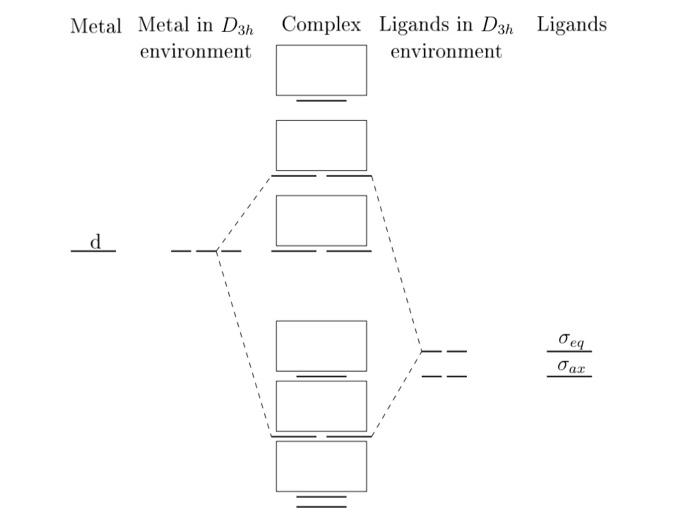
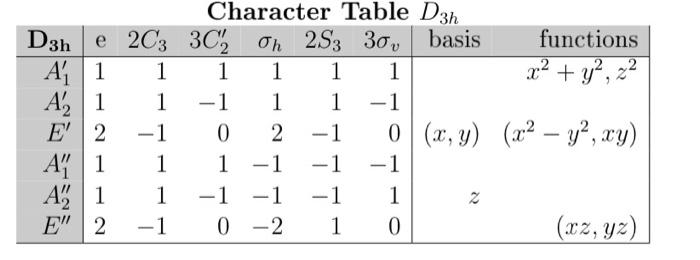
Write down one permutation matrix for a C2 operation using the numbering in the figure. Comment on the structure of this matrix. We distinguish equatorial (orange) and axial (purple) ligands. Use the result of part 2 and the character table to complete the molecular orbital diagram below, i.e. fill the white boxes with the symbol for the irreducible representation for which the orbitals are basis functions. The dashed lines connect orbitals of the same symmetry; also add all missing lines. Metal Metal in D3h Complex Ligands in D3h Ligands environment d Character Table D3h \begin{tabular}{r|rrrrrr|rr|} D3h & e & 2C3 & 3C2 & h & 2S3 & 3v & basis & functions \\ \hlineA1 & 1 & 1 & 1 & 1 & 1 & 1 & & x2+y2,z2 \\ A2 & 1 & 1 & -1 & 1 & 1 & -1 & & \\ E & 2 & -1 & 0 & 2 & -1 & 0 & (x,y) & (x2y2,xy) \\ A1 & 1 & 1 & 1 & -1 & -1 & -1 & & \\ A2 & 1 & 1 & -1 & -1 & -1 & 1 & z & \\ E & 2 & -1 & 0 & -2 & 1 & 0 & & (xz,yz) \\ \hline \end{tabular}
Step by Step Solution
There are 3 Steps involved in it

Get step-by-step solutions from verified subject matter experts
 Study Help