







Question: Part 2: Simple Harmonic motion: 1) Use the same vertical spring set-up that was used for Hooke's Law. Attach a small mass of about 50
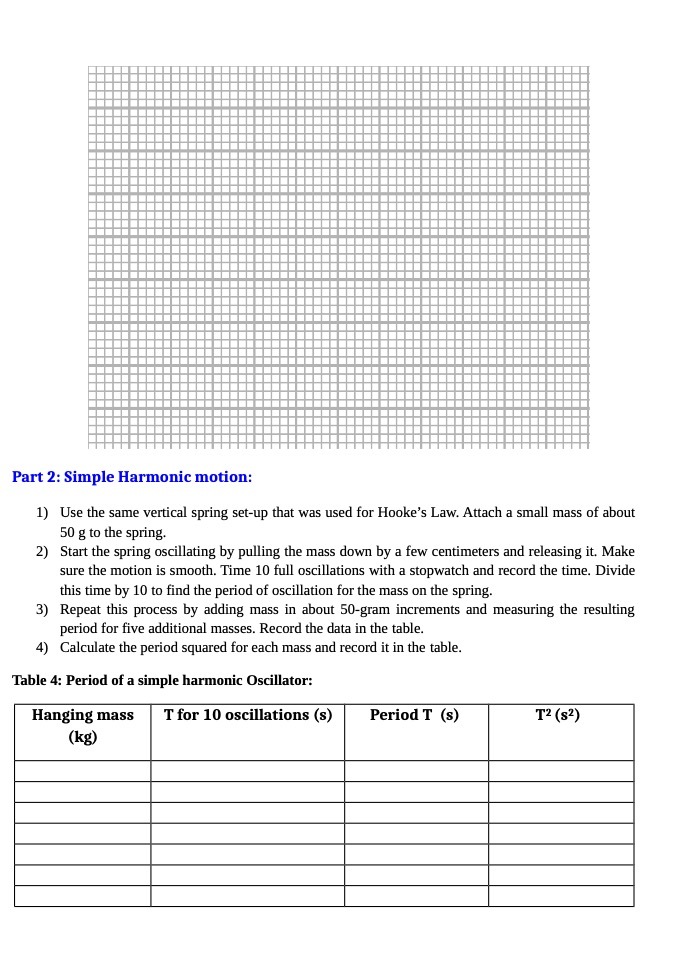
Part 2: Simple Harmonic motion: 1) Use the same vertical spring set-up that was used for Hooke's Law. Attach a small mass of about 50 g to the spring. 2) Start the spring oscillating by pulling the mass down by a few centimeters and releasing it. Make sure the motion is smooth. Time 10 full oscillations with a stopwatch and record the time. Divide this time by 10 to find the period of oscillation for the mass on the spring. 3) Repeat this process by adding mass in about 50-gram increments and measuring the resulting period for five additional masses. Record the data in the table. 4) Calculate the period squared for each mass and record it in the table. Table 4: Period of a simple harmonic Oscillator: Hanging mass T for 10 oscillations (s) Period T (s) T2 ($2) (kg)
Step by Step Solution
There are 3 Steps involved in it

Get step-by-step solutions from verified subject matter experts
 Study Help