







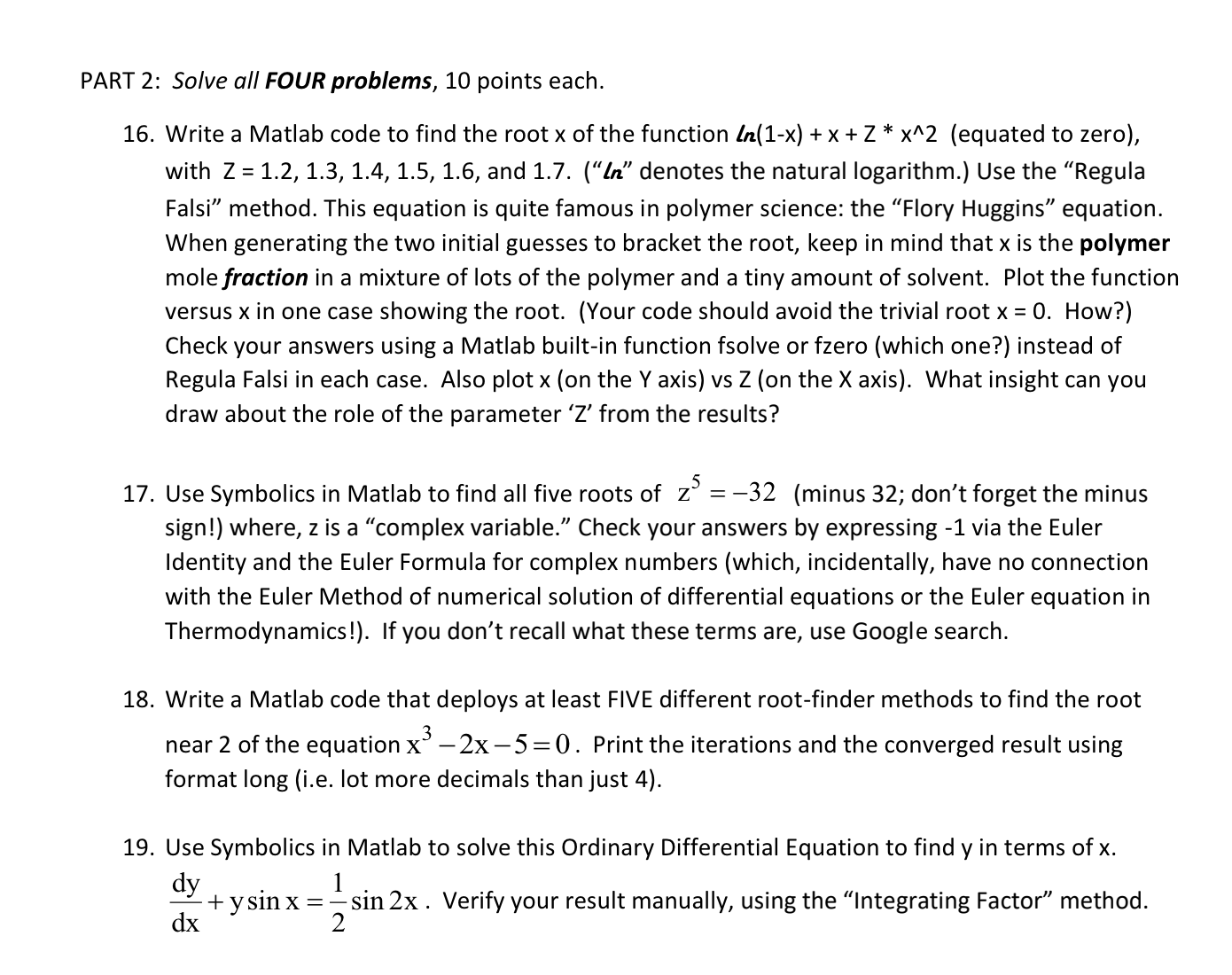
Question: PART 2 : Solve all FOUR problems, 1 0 points each. Write a Matlab code to find the root x of the function l n
PART : Solve all FOUR problems, points each.
Write a Matlab code to find the root of the function equated to zero
with and denotes the natural logarithm. Use the "Regula
Falsi" method. This equation is quite famous in polymer science: the "Flory Huggins" equation.
When generating the two initial guesses to bracket the root, keep in mind that is the polymer
mole fraction in a mixture of lots of the polymer and a tiny amount of solvent. Plot the function
versus in one case showing the root. Your code should avoid the trivial root How?
Check your answers using a Matlab builtin function fsolve or fzero which one? instead of
Regula Falsi in each case. Also plot on the axis vs on the axis What insight can you
draw about the role of the parameter from the results?
Use Symbolics in Matlab to find all five roots of minus ; don't forget the minus
sign! where, is a "complex variable." Check your answers by expressing via the Euler
Identity and the Euler Formula for complex numbers which incidentally, have no connection
with the Euler Method of numerical solution of differential equations or the Euler equation in
Thermodynamics! If you don't recall what these terms are, use Google search.
Write a Matlab code that deploys at least FIVE different rootfinder methods to find the root
near of the equation Print the iterations and the converged result using
format long ie lot more decimals than just
Use Symbolics in Matlab to solve this Ordinary Differential Equation to find in terms of
Verify your result manually, using the "Integrating Factor" method.
Step by Step Solution
There are 3 Steps involved in it
1 Expert Approved Answer
Step: 1 Unlock

Question Has Been Solved by an Expert!
Get step-by-step solutions from verified subject matter experts
Step: 2 Unlock
Step: 3 Unlock
 Study Help