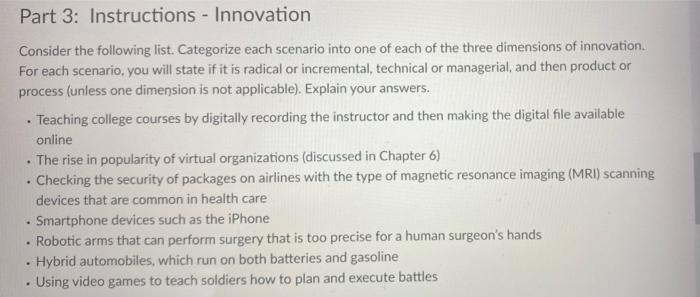
Part 3: Instructions - Innovation Consider the following list. Categorize each scenario into one of each of the three dimensions of innovation. For each scenario, you will state if it is radical or incremental, technical or managerial, and then product or process (unless one dimension is not applicable). Explain your answers. The rise in popularity of virtual organizations (discussed in Chapter 6) . Checking the security of packages on airlines with the type of magnetic resonance imaging (MRI) scanning devices that are common in health care Smartphone devices such as the iPhone Robotic arms that can perform surgery that is too precise for a human surgeon's hands Hybrid automobiles, which run on both batteries and gasoline Using video games to teach soldiers how to plan and execute battles . Teaching college courses by digitally recording the instructor and then making the digital file available online . . Part 4: Instructions - Change Assume that you are the manager of an organization that has a routine way of performing a task and now faces a major change in how it performs that task. Using the Lewin model, tell what steps you would take to implement the change. Using the comprehensive approach, tell what steps you would take. For each step, give specific examples of actions you would take at that step including how you would address resistance. Part 1: Instructions - Organizational Chart Whenever a new enterprise is started, the owner must make decisions about how to structure the organization. For example, he or she must decide what functions are required, how those functions will be broken down into individual jobs, how those jobs will be grouped back together into logical departments, and how authority and responsibility will be allocated across positions. Assume that you have decided to open a handmade chocolate business in your local community. Your products will be traditional bars and novelty- shaped chocolates, truffles, other chocolate products such as ice cream, and gift baskets and boxes featuring chocolates. You have hired a talented chef and believe that her expertise, coupled with your unique designs and high-quality ingredients, will make your products very popular. You have also inherited enough money to get your business up and running and to cover about one year of living expenses (in other words, you do not need to pay yourself a salary). You intend to buy food items including chocolate, cocoa, white chocolate, nuts, and fruit from suppliers who deliver to your area. Your chef will then turn those ingredients into luscious products that will then be attractively packaged. Local grocery store owners and restaurant chefs have seen samples of your products. and indicated a keen interest in selling them. You know, however, that you will still need to service accounts and keep your customers happy. At the present time, you are trying to determine how many people you need. to get your business going and how to group them most effectively into an organization. You realize that i you can start out quite small and then expand as sales warrant. However, you also worry that if you are continually adding people and rearranging your organization, confusion and inefficiency may result