







Question: Part 3 - Issues with Sampling The US presidential election of 1936 pitted Alfred Landon, the Republican governor of Kansas, against the incumbent President, Franklin
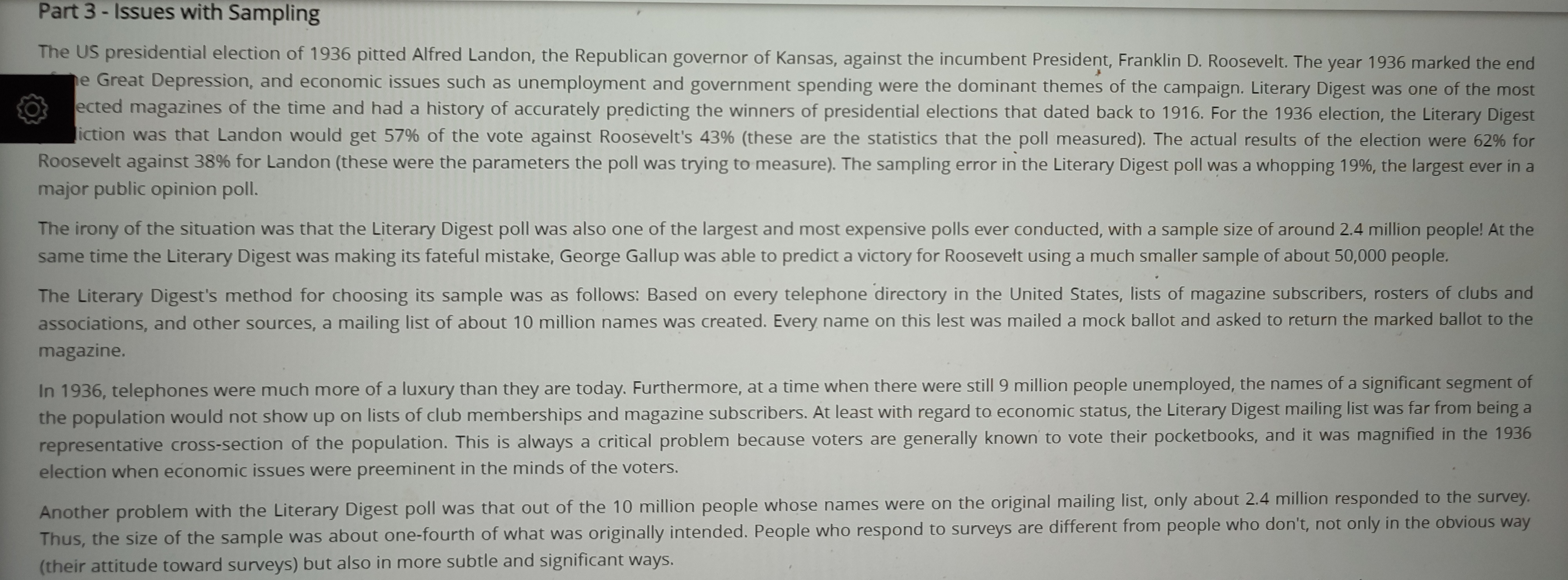
Part 3 - Issues with Sampling The US presidential election of 1936 pitted Alfred Landon, the Republican governor of Kansas, against the incumbent President, Franklin D. Roosevelt. The year 1936 marked the end e Great Depression, and economic issues such as unemployment and government spending were the dominant themes of the campaign. Literary Digest was one of the most ected magazines of the time and had a history of accurately predicting the winners of presidential elections that dated back to 1916. For the 1936 election, the Literary Digest iction was that Landon would get 57% of the vote against Roosevelt's 43% (these are the statistics that the poll measured). The actual results of the election were 62% for Roosevelt against 38% for Landon (these were the parameters the poll was trying to measure). The sampling error in the Literary Digest poll was a whopping 19%, the largest ever in a major public opinion poll. The irony of the situation was that the Literary Digest poll was also one of the largest and most expensive polls ever conducted, with a sample size of around 2.4 million people! At the same time the Literary Digest was making its fateful mistake, George Gallup was able to predict a victory for Roosevelt using a much smaller sample of about 50,000 people. The Literary Digest's method for choosing its sample was as follows: Based on every telephone directory in the United States, lists of magazine subscribers, rosters of clubs and associations, and other sources, a mailing list of about 10 million names was created. Every name on this lest was mailed a mock ballot and asked to return the marked ballot to the magazine. In 1936, telephones were much more of a luxury than they are today. Furthermore, at a time when there were still 9 million people unemployed, the names of a significant segment of the population would not show up on lists of club memberships and magazine subscribers. At least with regard to economic status, the Literary Digest mailing list was far from being a representative cross-section of the population. This is always a critical problem because voters are generally known to vote their pocketbooks, and it was magnified in the 1936 election when economic issues were preeminent in the minds of the voters. Another problem with the Literary Digest poll was that out of the 10 million people whose names were on the original mailing list, only about 2.4 million responded to the survey. Thus, the size of the sample was about one-fourth of what was originally intended. People who respond to surveys are different from people who don't, not only in the obvious way (their attitude toward surveys) but also in more subtle and significant ways
Step by Step Solution
There are 3 Steps involved in it

Get step-by-step solutions from verified subject matter experts
 Study Help