







Question: Part 3 - Subnetting a Class B block Suppose we're an organisation with a class B block available, let's say 1 5 5 . 1
Part Subnetting a Class B block
Suppose we're an organisation with a class B block available, let's say We have branches
in multiple cities, and want to split this address space into subnets to allocate to separate branches. We
want each branch to have enough addresses for hosts. How should we subnet in this case?
A subnet size can only be a power of so we need to find the next largest power of two: This
means we need to leave host bits We start with a class B block, so and we know
so a little bit of algebra gives us so we're borrowing bits for subnetting. In slash notation,
our subnet mask will be which in octet notation is
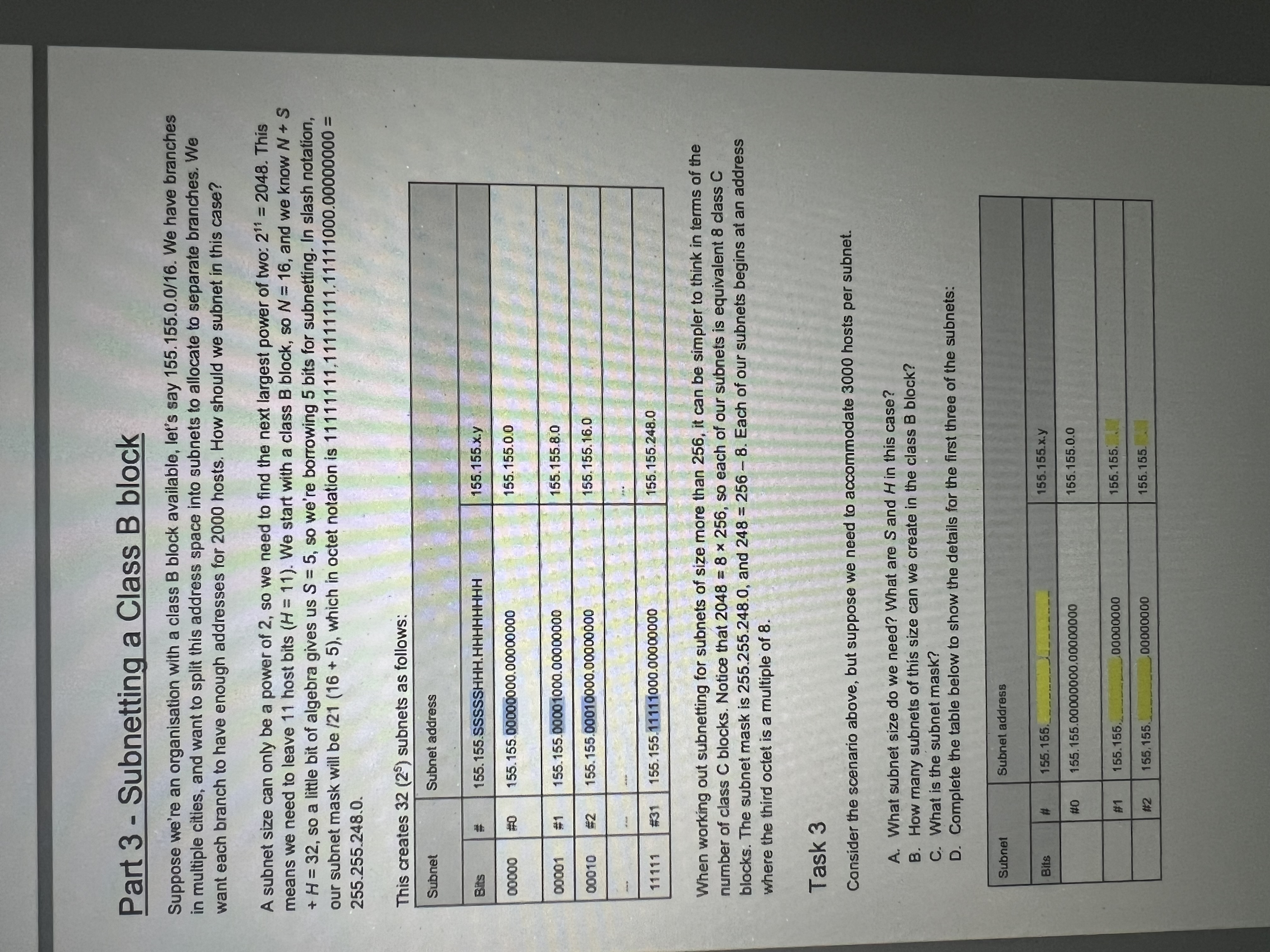
This creates subnets as follows:
When working out subnetting for subnets of size more than it can be simpler to think in terms of the
number of class C blocks. Notice that so each of our subnets is equivalent class
blocks. The subnet mask is and Each of our subnets begins at an address
where the third octet is a multiple of
Task
Consider the scenario above, but suppose we need to accommodate hosts per subnet.
A What subnet size do we need? What are and in this case?
B How many subnets of this size can we create in the class B block?
C What is the subnet mask?
D Complete the table below to show the details for the first three of the subnets:
Step by Step Solution
There are 3 Steps involved in it
1 Expert Approved Answer
Step: 1 Unlock

Question Has Been Solved by an Expert!
Get step-by-step solutions from verified subject matter experts
Step: 2 Unlock
Step: 3 Unlock
 Study Help