Question: PART 6 Comprehensive Case Knocking off the Knockoffs? Introduction As E-commerce numbers grow, counterfeiters are heading online. Producers of knockoff merchandise are busy all year
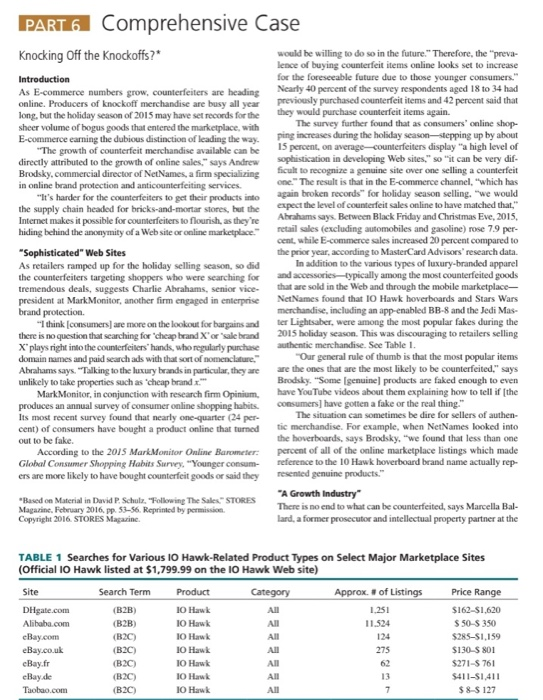
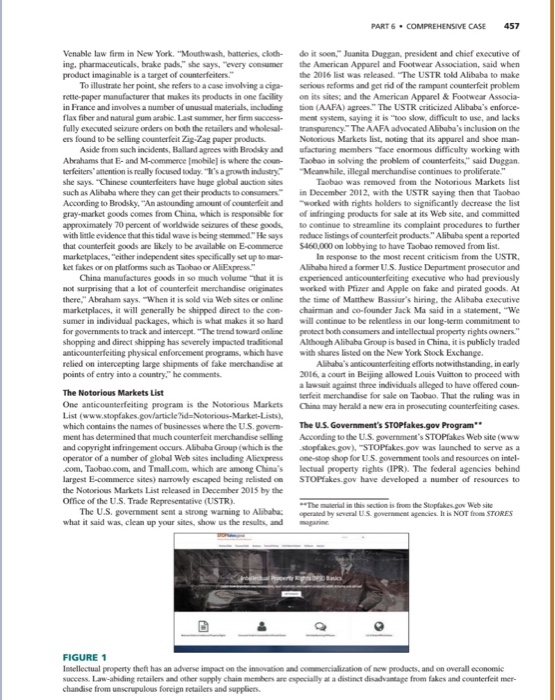
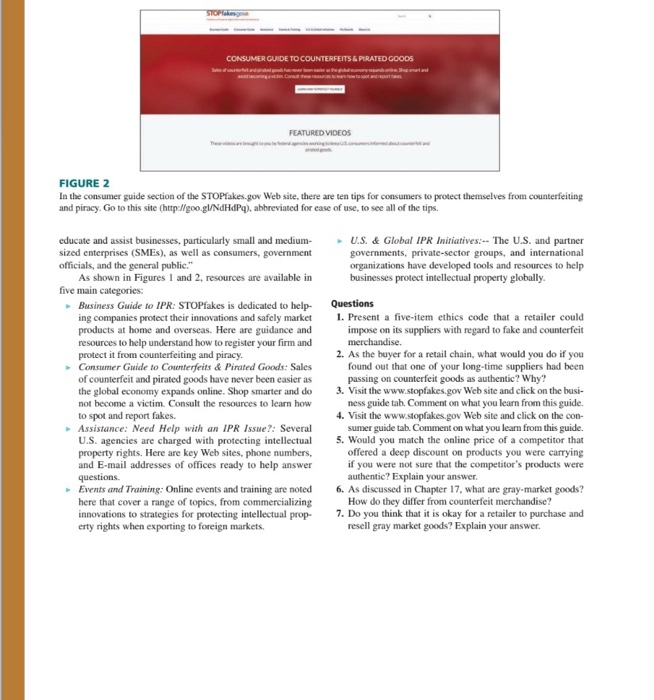
PART 6 Comprehensive Case Knocking off the Knockoffs?" Introduction As E-commerce numbers grow, counterfeiters are heading online. Producers of knockoff merchandise are busy all year long, but the holiday season of 2015 may have set records for the sheer volume of bogus goods that entered the marketplace, with E-commerce earning the dubious distinction of leading the way "The growth of counterfeit merchandise available can be directly attributed to the growth of online sales." says Andrew Brodsky, commercial director of NetNames, a firm specializing in online brand protection and anticounterfeiting services It's harder for the counterfeiters to get their products into the supply chain headed for bricks-and-mortar stores, but the Internet makes it possible for counterfeiers to flourish, as they're hiding behind the anonymity of a Web site or online marketplace." "Sophisticated Web Sites As retailers ramped up for the holiday selling season, so did the counterfeiters targeting shoppers who were searching for tremendous deals, suggests Charlie Abrahams, senior vice- president at Mark Monitor, another firm engaged in enterprise brand protection "I think Iconsumers are more on the lookout for bargains and there is no question that searching for cheap brand X' or 'sale brand X'plays right into the counterfeiers hands, who regularly purchase domain names and paid search ads with that sort of nomenclature." Abrahams says. "Talking to the luxury brands in particular, they are unlikely to take properties such as 'cheap brand. MarkMonitor, in conjunction with research firm Opinium, produces an annual survey of consumer online shopping habits. Its most recent survey found that nearly one-quarter (24 per cent) of consumers have bought a product online that turned out to be fake. According to the 2015 Mark Monitor Online Barometer Global Consumer Shopping Habits Survey. "Younger consum ers are more likely to have bought counterfeit goods or said they would be willing to do so in the future. Therefore, the preva lence of buying counterfeit items online looks set to increase for the foreseeable future due to those younger consumers." Nearly 40 percent of the survey respondents aged 18 to 34 had previously purchased counterfeit items and 42 percent said that they would purchase counterfeit items again. The survey further found that as consumers' online shop ping increases during the holiday season stepping up by about 15 percent, on average-counterfeiters display a high level of sophistication in developing Web sites," so it can be very dif- ficult to recognize a genuine site over one selling a counterfeit one. The result is that in the E-commerce channel, which has again broken records for holiday season selling, we would expect the level of counterfeit sales online to have matched that." Abrahams says. Between Black Friday and Christmas Eve, 2015, retail sales (excluding automobiles and gasoline) rose 79 per cent, while E-commerce sales increased 20 percent compared to the prior year, according to MasterCard Advisors' research data. In addition to the various types of luxury-branded apparel and accessories typically among the most counterfeited goods that are sold in the Web and through the mobile marketplace NetNames found that 10 Hawk hoverboards and Stars Wars merchandise, including an app-enabled BB-8 and the Jedi Mas ter Lightsaber, were among the most popular fakes during the 2015 holiday season. This was discouraging to retailers selling authentic merchandise. See Table 1 "Our general rule of thumb is that the most popular items are the ones that are the most likely to be counterfeited," says Brodsky. "Some genuinel products are faked enough to even have YouTube videos about them explaining how to tell if the consumers] have gotten a fake or the real thing." The situation can sometimes be dire for sellers of authen tic merchandise. For example, when NetNames looked into the hoverboards, says Brodsky, we found that less than one percent of all of the online marketplace listings which made reference to the 10 Hawk hoverboard brand name actually rep resented genuine products." Based on Material in David Schule Following The Sales STORES Magazine, February 2016, pp. 52-56. Reprinted by permis Copyright 2016. STORES Magazine "A Growth Industry There is no end to what can be counterfeited, says Marcella Bal Land, a former prosecutor and intellectual property partner at the TABLE 1 Searches for Various IO Hawk-Related Product Types on Select Major Marketplace Sites (Official IO Hawk listed at $1,799.99 on the IO Hawk Web site) Site Search Term Category Approx of Listings 11524 DHgate.com Alibaba.com cBay.com eBay.co.uk cBay.fr clay.de Taco.com (B2B (B2B) (B2C) (B2C) (B2C) (B2C) (B2C) Product 10 Hawk 10 Hawk 10 Hawk 10 Hawk 10 Hawk 10 Hawk IO Hawk Price Range $162-51.620 S50-S 350 $285-51.159 $130-5801 $271-5761 $411-S1411 $85127 PARTS COMPREHENSIVE CASE 457 Venable law firm in New York. "Mouthwash, batteries, cloth ing pharmaceuticals, brake pads, she says. "every conc er product imaginable is a target of counterfeitiers." To illustrate her point, she refers to a case involving aciga rette-paper manufacturer that makes its products in one facility in France and involves a mber of materials including Flax fiber and natural gumarabic. Last summer, her firms fully crecuted in orders on both the retailers and wholesal ens found to be selling counterfeit Zig Zag paper products Aside from such incidents, Ballandarees with Broddy and Abrams that and Mommerce is where the terciensi tion is really focused today 's powth indeer she says. Chinese countries have huge slobal acces such as Alibaha where they can get their products to consumers. According to Brodsky. "An astounding amount of counterfeitand pray-market goods comes from China, which is responsible for approximately 70 percent of worldwide seizures of these goods with little evidence that this tidal wave is being stemmed." He says that counterfeil poods are likely to be available on E-commerce marketplaces, either independent sites specifically set up to mar ket fakes or on platforms such as T hao AliExpress." China manufactures poods in so much volume that it is not surprising that a lot of counterfeit merchandise originates there." Abraham says. "When it is sold via Web sites or online marketplaces, it will generally he shipped direct to the con sumer in individual packages, which is what makes it so hard for governments to track and intercept. "The trend toward online shopping and direct shipping has severely impacted traditional anticounterfeiting physical enforcement programs, which have relied on intercepting large shipments of fake merchandise points of entry into a country," he comments The Notorious Markets List One anticounterfeiting program is the Notorious Markets List (www.topfakes.gov/article de Notorious Market-Lists). which contains the names of businesses where the US govem ment has determined that much counterfeit merchandise selling and copyright infringement occurs. Alibaba Group (which is the operator of a number of global Websites including Aliexpress .com. Taobao.com.and Tmall.com, which are among China's largest E-commerce sites) narrowly escaped being relisted on the Notorious Markets List released in December 2015 by the Office of the US Trade Representative (USTR). The US government sent a strong warning to Alibaba what it said was clean up your sites, show as the results and do it soon. Juanita Dugan, president and chief executive of the American Apparel and Footwear Association, said when the 2016 list was released "The USTR told Alibaba to make serios reforms and get rid of the rampant counterfeit problem on its sites and the American Apparel & Footwear Associ tion (AAFA) agrees. The USTR criticized Alibaba's enforce ment system, saying it is so difficult to use and lacks transparency.The AAFA advocated Alibaba's inclusion on the Notons Markets list, noting that its apparel and shoeman facturing members Tace enormes difficulty working with Tahoe in solving the problem of counterfeits," said Duggan "Meanwhile, illegal merchandise continues to proliferate." Taobao was removed from the Notorious Markets list in December 2012, with the USTR saying then that Taobao worked with right holders to significantly decrease the list of infringing products for sale at its Website and committed to continue to streamline its complaint procedures to further reduce listings of counterfeit products." Alibaba spent a reported S160,000 on lobbying to have Taobao removed from list. In response to the most recent criticism from the USTR Alibaba hired a former US. Justice Department prosecutor and experienced antcounterfeiting executive who had previously worked with Puner and Apple on fake and pirated goods. Al the time of Matthew Bassiur's hiring, the Alibaba executive chairman and co-founder Jack Ma said in a statement, "We will continue to be relentless in our long-term commitment to protect both consumers and intellectual property rights owners." Although Alibaba Group is based in China, it is publicly traded Ahab's anticounterfesting efforts to withstanding, in early 2016, a court in Beijing allowed Louis Vuitton to proceed with a lawsuit against three individuals alleged to have offered coun terfeit merchandise for sale on Taobao. That the ruling was in China may heralda new era in prosecuting counterfeiting cases The U.S. Government's STOPfakes.gov Program" According to the US gover 'STOPfakes Web site (www stopfakes.gov). "STOPfakes.gov was launched to serve as a one-op shop for US government tools and resources on inte lectual property rights (IPR). The federal agencies behind STOPfakes gou have developed a number of resources to Theme by US the powe NOT STORES FIGURE 1 Intellectual property that has an adverse impact on the c o w products and overall come ce L i ding retailers and other supply chain members are especially at a distinct disadvantage from fakes and counterfeit mer chandise from unscrupulous foreign retailers and supplies STOPlake CONSUMER GUIDE TO COUNTERFEITS & PIRATED GOODS FEATURED VIDEOS FIGURE 2 In the consumer guide section of the STOPfakes.gov Web site, there are ten tips for consumers to protect themselves from counterfeiting and piracy. Go to this site (http://goo.gl/NdHdPq), abbreviated for ease of use, to see all of the tips. U.S. & Global IPR Initiatives - The U.S. and partner governments, private-sector groups, and international organizations have developed tools and resources to help businesses protect intellectual property globally. educate and assist businesses, particularly small and medium- sized enterprises (SMEs), as well as consumers, government officials, and the general public." As shown in Figures 1 and 2, resources are available in five main categories: Business Guide to IPR: STOPfakes is dedicated to help d to help ing companies protect their innovations and safely market products at home and overseas. Here are guidance and resources to help understand how to register your firm and protect it from counterfeiting and piracy. Consumer Guide to Counterfeits & Pirated Goods: Sales of counterfeit and pirated goods have never been easier as the global economy expands online. Shop smarter and do not become a victim. Consult the resources to learn how to spot and report fakes. Assistance: Need Help with an IPR Issue?: Several U.S. agencies are charged with protecting intellectual property rights. Here are key Web sites, phone numbers, and E-mail addresses of offices ready to help answer questions Events and Training: Online events and training are noted here that cover a range of topics, from commercializing innovations to strategies for protecting intellectual prop- erty rights when exporting to foreign markets. Questions 1. Present a five-item ethics code that a retailer could impose on its suppliers with regard to fake and counterfeit merchandise. 2. As the buyer for a retail chain, what would you do if you found out that one of your long-time suppliers had been passing on counterfeit goods as authentic? Why? 3. Visit the www.stopfakes.gov Web site and click on the busi- ness guide tah. Comment on what you learn from this guide. 4. Visit the www.stopfakes.gov Web site and click on the con- sumer guide tab. Comment on what you learn from this guide. 5. Would you match the online price of a competitor that offered a deep discount on products you were carrying if you were not sure that the competitor's products were authentic? Explain your answer. 6. As discussed in Chapter 17, what are gray-market goods? How do they differ from counterfeit merchandise? 7. Do you think that it is okay for a retailer to purchase and resell gray market goods? Explain your









 Study Help