





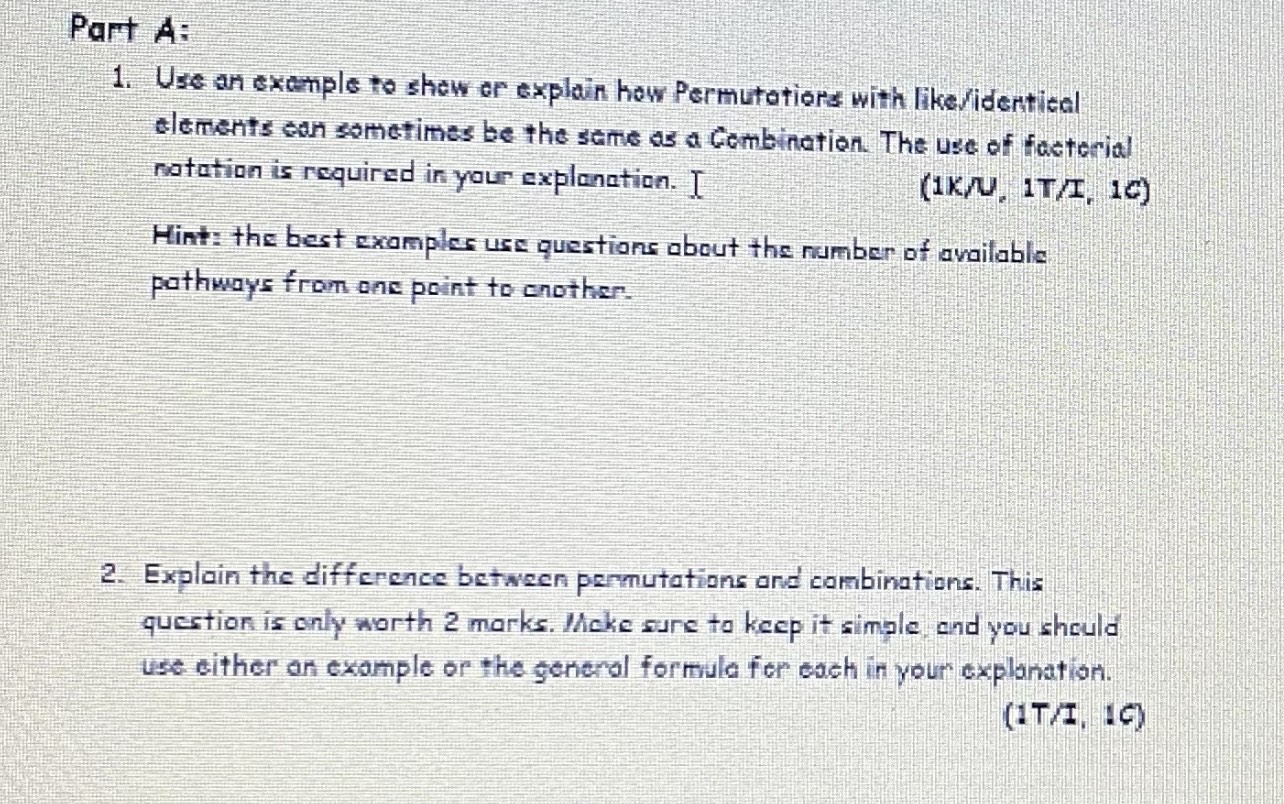
Question: Part A: 1. Use an example to show or explain how Permutations with like/identical elements can sometimes be the same as a Combination. The use
Part A: 1. Use an example to show or explain howPart A: 1. Use an example to show or explain howPart A: 1. Use an example to show or explain how
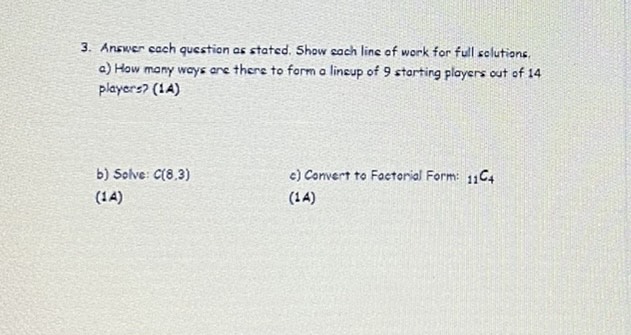
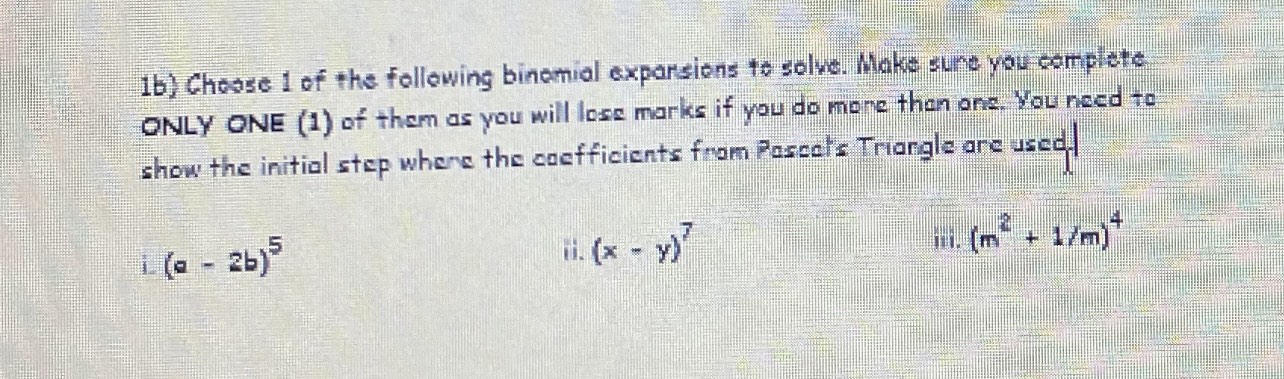
Part A: 1. Use an example to show or explain how Permutations with like/identical elements can sometimes be the same as a Combination. The use of facterial notation is required in your explanation. I (1X/U. IT/I, 16) Hint: the best examples use questions about the number of available pathways from one point to another. 2. Explain the difference between permutations and combinations. This question is only worth 2 marks. Make sure to keep it simple, and you should use either an example or the general formula for each in your explanation. (IT/I, 19)3. Answer cach question as stated. Show each line of work for full solutions a) How many ways are there to form a lineup of 9 starting players out of 14 players? (14) b) Solve: C(8.3) c) Convert to Factorial Form: 11 C4 (14) (14)1b) Choose 1 of the following binomial expansions to solve. Make sure you complete ONLY ONE (1) of them as you will lose marks if you do more than one. You need to show the initial step where the coefficients from Pascal's Triangle are used. 1 (9 - 2b) il. (x - y) ill. (m + 1/m)+
Step by Step Solution

There are 3 Steps involved in it

1 Expert Approved Answer
Step: 1 Unlock blur-text-image
Question Has Been Solved by an Expert!

Get step-by-step solutions from verified subject matter experts

Step: 2 Unlock
Step: 3 Unlock

Students Have Also Explored These Related Mathematics Questions!