







Question: Part A. [Arranging an orthogonal design problem} 1. verify that Xg = U and X: are orthogonal. 2. Compute a corrected version of X2 that
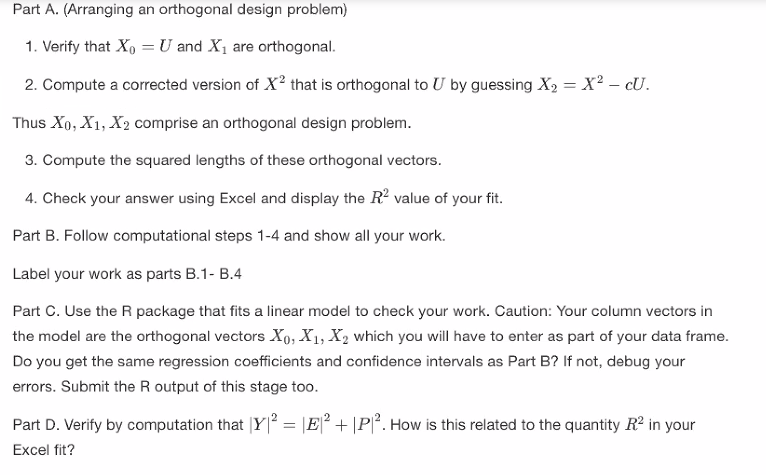

Part A. [Arranging an orthogonal design problem} 1. verify that Xg = U and X: are orthogonal. 2. Compute a corrected version of X2 that is orthogonal to U by guessing X2 = X2 cU. Thus Xg,X1,X2 comprise an orthogonal design problem. 3. lGompute the squared lengths of these orthogonal 1rectors. 4. Check your answer using Excel and display the R2 value of your fit. Part B. Follow computational steps 14 and show all your work. Label your work as pans 5.1 3.4 Part C. Use the Pl package that ts a linear model to check your work. Caution: Your column tractors in the model are the orthogonal tractors XI], X1, X2 which you will have to enter as part of your data frame. Do you get the same regression coefcients and confidence intervals as Part B? If not. debug your errors. Submit the H output of this stage too. Part D. yority by computation that IYIE : |E|2 + |P|2. How is this related to the quantity R2 in your Excel t? Given the 7 data points X1 = (-3, -2, -1, 0, 1, 2, 3) and the target vector Y = (-5, -6, -7, -4, -1, 3, 8) fit a quadratic model to the target vector and compute confidence intervals for the coefficients in that model . Follow these steps
Step by Step Solution
There are 3 Steps involved in it

Get step-by-step solutions from verified subject matter experts
 Study Help