



Question: Part (a) Calculate and enter a value for the distance, in centimeters, between the image and the mirror given the values in problem statement. Numeric
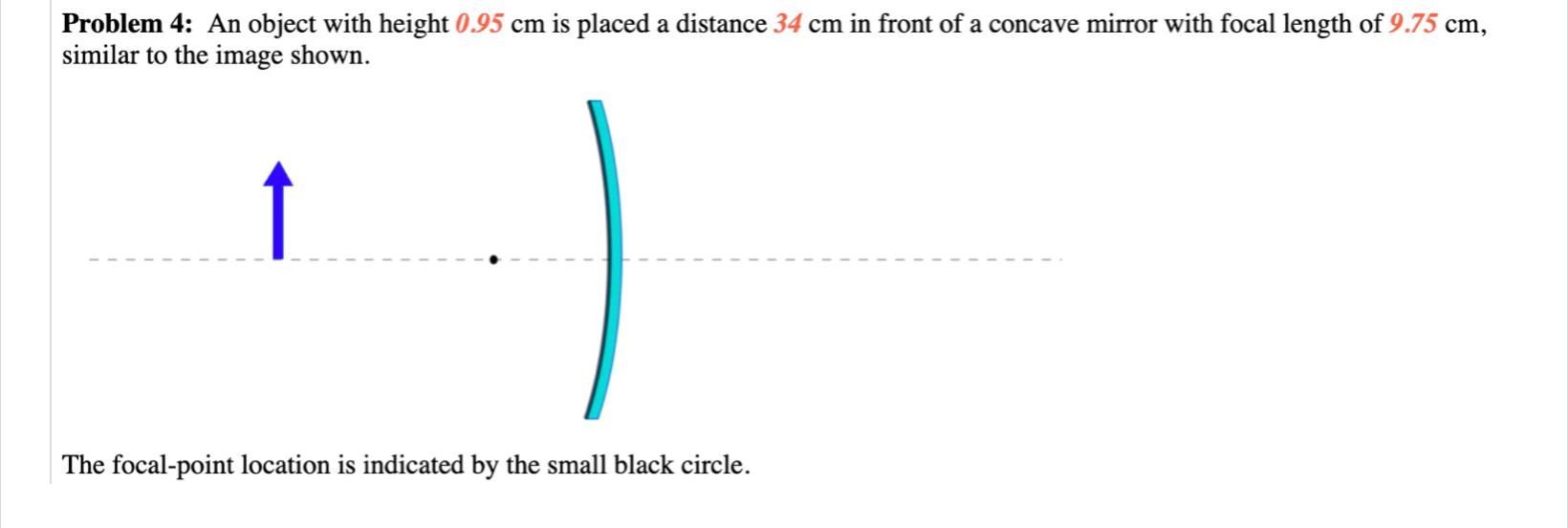 Part (a) Calculate and enter a value for the distance, in centimeters, between the image and the mirror given the values in problem statement. Numeric : A numeric value is expected and not an expression. di = __________________________________________ Part (b) Which statement best indicates the position of the image? MultipleChoice : 1) The object and image are on opposite sides of the mirror, and the image is farther from the mirror than the focal point. 2) The object and image are on the same side of the mirror, and image is farther from the mirror than the object. 3) The object and image are on the same side of the mirror, and the image is closer to the mirror than the focal point. 4) The object and image are on the same side of the mirror, and the image is between the object and the same-side focal point. 5) The object and image are on opposite sides of the mirror, and the image is closer to the mirror than the focal point. Part (c) Using the values given in the problem statement, calculate and enter a value, in centimeters, for the magnitude of the image height, |hi|. Numeric : A numeric value is expected and not an expression. |hi| = __________________________________________ Part (d) Which statement best describes the image that is formed? MultipleChoice : 1) The image is inverted and smaller than the object. 2) The image is upright and the same size as the object. 3) The image is inverted and the same size as the object. 4) The image is upright and smaller than the object. 5) The image is upright and larger than the object. 6) The image is inverted and larger than the object. Part (e) Which statement best describes the image that is formed? MultipleChoice : 1) The image is virtual because the reflected principal rays physically converge at a common point. 2) The image is real because the reflected principal rays physically converge at a common point. 3) The image is real because the reflected principal rays may be extrapolated to converge at a common point. 4) The image is virtual because the reflected principal rays may be extrapolated to converge at a common point.
Problem 4: An object with height 0.95 cm is placed a distance 34 cm in front of a concave mirror with focal length of 9.75 cm, similar to the image shown. The focal-point location is indicated by the small black circle
Step by Step Solution
There are 3 Steps involved in it

Get step-by-step solutions from verified subject matter experts