Question: PART A: CASE ANALYSIS. Please Questions 1 and 2 according to the text. (2x20 points) The Hong Kong-listed company, Xiaomi, published its annual report of
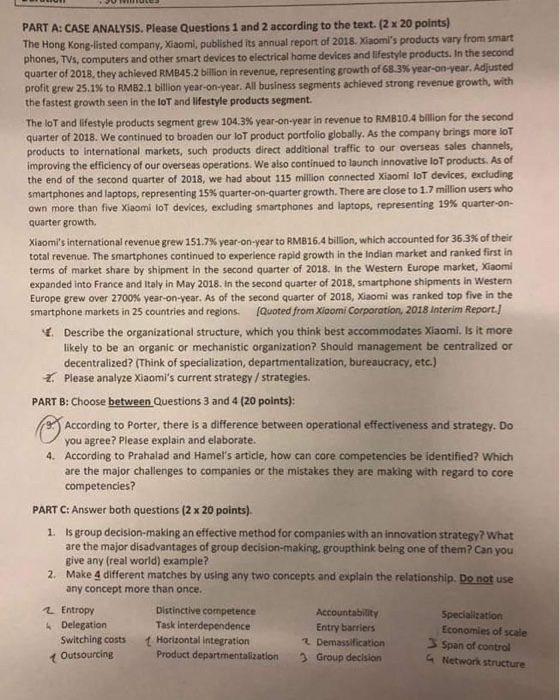
PART A: CASE ANALYSIS. Please Questions 1 and 2 according to the text. (2x20 points) The Hong Kong-listed company, Xiaomi, published its annual report of 2018. Xiaomi's products vary from smart phones, TVs, computers and other smart devices to electrical home devices and lifestyle products. In the second quarter of 2018, they achieved RMB45.2 billion in revenue, representing growth of 68.3% year-on-year. Adjusted profit grew 25.1% to RMB2.1 billion year-on-year. All business segments achieved strong revenue growth, with the fastest growth seen in the loT and lifestyle products segment. The loT and lifestyle products segment grew 104.3% year-on-vear in revenue to RMB10.4 billion for the second quarter of 2018. We continued to broaden our loT product portfolio globally. As the company brings more lot products to International markets, such products direct additional traffic to our overseas sales channels, Improving the efficiency of our overseas operations. We also continued to launch innovative IoT products. As of the end of the second quarter of 2018, we had about 115 million connected Xiaomi loT devices, excluding Smartphones and laptops, representing 15% quarter-on-quarter growth. There are close to 1.7 million users who own more than five Xiaomi IoT devices, excluding smartphones and laptops, representing 19% quarter-on- quarter growth. Xiaomi's international revenue grew 151.7% year-on-year to RMB16.4 billion, which accounted for 36.3% of their total revenue. The smartphones continued to experience rapid growth in the Indian market and ranked first in terms of market share by shipment in the second quarter of 2018. In the Western Europe market, Xiaomi expanded into France and Italy in May 2018. In the second quarter of 2018, smartphone shipments in Western Europe grew over 27003 year-on-year. As of the second quarter of 2018, Xiaomi was ranked top five in the smartphone markets in 25 countries and regions. (Quoted from Xiaomi Corporation, 2018 Interim Report. Describe the organizational structure, which you think best accommodates Xiaomi. Is it more likely to be an organic or mechanistic organization? Should management be centralized or decentralized? (Think of specialization, departmentalization, bureaucracy, etc.) Please analyze Xiaomi's current strategy / strategies. PART B: Choose between Questions 3 and 4 (20 points): According to Porter, there is a difference between operational effectiveness and strategy. Do you agree? Please explain and elaborate. 4. According to Prahalad and Hamel's article, how can core competencies be identified? Which are the major challenges to companies or the mistakes they are making with regard to core competencies? PART C: Answer both questions (2 x 20 points). 1. Is group decision-making an effective method for companies with an innovation strategy? What are the major disadvantages of group decision-making, groupthink being one of them? Can you give any (real world) example? 2. Make 4 different matches by using any two concepts and explain the relationship. Do not use any concept more than once. Entropy Distinctive competence Accountability Specialization Delegation Task interdependence Entry barriers Economies of scale Switching costs Horizontal integration Demassification Span of control Outsourcing Product departmentalization 3 Group decision 4 Network structure PART A: CASE ANALYSIS. Please Questions 1 and 2 according to the text. (2x20 points) The Hong Kong-listed company, Xiaomi, published its annual report of 2018. Xiaomi's products vary from smart phones, TVs, computers and other smart devices to electrical home devices and lifestyle products. In the second quarter of 2018, they achieved RMB45.2 billion in revenue, representing growth of 68.3% year-on-year. Adjusted profit grew 25.1% to RMB2.1 billion year-on-year. All business segments achieved strong revenue growth, with the fastest growth seen in the loT and lifestyle products segment. The loT and lifestyle products segment grew 104.3% year-on-vear in revenue to RMB10.4 billion for the second quarter of 2018. We continued to broaden our loT product portfolio globally. As the company brings more lot products to International markets, such products direct additional traffic to our overseas sales channels, Improving the efficiency of our overseas operations. We also continued to launch innovative IoT products. As of the end of the second quarter of 2018, we had about 115 million connected Xiaomi loT devices, excluding Smartphones and laptops, representing 15% quarter-on-quarter growth. There are close to 1.7 million users who own more than five Xiaomi IoT devices, excluding smartphones and laptops, representing 19% quarter-on- quarter growth. Xiaomi's international revenue grew 151.7% year-on-year to RMB16.4 billion, which accounted for 36.3% of their total revenue. The smartphones continued to experience rapid growth in the Indian market and ranked first in terms of market share by shipment in the second quarter of 2018. In the Western Europe market, Xiaomi expanded into France and Italy in May 2018. In the second quarter of 2018, smartphone shipments in Western Europe grew over 27003 year-on-year. As of the second quarter of 2018, Xiaomi was ranked top five in the smartphone markets in 25 countries and regions. (Quoted from Xiaomi Corporation, 2018 Interim Report. Describe the organizational structure, which you think best accommodates Xiaomi. Is it more likely to be an organic or mechanistic organization? Should management be centralized or decentralized? (Think of specialization, departmentalization, bureaucracy, etc.) Please analyze Xiaomi's current strategy / strategies. PART B: Choose between Questions 3 and 4 (20 points): According to Porter, there is a difference between operational effectiveness and strategy. Do you agree? Please explain and elaborate. 4. According to Prahalad and Hamel's article, how can core competencies be identified? Which are the major challenges to companies or the mistakes they are making with regard to core competencies? PART C: Answer both questions (2 x 20 points). 1. Is group decision-making an effective method for companies with an innovation strategy? What are the major disadvantages of group decision-making, groupthink being one of them? Can you give any (real world) example? 2. Make 4 different matches by using any two concepts and explain the relationship. Do not use any concept more than once. Entropy Distinctive competence Accountability Specialization Delegation Task interdependence Entry barriers Economies of scale Switching costs Horizontal integration Demassification Span of control Outsourcing Product departmentalization 3 Group decision 4 Network structure









 Study Help