







Question: Part A Consider the frame shown in ( Figure 1 ) . Assume the frame is pin connected at ( A ) and
Part A
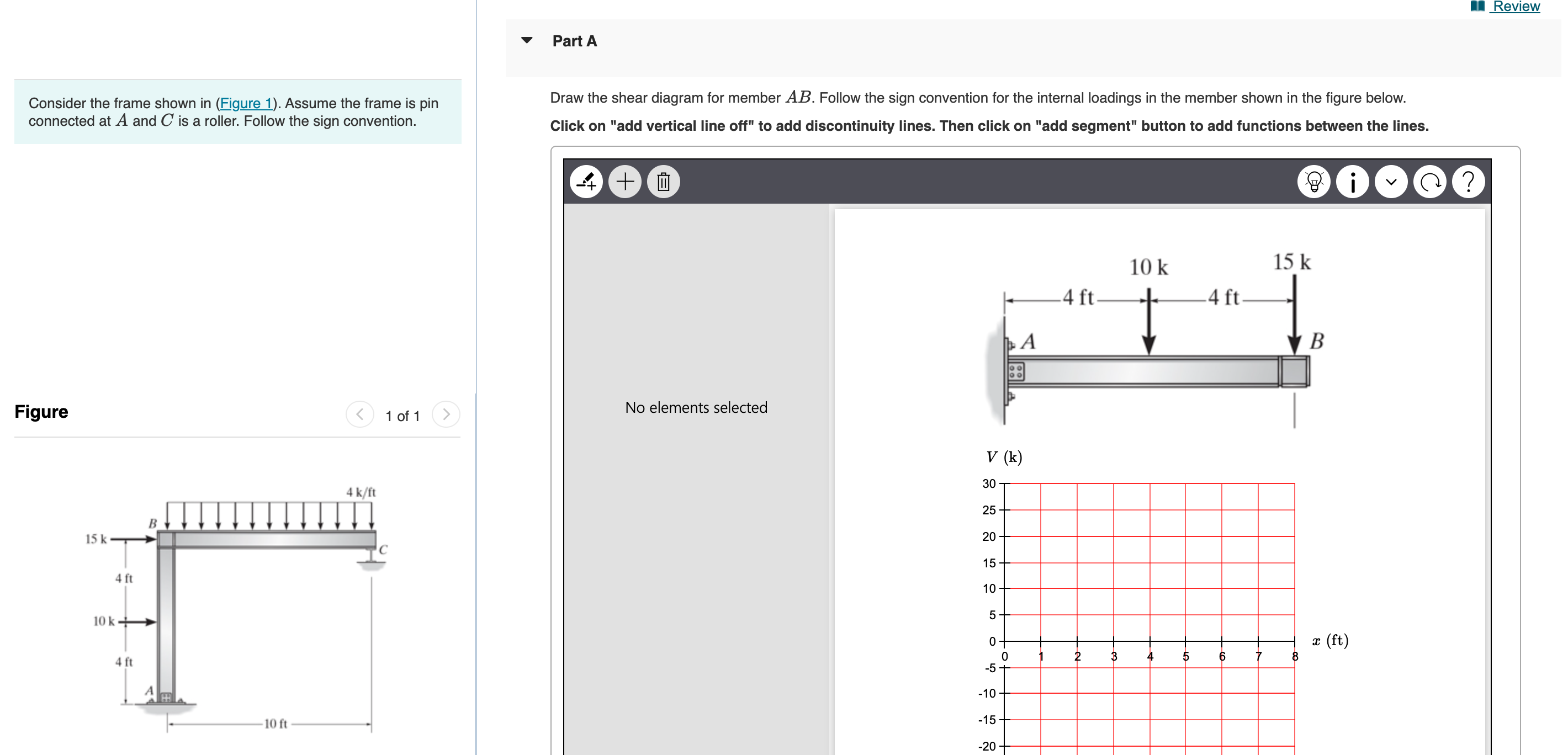
Consider the frame shown in Figure Assume the frame is pin connected at A and C is a roller. Follow the sign convention.
Figure
of
Draw the shear diagram for member A B Follow the sign convention for the internal loadings in the member shown in the figure below.
Click on "add vertical line off" to add discontinuity lines. Then click on "add segment" button to add functions between the lines.
No elements selected Part B
Consider the frame shown in Figure Assume the frame is pin connected at A and C is a roller. Follow the sign convention.
Draw the moment diagram for member A B Follow the sign convention for the internal loadings in the member shown in the figure below.
Click on "add vertical line off" to add discontinuity lines. Then click on "add segment" button to add functions between the lines.
No elements selected
Figure
Consider the frame shown in Figure Assume the frame is pin connected at A and C is a roller. Follow the sign convention.
Part C
Draw the shear diagram for member B C
Click on "add vertical line off" to add discontinuity lines. Then click on "add segment" button to add functions between the lines. Note You should not draw an "extra" vertical line at the point where the shear curve passes the xaxis. Part D
Consider the frame shown in Figure Assume the frame is pin connected at A and C is a roller. Follow the sign convention.
Figure
Step by Step Solution
There are 3 Steps involved in it
1 Expert Approved Answer
Step: 1 Unlock

Question Has Been Solved by an Expert!
Get step-by-step solutions from verified subject matter experts
Step: 2 Unlock
Step: 3 Unlock
 Study Help