







Question: Part A - Determining the forces in three specified members of the truss Learning Goal: If a truss is in equilibrium then every member in
Part A Determining the forces in three specified members of the truss
Learning Goal:
If a truss is in equilibrium then every member in the truss must also be in equilibrium. This principle is used in analyzing a truss using the method of sections. To apply the method of sections, we use an imaginary cut through members of the truss to expose the forces in those members as extemal forces.
Eigure
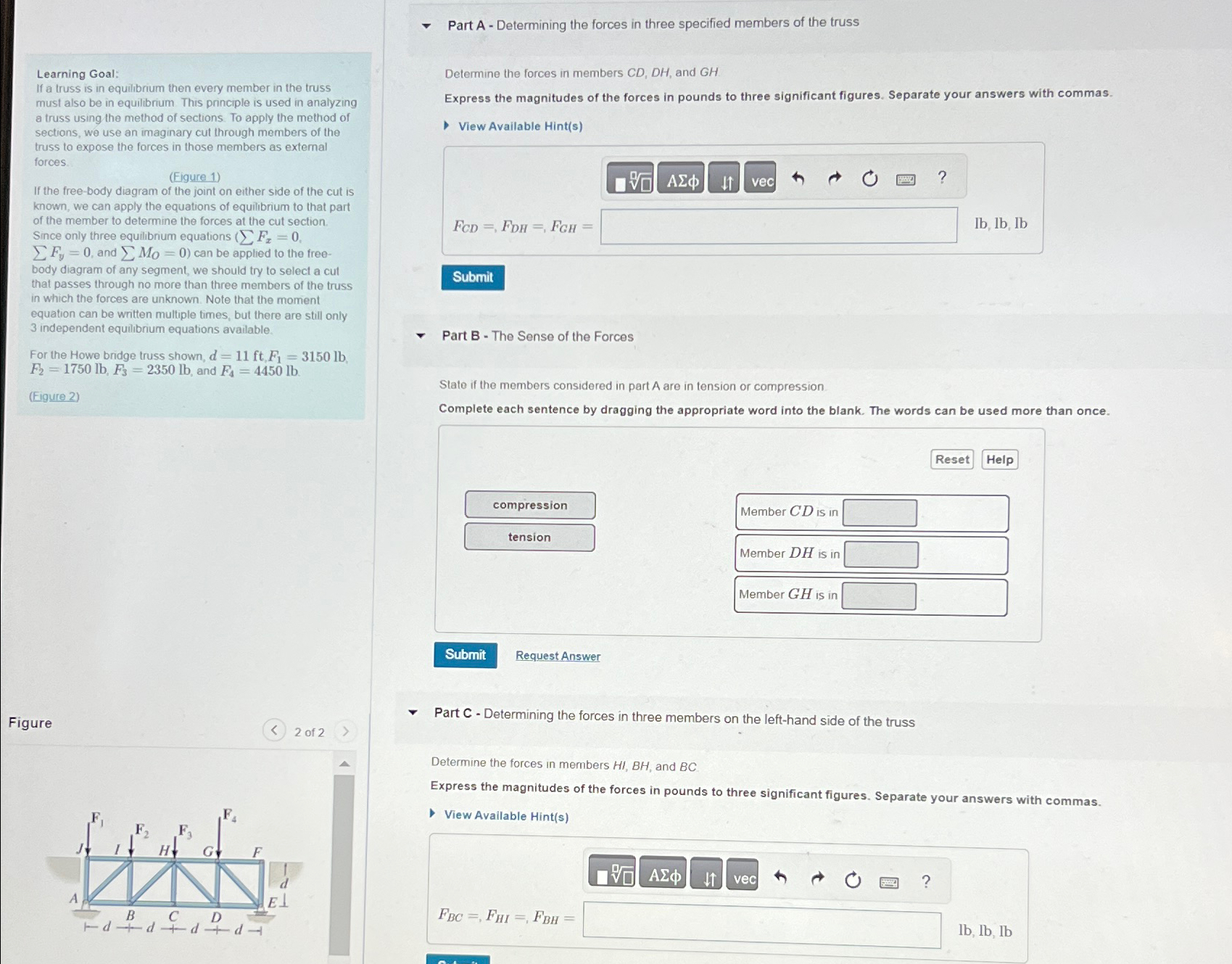
If the freebody diagram of the joint on either side of the cut is known, we can apply the equations of equilibrium to that part of the member to determine the forces at the cut section. Since only three equilibrium equations and can be applied to the freebody diagram of any segment, we should try to select a cut that passes through no more than three members of the truss in which the forces are unknown. Note that the moment equation can be written multiple times, but there are still only independent equilibrium equations available.
For the Howe bridge truss shown, and
Eigure
Figure
of
of
Express the magnitudes of the forces in pounds to three significant figures. Separate your answers with commas.
View Available Hints
Determine the forces in members and
Express the magnitudes of the forces in pounds to three significant figures. Separate your answers with commas.
View Available Hints
Part B The Sense of the Forces
State if the members considered in part A are in tension or compression
Complete each sentence by dragging the appropriate word into the blank. The words can be used more than once.
Member is in
Member is in
Member is in
Part Determining the forces in three members on the lefthand side of the truss
Determine the forces in members and
Step by Step Solution
There are 3 Steps involved in it
1 Expert Approved Answer
Step: 1 Unlock

Question Has Been Solved by an Expert!
Get step-by-step solutions from verified subject matter experts
Step: 2 Unlock
Step: 3 Unlock
 Study Help