







Question: Part A I get 12.4 rad/sec Part B please include the quadratic formula Part C please include all steps, I get confused with derivatives Part
Part A I get 12.4 rad/sec Part B please include the quadratic formula Part C please include all steps, I get confused with derivatives Part D I keep getting the wrong graph, it turns out to be a circle every time :(I appreciate the help, thank you !!!!
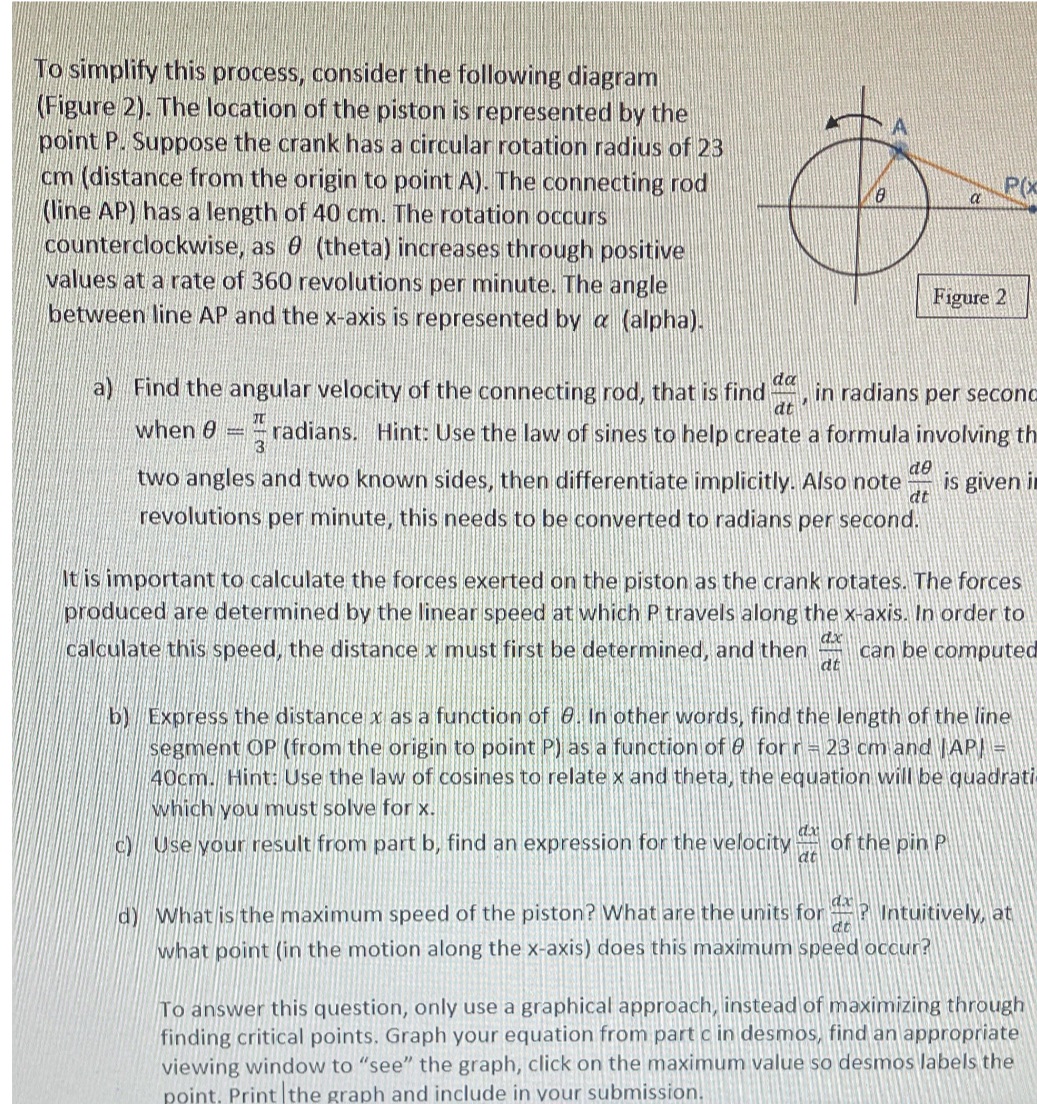
CoursHeroTranscribedText: To simplify this process, consider the following diagram (Figure 2). The location of the piston is represented by the point P. Suppose the crank has a circular rotation radius of 23 cm (distance from the origin to point A). The connecting rod a (line AP) has a length of 40 cm. The rotation occurs counterclockwise, as 8 (theta) increases through positive values at a rate of 360 revolutions per minute. The angle Figure 2 between line AP and the x-axis is represented by a (alpha). a) Find the angular velocity of the connecting rod, that is find -, in radians per second when 0 = = radians. Hint: Use the law of sines to help create a formula involving th two angles and two known sides, then differentiate implicitly. Also note " ar is given i revolutions per minute, this needs to be converted to radians per second. It is important to calculate the forces exerted on the piston as the crank rotates. The forces produced are determined by the linear speed at which P travels along the x-axis. In order to calculate this speed, the distance x must first be determined, and then - can be computer b) Express the distance x as a function of 8. In other words, find the length of the line segment OP (from the origin to point P) as a function of @ for r- Fr - 23 cm and |AP/ - 40cm. Hint: Use the law of cosines to relate x and theta, the equation will be quadrat which you must solve for x. .) Use your result from part b, find an expression for the velocity of the pin P d) What is the maximum speed of the piston? What are the units for ? 193? Intuitively, at what point (in the motion along the x-axis) does this maximum speed occur? To answer this question, only use a graphical approach, instead of maximizing through finding critical points. Graph your equation from part c in desmos, find an appropriate viewing window to "see" the graph, click on the maximum value so desmos labels the point. Print the graph and include in your submission
Step by Step Solution
There are 3 Steps involved in it

Get step-by-step solutions from verified subject matter experts
 Study Help