







Question: Part A - Knowledge and Understanding Multiple Choice Questions [16 marks] Use a pencil to circle the most appropriate answer for each question. 1. A
![Part A - Knowledge and Understanding Multiple Choice Questions [16 marks]](https://s3.amazonaws.com/si.experts.images/answers/2024/06/6676f7919b233_6576676f791738ac.jpg)
![1. A bus drives 60.0 km [E] from town A to town](https://s3.amazonaws.com/si.experts.images/answers/2024/06/6676f7929c7db_6586676f79277053.jpg)
![B, then another 20.0 km [S] to town C in a total](https://s3.amazonaws.com/si.experts.images/answers/2024/06/6676f79328f8c_6596676f7930255c.jpg)
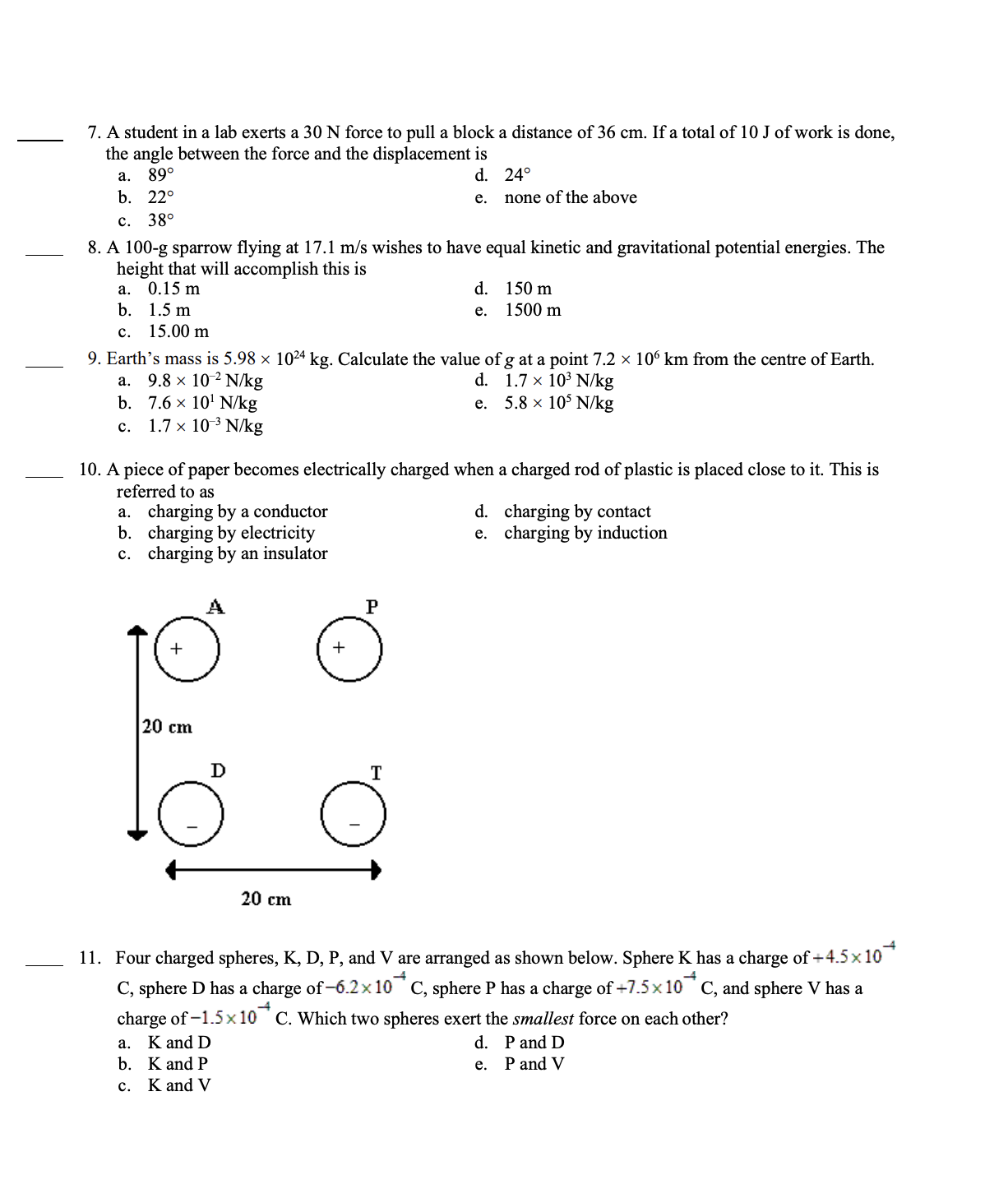
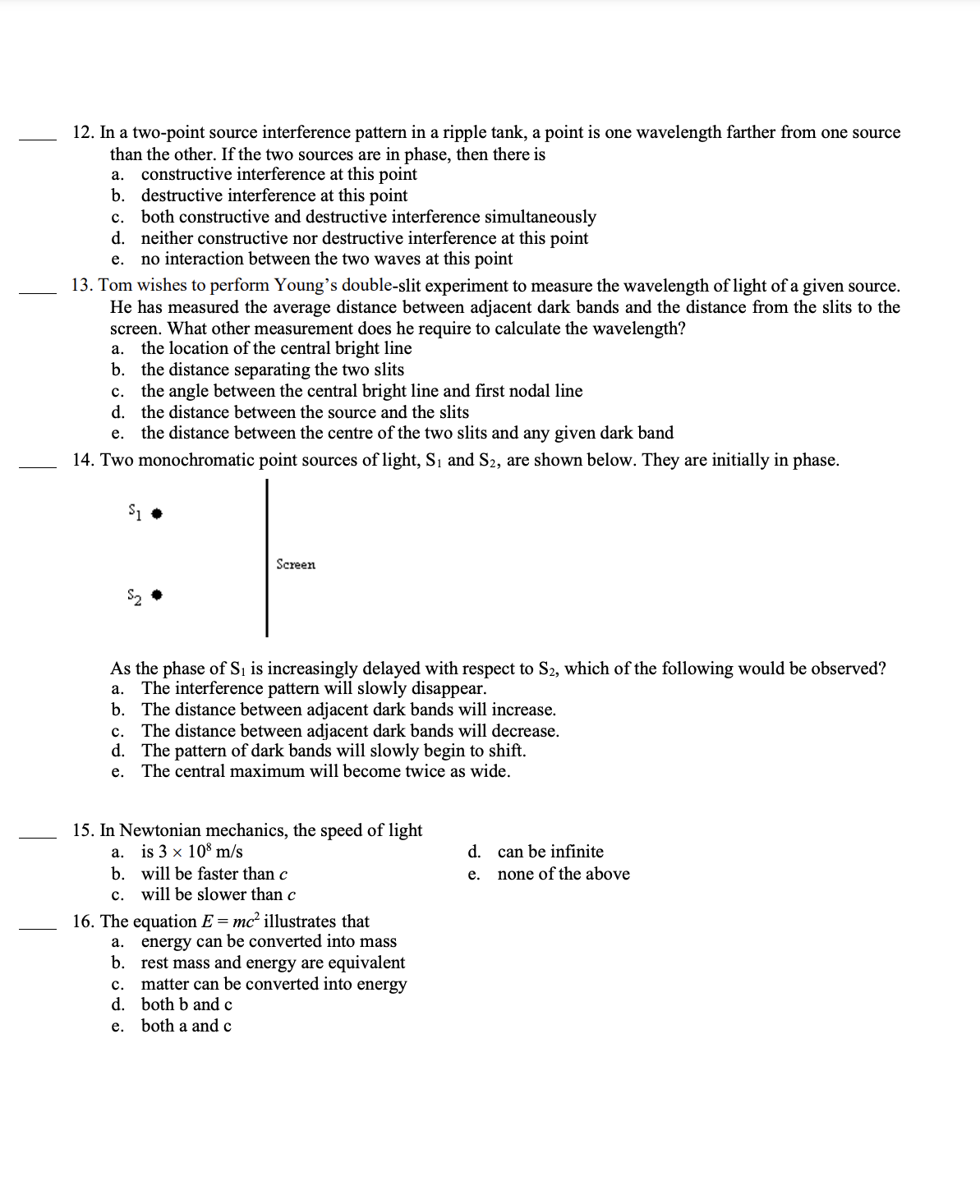
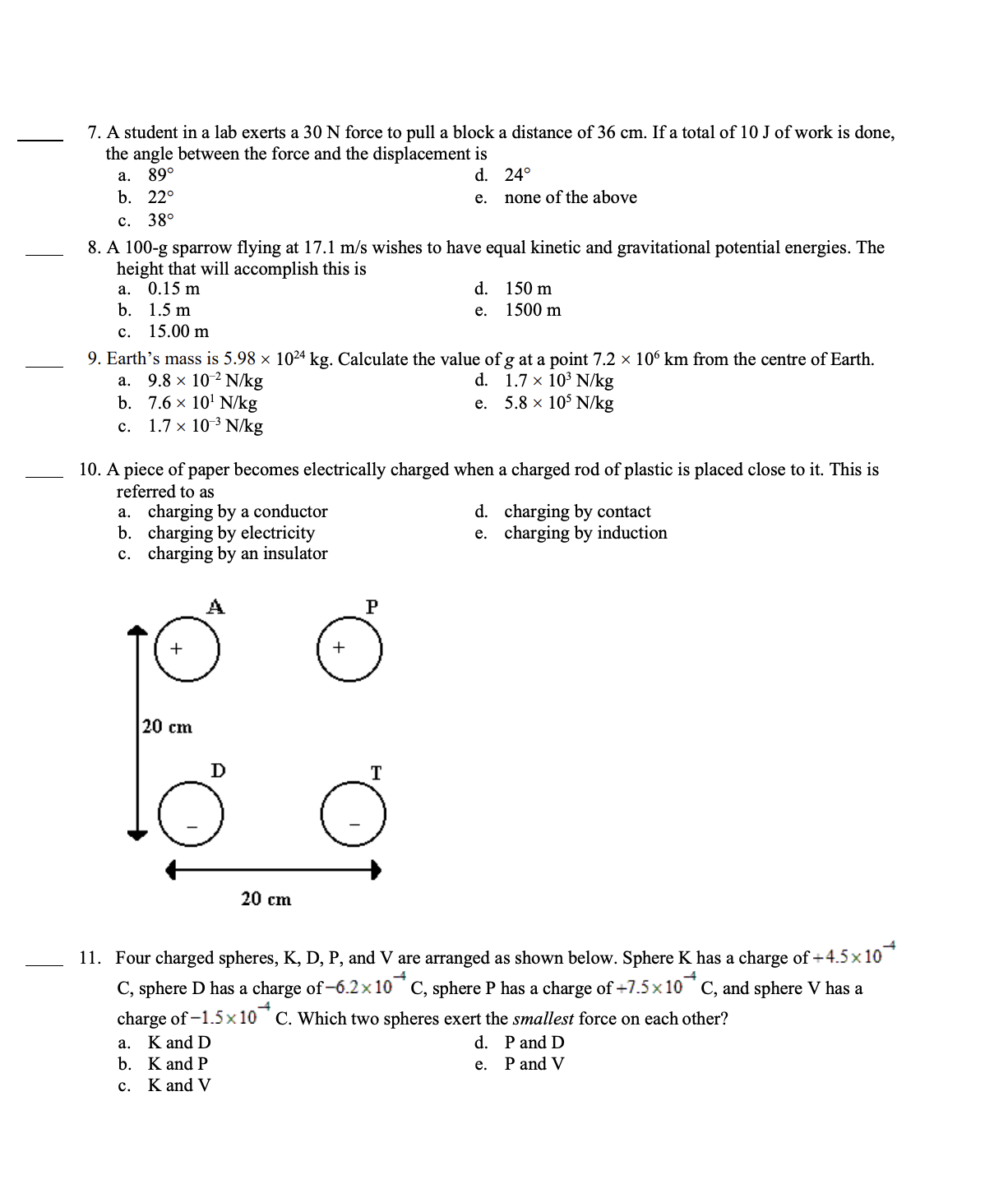
Part A - Knowledge and Understanding Multiple Choice Questions [16 marks] Use a pencil to circle the most appropriate answer for each question. 1. A bus drives 60.0 km [E] from town A to town B, then another 20.0 km [S] to town C in a total time of 2.00 hr. What are the values of its average speed and average velocity, respectively? a. 40.0 km/h, 32.0 kmfh [18" S of E] d. 30.0 km/h, 63.0 kin/h [18 S of E] b. 70.0 kmfh, 40.0 kmfh [18\" S of E] c. 40.0 kmfh [18" S ofE], 63.0 kmih c. 50.0 km/h, 50.0 kmfh [18" S of E] 2. The acceleration due to gravity on Earth a. is the same at all locations on the surface of Earth b. is the same at any two locations provided that the distance to the centre of Earth at those locations is the same c. is greater at the equator and less at the poles d. is greater for heavier objects e. varies slightly with latitude 3. A plane must y to a destination that is North-West of its departure point. Because of the wind, it heads West. What direction is the wind blowing in? a. South d. North-West b. East e. West c. South -West 4. The orbital radius of a satellite circling the Earth depends only on its mass and orbital speed depends only on its mass depends on its orbital speed is the same for all satellites is directly proportional to its orbital speed sheer! 5. The acceleration of an object travelling with \"uniform circular motion,\" is a. directed toward the centre of the circle b. directed tangent to the circle c. zero because the speed is constant d. changing in magnitude depending on its position in the circle e. directed outward from the centre of the circle 6. Astronauts on board an orbiting space station appear to be \"oating\" because a. they are in the vacuum of space b. they are outside Earth's gravitational inuence c. they are in free fall along with the space station itself d. they have become truly \"weightless\" e. they are pulled by the gravity of the moon 7. A student in a lab exerts a 30 N force to pull a block a distance of 36 cm. If a total of 10 J of work is done, the angle between the force and the displacement is a. d. 240 b. 220 e. none of the above c. 380 8. A 100-g sparrow flying at 17.1 m/s wishes to have equal kinetic and gravitational potential energies. The height that will accomplish this is a. 0.15 m d. 150 m . 1.5 m e . 1500 m . 15.00 m 9. Earth's mass is 5.98 x 1024 kg. Calculate the value of g at a point 7.2 x 10 km from the centre of Earth. a. 9.8 x 10 2 N/kg d. 1.7 x 10' N/kg b. 7.6 x 10' N/kg e. 5.8 x 10' N/kg c. 1.7 x 10 N/kg 10. A piece of paper becomes electrically charged when a charged rod of plastic is placed close to it. This is referred to as charging by a conductor d. charging by contact b. charging by electricity e. charging by induction c. charging by an insulator + 20 cm D 20 cm 11. Four charged spheres, K, D, P, and V are arranged as shown below. Sphere K has a charge of +4.5 x 10" C, sphere D has a charge of -6.2x10 C, sphere P has a charge of +7.5 x10 C, and sphere V has a charge of -1.5x10 C. Which two spheres exert the smallest force on each other? a. d. P and D . K and P e. P and V c. K and V12. In a two-point source interference pattern in a ripple tank, a point is one wavelength farther from one source than the other. If the two sources are in phase, then there is a. constructive interference at this point b. destructive interference at this point c. both constructive and destructive interference simultaneously d. neither constructive nor destructive interference at this point e. no interaction between the two waves at this point 13. Tom wishes to perform Young's double-slit experiment to measure the wavelength of light of a given source. He has measured the average distance between adjacent dark bands and the distance from the slits to the screen. What other measurement does he require to calculate the wavelength? the location of the central bright line a. b. the distance separating the two slits c. the angle between the central bright line and rst nodal line d. the distance between the source and the slits e. the distance between the centre of the two slits and any given dark band 14. Two monochromatic point sources of light, S] and 32, are shown below. They are initially in phase. 31 . Screen 52. As the phase of $1 is increasingly delayed with respect to 82, which of the following would be observed? The interference pattern will slowly disappear. The distance between adjacent dark bands will increase. The distance between adjacent dark bands will decrease. The pattern of dark bands will slowly begin to shift. The central maximum will become twice as wide. rush99'! 15. In Newtonian mechanics, the speed of light a. is 3 x 10⁸ mfs d. can be infinite b. will be faster than c e. none of the above c. will be slower than c 16. The equation E = mc2 illustrates that energy can be converted into mass rest mass and energy are equivalent matter can be converted into energy both b and c both a and c 951.057
Step by Step Solution
There are 3 Steps involved in it

Get step-by-step solutions from verified subject matter experts
 Study Help