







Question: Part A Light emitted by element X passes through a diffraction grating that has 1200 slits/mm. The interference pattern is observed on a screen 76.0
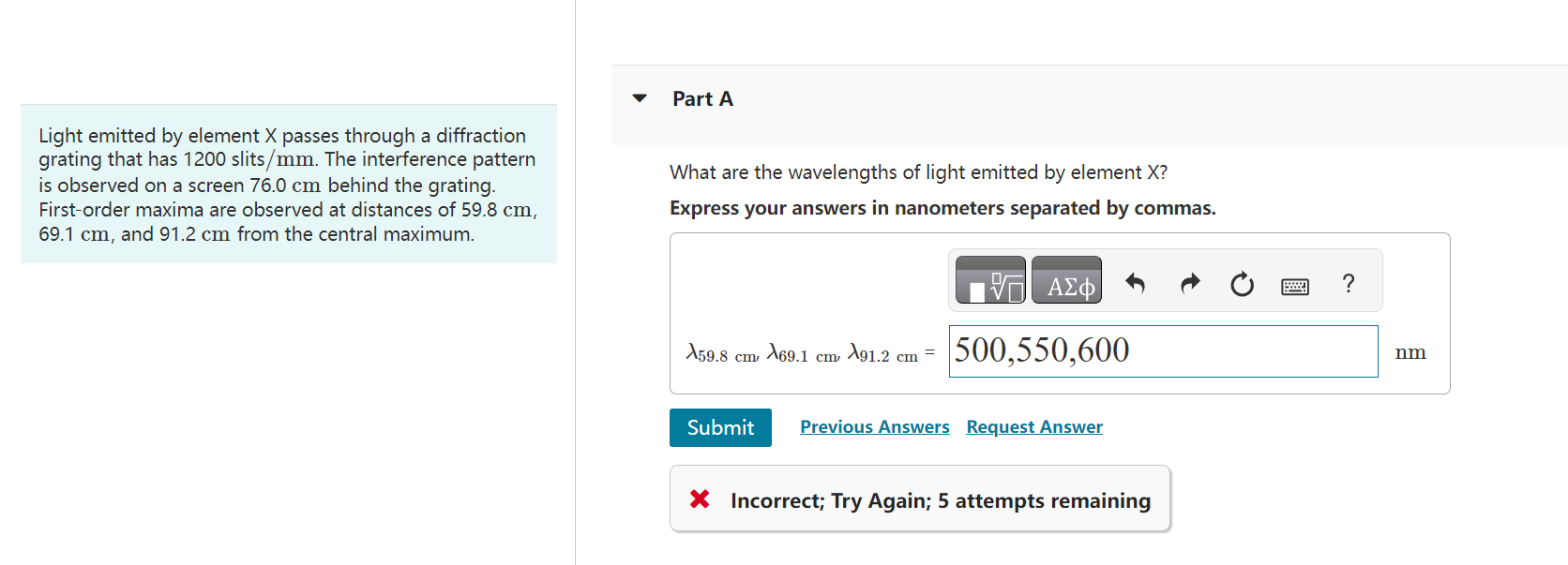
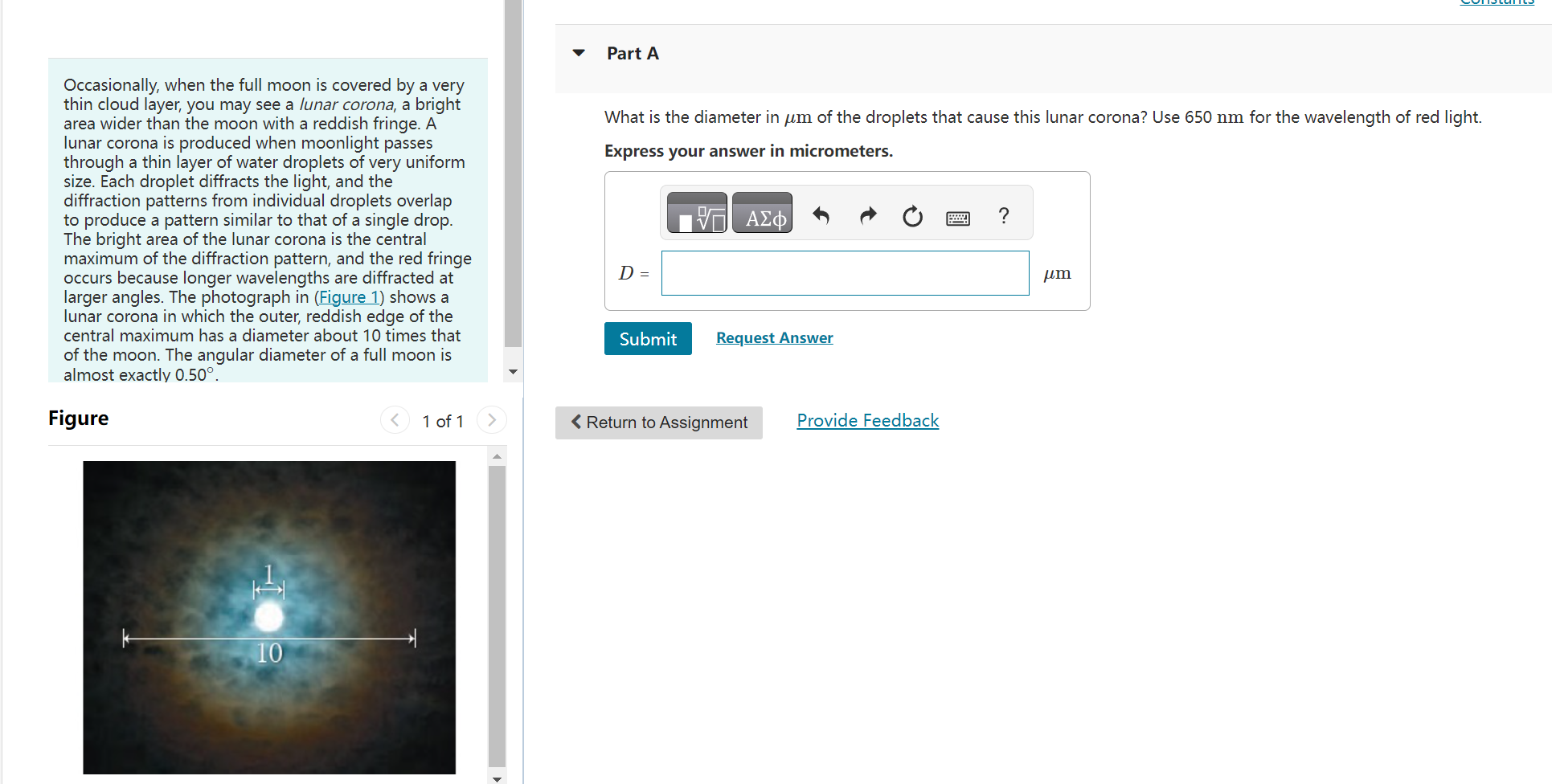
Part A Light emitted by element X passes through a diffraction grating that has 1200 slits/mm. The interference pattern is observed on a screen 76.0 cm behind the grating. What are the wavelengths of light emitted by element X? First-order maxima are observed at distances of 59.8 cm, Express your answers in nanometers separated by commas. 69.1 cm, and 91.2 cm from the central maximum. V ? 159.8 cm, X69.1 cm 191.2 cm = 500,550,600 nm Submit Previous Answers Request Answer X Incorrect; Try Again; 5 attempts remainingV Part A Occasionally, when the full moon is covered by a very thin cloud layer, you may see a lunar corona, a bright area wider than the moon with a reddish fringe. A What is the diameter in um of the droplets that cause this lunar corona? Use 650 nm for the wavelength of red light. lunar corona is produced when moonlight passes through a thin layer of water droplets of very uniform Express your answer in micrometers. size. Each droplet diffracts the light, and the diffraction patterns from individual droplets overlap to produce a pattern similar to that of a single drop. Vn AEd ? The bright area of the lunar corona is the central maximum of the diffraction pattern, and the red fringe occurs because longer wavelengths are diffracted at D = um larger angles. The photograph in (Figure 1) shows a lunar corona in which the outer, reddish edge of the central maximum has a diameter about 10 times that Submit Request Answer of the moon. The angular diameter of a full moon is almost exactly 0.50. Figure
Step by Step Solution
There are 3 Steps involved in it

Get step-by-step solutions from verified subject matter experts
 Study Help