







Question: PART A: Multiple Choice/True False: [#1-4 are 3 marks, #5 is 8 marks] 1. Circle all the incorrect equations. A. If ( x )
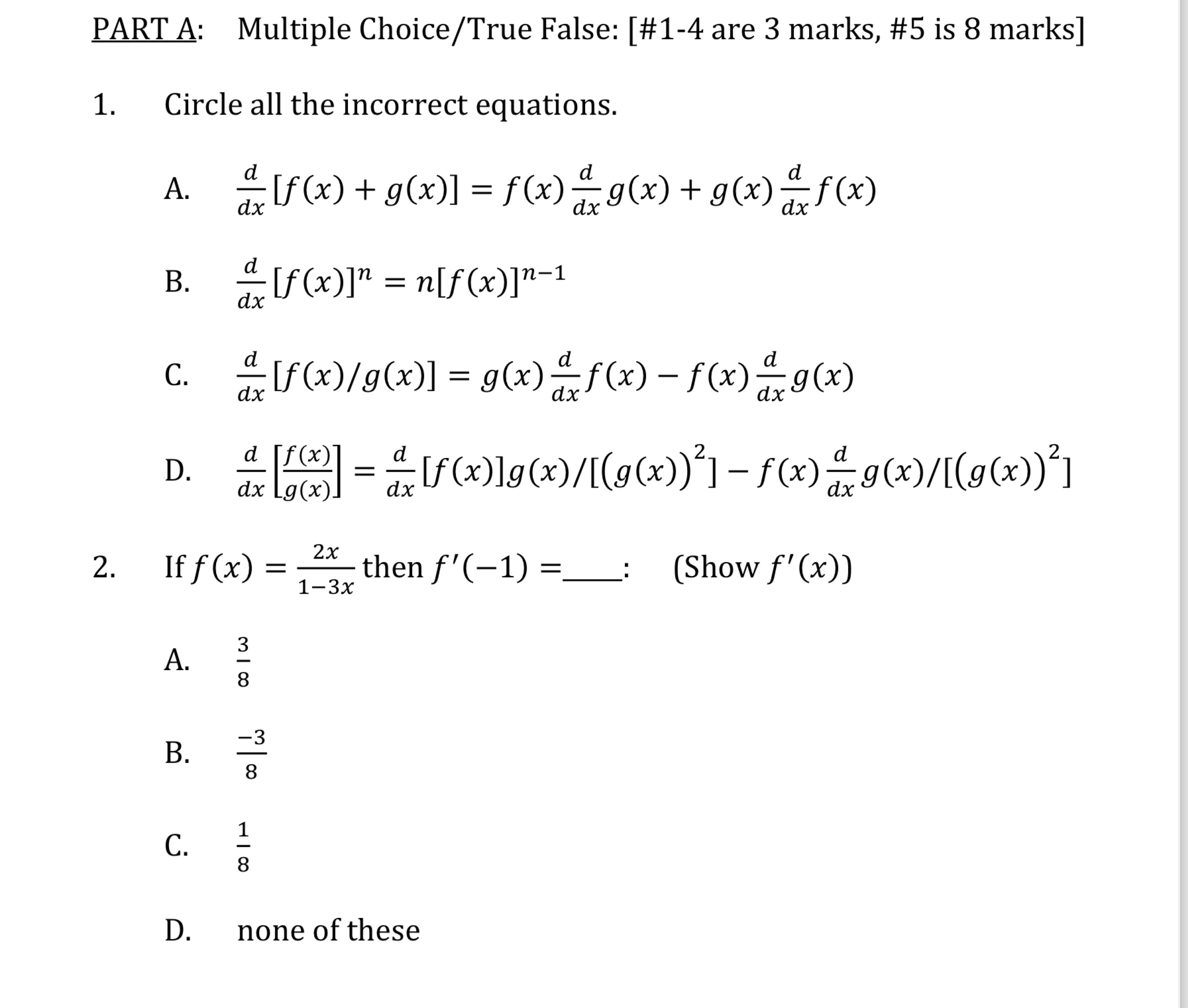
![8 marks] 1. Circle all the incorrect equations. A. " If (](https://dsd5zvtm8ll6.cloudfront.net/si.experts.images/questions/2024/10/6703efe594385_2696703efe56c149.jpg)
![x ) + g(x)] = f(x) -g(x) + g(x)-f(x) B. - If](https://dsd5zvtm8ll6.cloudfront.net/si.experts.images/questions/2024/10/6703efe6247a7_2696703efe5c6f44.jpg)
![(x) ]" = nIf (x ) ]n - 1 C. dx If](https://dsd5zvtm8ll6.cloudfront.net/si.experts.images/questions/2024/10/6703efe693587_2706703efe66e717.jpg)
![( x ) / g ( x) ] = g(x ) -](https://dsd5zvtm8ll6.cloudfront.net/si.experts.images/questions/2024/10/6703efe71f7ff_2706703efe6e3db3.jpg)
![f (x ) - f (x) -9(x) D. d [f ( )]](https://dsd5zvtm8ll6.cloudfront.net/si.experts.images/questions/2024/10/6703efe77a2e4_2716703efe75bead.jpg)
![dx Lg(x) = If (x)Ig(x) /I(g(x) ) ] - f(x) a g(x)/I(g(x))](https://dsd5zvtm8ll6.cloudfront.net/si.experts.images/questions/2024/10/6703efe7e0dd1_2716703efe7a9792.jpg)
PART A: Multiple Choice/True False: [#1-4 are 3 marks, #5 is 8 marks] 1. Circle all the incorrect equations. A. " If ( x ) + g(x)] = f(x) -g(x) + g(x)-f(x) B. - If (x) ]" = nIf (x ) ]n - 1 C. dx If ( x ) / g ( x) ] = g(x ) - f (x ) - f (x) -9(x) D. d [f ( )] dx Lg(x) = If (x)Ig(x) /I(g(x) ) ] - f(x) a g(x)/I(g(x)) 1 2. If f (x) = 2x - then f'(-1) =: (Show f' (x)) 1-3x A. B. -3 C. D. none of these3. b) An object moves back and forth along a horizontal line. Its position, velocity, and acceleration graphs are shown. The curves intersect the taxisatt=0, 1, 2, 3, and 4 seconds. 3 > 1 2 Graphs @, @ and represent the - and___ functions, respectively. Explain. velocity, position, acceleration velocity, acceleration, position position, velocity, acceleration acceleration, velocity, position = Draw vertical lines on the graph showing when the object is moving to the right. State the interval(s) when the object is speeding up. See 7d) 4. Consider the curve with equation y = -x3 - $x2 + 2x Circle all the points on the curve where a tangent is horizontal. Please show your work. A. 3' 27) B. (-1,=3 C. 2, -53 27 D. (1, 7 ) True or False: For full marks on this question, only if the answer is false, give a counter example or explain correct reasoning at the bottom of this page. a) The function and its derivative always have the same domains. b) To find the derivative of h(x) = (x) g(x) you must use the Quotient Rule. c) If f and g are continuous then ~ f(g(x)) = f'(g(x))g'(x) d) If lim f (x) exists, then f (x) must have a horizontal asymptote. x - - 00 e) It is possible that functions f and g are not continuous at x = a but the function f + g is continuous at x = a () Ixl = x if x 2 0 and |x| = -xifx
Step by Step Solution
There are 3 Steps involved in it

Get step-by-step solutions from verified subject matter experts
 Study Help