Question: Part A: Observing Relations * As you go through your day, observe naturally occurring day-to-day conversation at home or at work (or at the playground
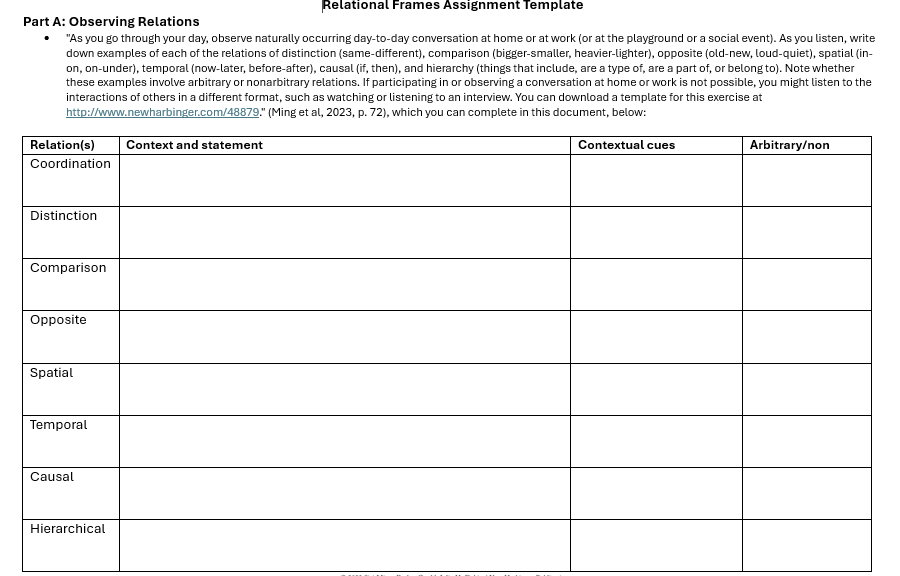
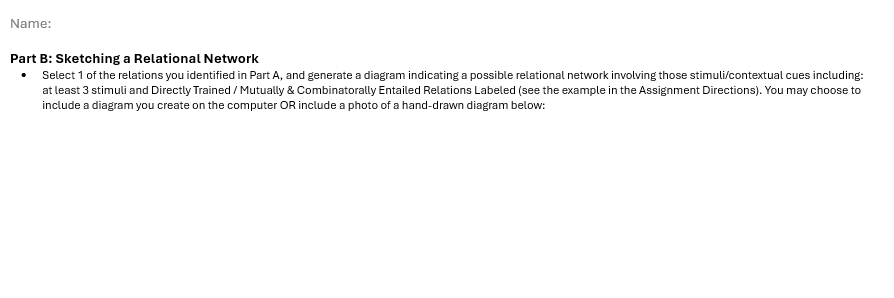
Part A: Observing Relations * "As you go through your day, observe naturally occurring day-to-day conversation at home or at work (or at the playground or a social event). As you listen, write down examples of each of the relations of distinction (same-different), comparison (bigger-smaller, heavier-lighter), opposite (old-new, loud-quiet), spatial (in- on, on-under), temporal (now-later, before-after), causal (if, then), and hierarchy (things that include, are a type of, are a part of, or belong ta). Note whether these examples involve arbitrary or nonarbitrary relations. If participating in or observing a conversation at hame or work is not possible, you might listen to the interactions of others in a different format, such as watching or listening to an interview. You can download a template for this exercise at https //wwrw.new harbinger.com/48579." (Ming et al, 2023, p. 72), which you can complete in this document, below: Relational Frames Assignment Template Relation(s) Coordination Distinction Context and statement Contextual cues Arbitraryon Comparison Opposite Spatial Temporal Causal Hierarchical Name: Part B: Sketching a Relational Network * Select 1 of the relations you identified in Part 4, and generate a diagram indicating a possible relational network involving those stimuli/contextual cues including: at least 3 stimuli and Directly Trained / Mutually & Combinatorally Entailed Relations Labeled (see the example in the Assignment Directions). You may choose to include a diagram you create on the computer OR include a phote of a hand-drawn diagram below
Step by Step Solution
There are 3 Steps involved in it
1 Expert Approved Answer
Step: 1 Unlock
Question Has Been Solved by an Expert!
Get step-by-step solutions from verified subject matter experts
Step: 2 Unlock
Step: 3 Unlock
Students Have Also Explored These Related Accounting Questions!









 Study Help