







Question: Part A: RAPTOR Exercise a) b) Your flowchart continues asking for a number until the user decides to stop and A sample interaction is shown
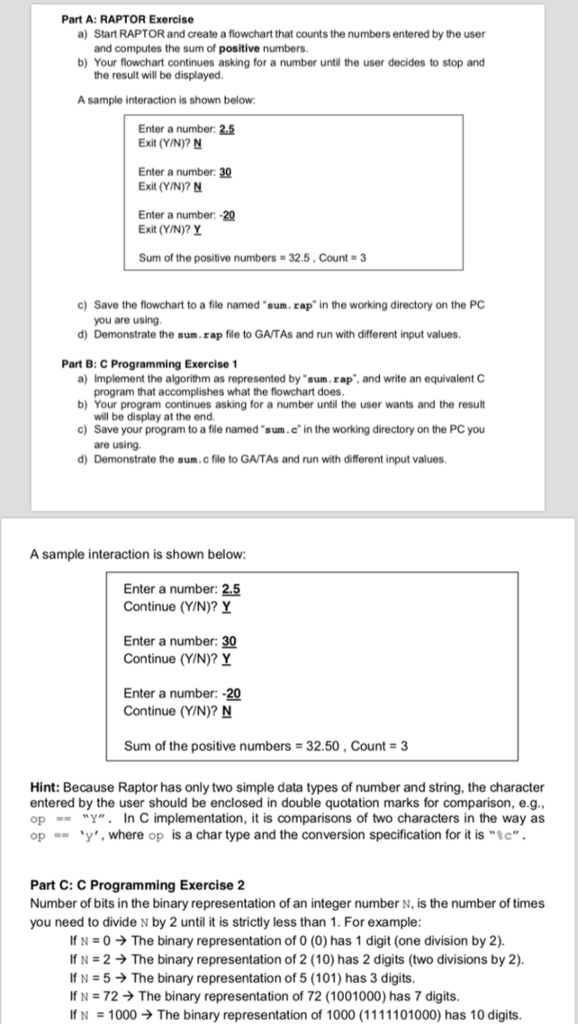
Part A: RAPTOR Exercise a) b) Your flowchart continues asking for a number until the user decides to stop and A sample interaction is shown below Start RAPTOR and create a flowchart that counts the numbers entered by the user and computes the sum of positive numbers the result will be displayed. Enter a number: 2.5 Exit (Y/N)? N Enter a number: 30 Exit (YIN)?N Enter a number: -20 Exit (Y/N)? Y Sum of the positive numbers- 32.5,Count-3 c) Save the flowchart to a file named "sum. rap" in the working directory on the PC you are using. d) Demonstrate the sum.rap file to GA/TAs and run with different input values Part B: C Programming Exercise 1 a) Implement the algorithm as represented by "sum.rap, and write an equivalent C b) Your program continues asking for a number until the user wants and the resut c) Save your program to a file named "sum.c" in the working directory on the PC you d) Demonstrate the sum.c file to GA/TAs and run with different input values. program that accomplishes what the flowchart does will be display at the end are using. A sample interaction is shown below Enter a number: 2.5 Continue (YIN)? Y Enter a number: 30 Continue (YIN)? Y Enter a number: -20 Continue (Y/N)? N Sum of the positive numbers-32.50,Count 3 Hint: Because Raptor has only two simple data types of number and string, the character entered by the user should be enclosed in double quotation marks for comparison, e.g opY". In C implementation, it is comparisons of two characters in the way as op'y",where op is a char type and the conversion specification for it is "c" Part C: C Programming Exercise 2 Number of bits in the binary representation of an integer number N, is the number of times you need to divide N by 2 until it is strictly less than 1. For example f N-0 The binary representation of 0 (0) has 1 digit (one division by 2). If N-2-> The binary representation of 2 (10) has 2 digits (two divisions by 2) If N 5 The binary representation of 5 (101) has 3 digits. f N-72> The binary representation of 72 (1001000) has 7 digits
Step by Step Solution
There are 3 Steps involved in it

Get step-by-step solutions from verified subject matter experts
 Study Help