



Question: PART A: Standardization of the sodium hydroxide solution - Concentration of Standard H2SO4 solution: 0.04913 M - Titration of 25.00 ml of standard H2SO4 solution
PART A: Standardization of the sodium hydroxide solution
- Concentration of Standard H2SO4 solution: 0.04913 M
- Titration of 25.00 ml of standard H2SO4 solution with ~0.1 NaOH solution
| Trial 1 | Trial 2 | |
| Final Volume of NaOH (ml) | 26.95 | 49.81 |
| Initial Volume of NaOH (ml) | 0.77 | 26.95 |
| Volume of NaOH added (ml) | 26.18 | 22.86 |
PART B: Analysis of Unknown Carbonate
- Tared mass of impure carbonate: 1.566 g
- Titration of 25.00 ml of impure carbonate solution with ~0.1 NaOH solution
| Trial 1 | Trial 2 | |
| Final Volume of NaOH (ml) | 29.15 | - |
| Initial Volume of NaOH (ml) | 0.54 | - |
| Volume of NaOH added (ml) | 28.61 | 28.71 |
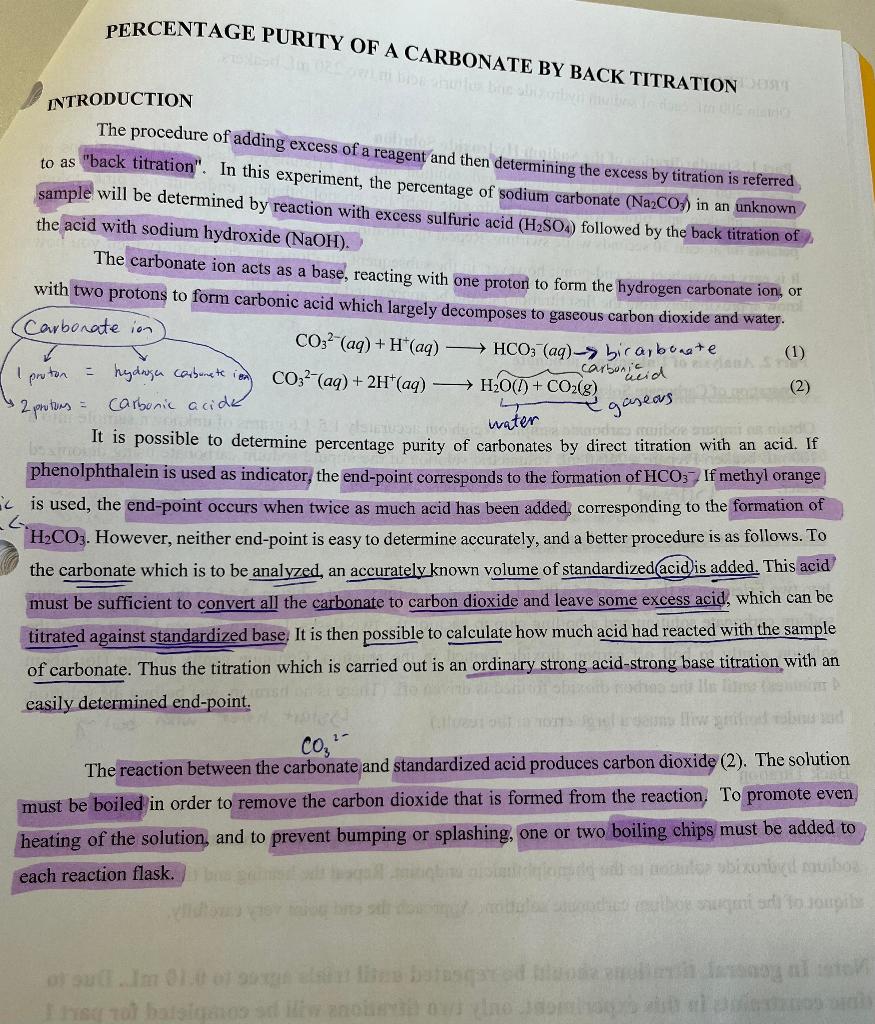
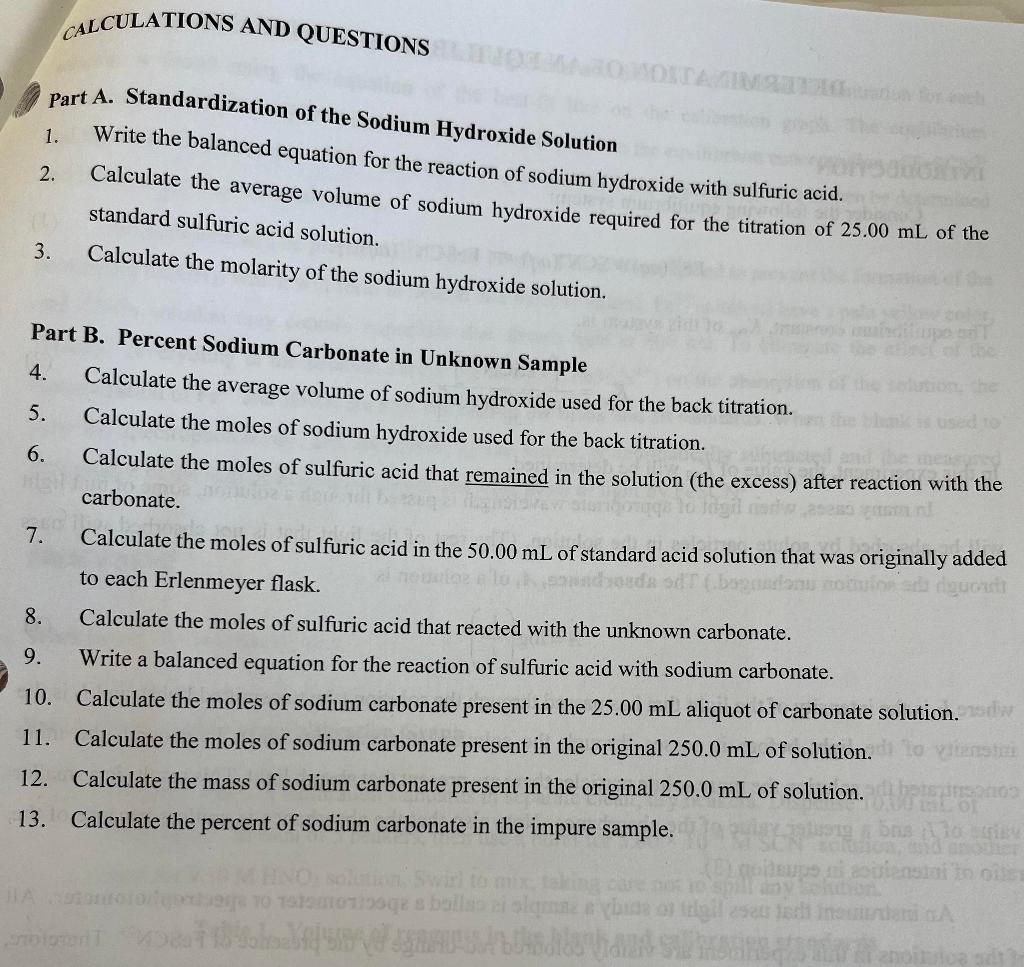
PERCENTAGE PURITY OF A CARBONATE BY BACK TITRATION INTRODUCTION The procedure of adding excess of a reagent and then determining the excess by titration is referred to as "back titration". In this experiment, the percentage of sodium carbonate (Na2CO3) in an unknown sample will be determined by reaction with excess sulfuric acid (H2SO4) followed by the back titration of the acid with sodium hydroxide (NaOH). The carbonate ion acts as a base, reacting with one proton to form the hydrogen carbonate ion, or with two protons to form carbonic acid which largely decomposes to gaseous carbon dioxide and water. phenolphthalein is used as indicator, the end-point corresponds to the formation of HCO3 If methyl orange is used, the end-point occurs when twice as much acid has been added, corresponding to the formation of H2CO3. However, neither end-point is easy to determine accurately, and a better procedure is as follows. To the carbonate which is to be analyzed, an accurately known volume of standardized@acid is added. This acid must be sufficient to convert all the carbonate to carbon dioxide and leave some excess acid, which can be titrated against standardized base, It is then possible to calculate how much acid had reacted with the sample of carbonate. Thus the titration which is carried out is an ordinary strong acid-strong base titration with an easily determined end-point. CO32 The reaction between the carbonate and standardized acid produces carbon dioxide (2). The solution must be boiled in order to remove the carbon dioxide that is formed from the reaction, T, heating of the solution, and to prevent bumping or splashing, one or two boiling chips must be added t Part A. Standardization of the Sodium Hydroxide Solution 1. Write the balanced equation for the reaction of sodium hydroxide with sulfuric acid. 2. Calculate the average volume of sodium hydroxide required for the titration of 25.00mL of the standard sulfuric acid solution. 3. Calculate the molarity of the sodium hydroxide solution. Part B. Percent Sodium Carbonate in Unknown Sample 4. Calculate the average volume of sodium hydroxide used for the back titration. 5. Calculate the moles of sodium hydroxide used for the back titration. 6. Calculate the moles of sulfuric acid that remained in the solution (the excess) after reaction with the carbonate. 7. Calculate the moles of sulfuric acid in the 50.00mL of standard acid solution that was originally added to each Erlenmeyer flask. 8. Calculate the moles of sulfuric acid that reacted with the unknown carbonate. 9. Write a balanced equation for the reaction of sulfuric acid with sodium carbonate. 10. Calculate the moles of sodium carbonate present in the 25.00mL aliquot of carbonate solution. 11. Calculate the moles of sodium carbonate present in the original 250.0mL of solution. 12. Calculate the mass of sodium carbonate present in the original 250.0mL of solution. 13. Calculate the percent of sodium carbonate in the impure sample
Step by Step Solution
There are 3 Steps involved in it

Get step-by-step solutions from verified subject matter experts