







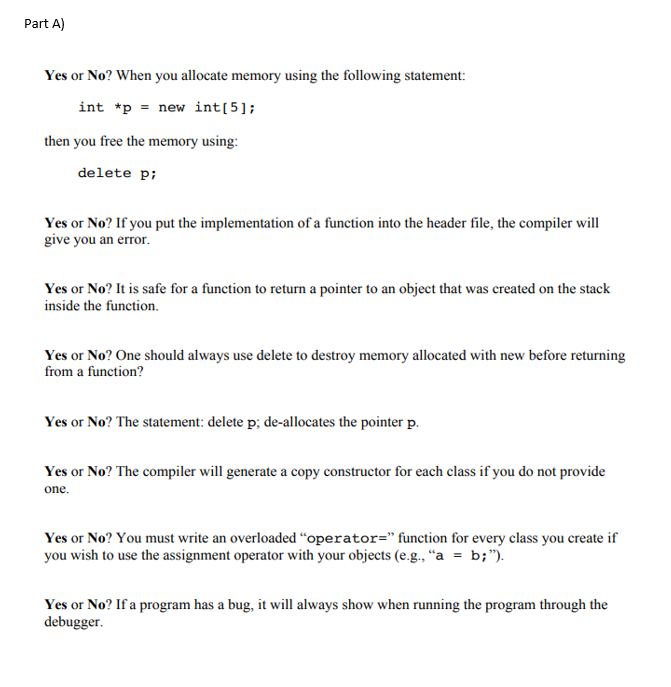
Question: Part A) Yes or No? When you allocate memory using the following statement: int *pnew int[5]; then you free the memory using: delete p: Yes
![following statement: int *pnew int[5]; then you free the memory using: delete](https://dsd5zvtm8ll6.cloudfront.net/si.experts.images/questions/2024/09/66f3a14acd207_57066f3a14a55da3.jpg)
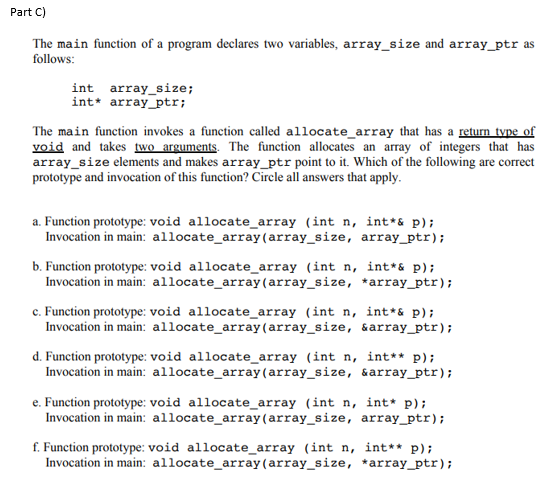
Part A) Yes or No? When you allocate memory using the following statement: int *pnew int[5]; then you free the memory using: delete p: Yes or No? If you put the implementation of a function into the header file, the compiler will give you an error. Yes or No? It is safe for a function to return a pointer to an object that was created on the stack inside the function. Yes or No? One should always use delete to destroy memory allocated with new before returning from a function? Yes or No? The statement: delete p; de-allocates the pointer p. Yes or No? The compiler will generate a copy constructor for each class if you do not provide one. Yes or No? You must write an overloaded "operator=" function for every class you create if you wish to use the assignment operator with your objects (e.g., "a b;"). Yes or No? If a program has a bug, it will always show when running the program through the debugger
Step by Step Solution
There are 3 Steps involved in it

Get step-by-step solutions from verified subject matter experts
 Study Help