







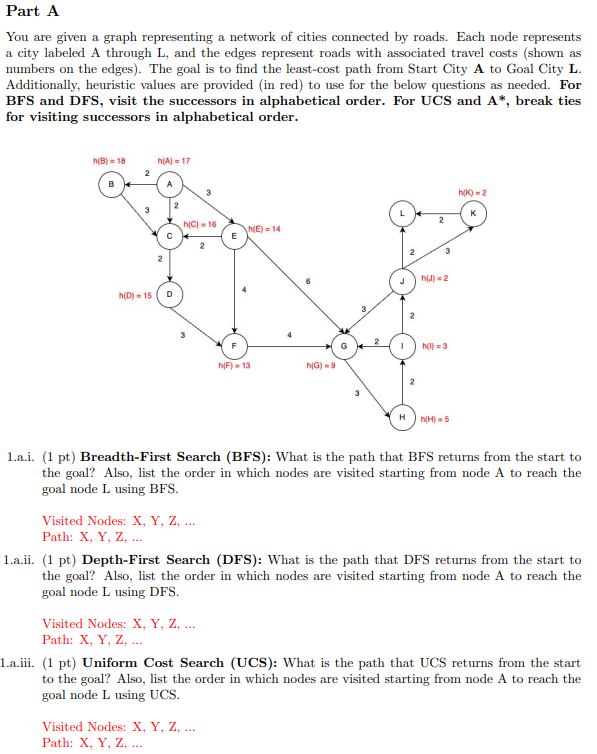
Question: Part A You are given a graph representing a network of cities connected by roads. Each node represents a city labeled A through L ,
Part A
You are given a graph representing a network of cities connected by roads. Each node represents a city labeled A through L and the edges represent roads with associated travel costs shown as numbers on the edges The goal is to find the leastcost path from Start City A to Goal City mathbfL Additionally, heuristic values are provided in red to use for the below questions as needed. For BFS and DFS visit the successors in alphabetical order. For UCS and A break ties for visiting successors in alphabetical order.
ai pt BreadthFirst Search BFS: What is the path that BFS returns from the start to the goal? Also, list the order in which nodes are visited starting from node A to reach the goal node L using BFS
Visited Nodes: X Y Z
Path: X Y Z
aii pt DepthFirst Search DFS: What is the path that DFS returns from the start to the goal? Also, list the order in which nodes are visited starting from node A to reach the goal node L using DFS
Visited Nodes: X Y Z
Path: X Y Z
aiii. pt Uniform Cost Search UCS: What is the path that UCS returns from the start to the goal? Also, list the order in which nodes are visited starting from node A to reach the goal node L using UCS.
Visited Nodes: X Y Z
Path: X Y Z
Step by Step Solution
There are 3 Steps involved in it
1 Expert Approved Answer
Step: 1 Unlock

Question Has Been Solved by an Expert!
Get step-by-step solutions from verified subject matter experts
Step: 2 Unlock
Step: 3 Unlock
 Study Help