







Question: part a,b and c please Part 4. Simultaneous Equilibria Systems - Wil complete on Mon, Fob 6 and Tues, Feb 7. In nature, equilibrium reactions
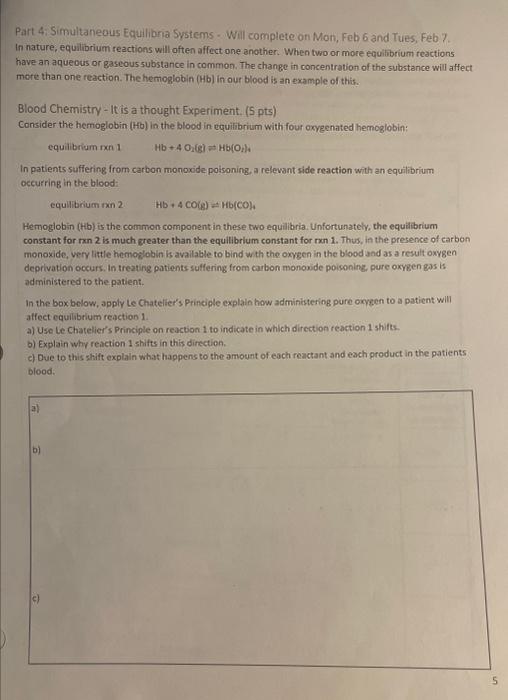
Part 4. Simultaneous Equilibria Systems - Wil complete on Mon, Fob 6 and Tues, Feb 7. In nature, equilibrium reactions will often affect one another. When two or more equilibrium reactions have an aqueous or gaseous substance in commen. The change in concentration of the substance will affect more than one reaction. The hemoglobin (Hbl in our blood is an example of this. Blood Chemistry - It is a thought Experiment. ( 5 pts) Consider the hemoglobin (Hb) in the blood in equilibrium with four axyeenated hemoglobin: equilibriam xnn1Hb+4O(g)Hb(O2), In patients suffering from carbon monoxide poisoning, a relevant side reaction with an equilibrium occurring in the blood: equllibrium ixn 2Hb+4CO(g)=HbC(CO) Hemoglobin (Hb) is the common component in these two equilibria. Unfortunately, the equilibrium constant for ran 2 is much greater than the equilibrium constant for ren 1 . Thus, in the presence of carbon monoxide, very little hemoglobin is available to bind w th the oxyeen in the blood and as a result oxygen deprivation occurs, In trezting patients suffering from carbon monoside poisoning, pure oxygen gas is administered to the patient. In the box below, apply Le Chatelier's Princigle explain how administering pure onyeen to a patient will affect equilibrium reaction 1 . a) Use Le Charelier's Principle on reaction 1 to indicate in which direction reaction 1 shifts. b) Explain why reaction 1 shifts in this dirtection. c) Due to this shift explain what happens to the amount of each reactant and each product in the patients: blood
Step by Step Solution
There are 3 Steps involved in it

Get step-by-step solutions from verified subject matter experts
 Study Help