







Question: PART B ( 4 0 pts ) : A rocket is ascending through the atmosphere, using a nozzle to expand high - pressure combustion gases
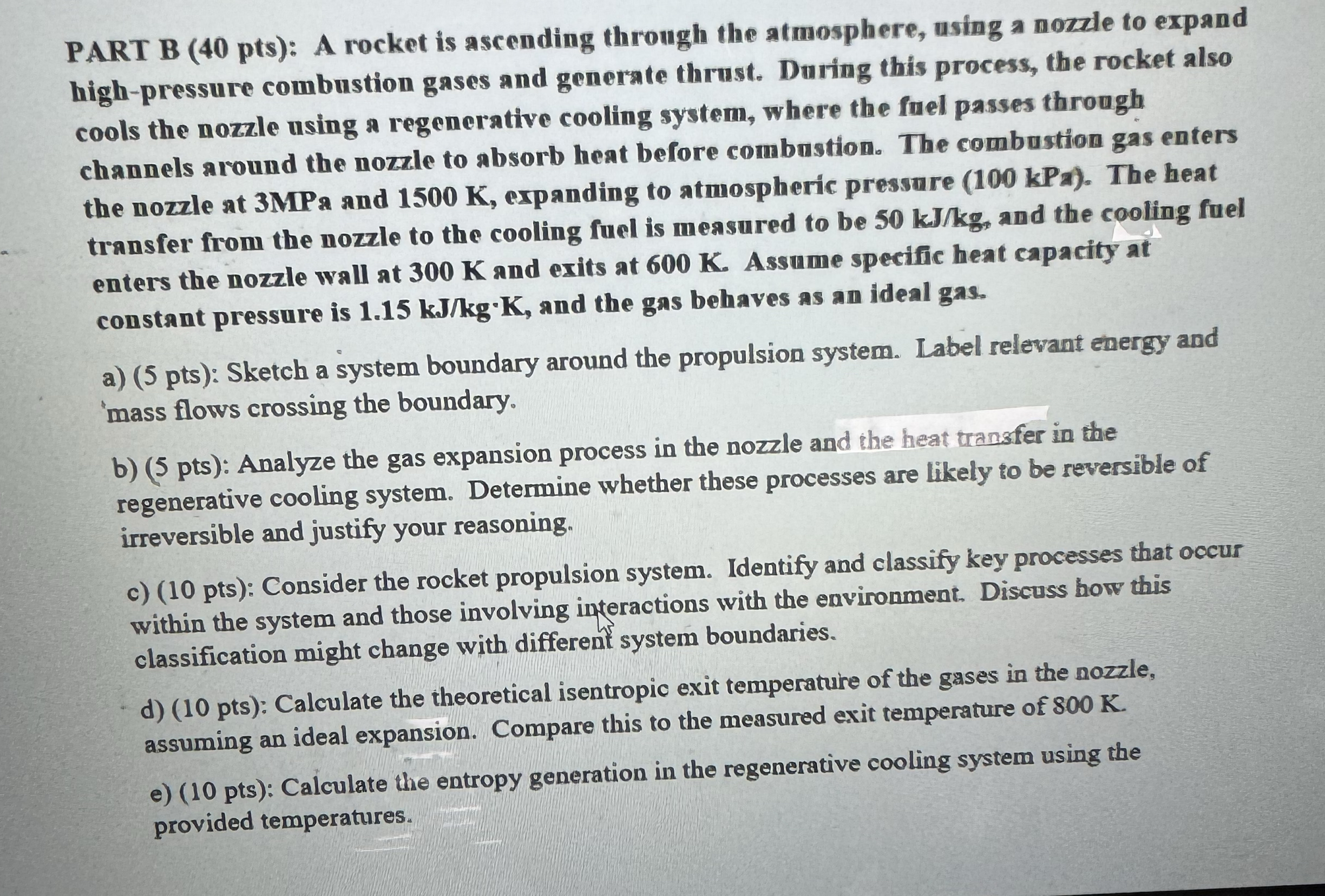
PART B pts: A rocket is ascending through the atmosphere, using a nozzle to expand highpressure combustion gases and generate thrust. During this process, the rocket also cools the nozzle using a regenerative cooling system, where the fuel passes through channels around the nozzle to absorb heat before combustion. The combustion gas enters the nozzle at MPa and K expanding to atmospheric pressure The heat transfer from the nozzle to the cooling fuel is measured to be and the cooling fuel enters the nozzle wall at K and exits at K Assume specific heat capacity at constant pressure is and the gas behaves as an ideal gas.
a pts : Sketch a system boundary around the propulsion system. Label relevant energy and 'mass flows crossing the boundary.
b pts : Analyze the gas expansion process in the nozzle and the heat transfer in the regenerative cooling system. Determine whether these processes are likely to be reversible of irreversible and justify your reasoning.
c pts: Consider the rocket propulsion system. Identify and classify key processes that occur within the system and those involving interactions with the eavironment. Discuss how this classification might change with different system boundaries.
d pts : Calculate the theoretical isentropic exit temperature of the gases in the nozzle, assuming an ideal expansion. Compare this to the measured exit temperature of K
e pts : Calculate the entropy generation in the regenerative cooling system using the provided temperatures.
Step by Step Solution
There are 3 Steps involved in it
1 Expert Approved Answer
Step: 1 Unlock

Question Has Been Solved by an Expert!
Get step-by-step solutions from verified subject matter experts
Step: 2 Unlock
Step: 3 Unlock
 Study Help