







Question: Part B: Let's talk about fluid exchange and pressure Model 3 shows a 90-foot long soaker hose, the kind people lay out in their gardens
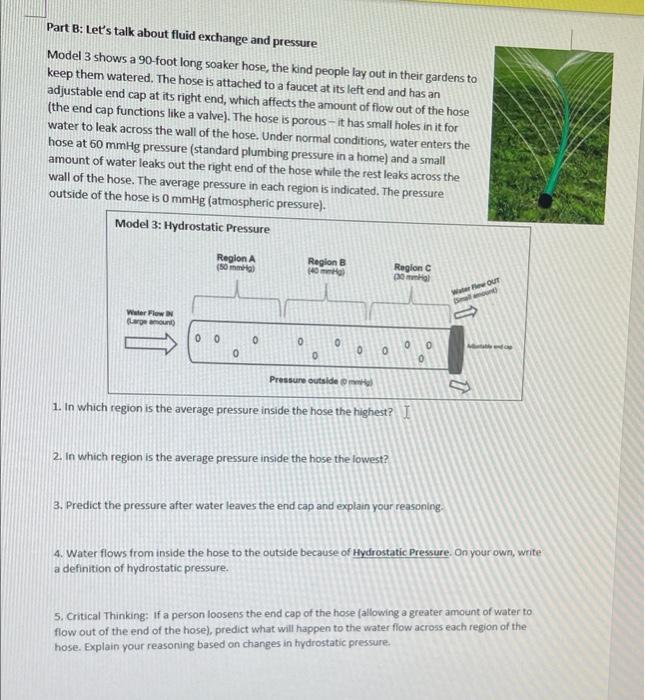
Part B: Let's talk about fluid exchange and pressure Model 3 shows a 90-foot long soaker hose, the kind people lay out in their gardens to keep them watered. The hose is attached to a faucet at its left end and has an adjustable end cap at its right end, which affects the amount of flow out of the hose (the end cap functions like a valve). The hose is porous- it has small holes in it for water to leak across the wall of the hose. Under normal conditions, water enters the hose at 60 mmHg pressure (standard plumbing pressure in a home) and a small amount of water leaks out the right end of the hose while the rest leaks across the wall of the hose. The average pressure in each region is indicated. The pressure outside of the hose is OmmHg (atmospheric pressure). Model 3: Hydrostatic Pressure Region A (50 mm) Region B 140 Ragionc www OUT Water Flow O mund 0 0 0 0 0 0 0 0 0 0 0 Pressure outside 1. In which region is the average pressure inside the hose the highest? I 2. In which region is the average pressure inside the hose the lowest? 3. Predict the pressure after water leaves the end cap and explain your reasoning. 4. Water flows from inside the hose to the outside because of Hydrostatic Pressure. On your own, write a definition of hydrostatic pressure. 5. Critical Thinking: If a person loosens the end cap of the hose (allowing a greater amount of water to flow out of the end of the hose), predict what will happen to the water flow across each region of the hose. Explain your reasoning based on changes in hydrostatic pressure
Step by Step Solution
There are 3 Steps involved in it

Get step-by-step solutions from verified subject matter experts
 Study Help