







Question: Part B - Maximum shear at C Determine the maximum positive shear that can be developed at point C . Express your answer in kN
Part B Maximum shear at
Determine the maximum positive shear that can be developed at point
Express your answer in kN to three significant figures.
View Available Hints
X Incorrect; Try Again; attempts remaining
The live load does not need to be applied over the entire length of the beam.
You may want to review Hint Location of the live load.
Part C Maximum moment at
Determine the maximum moment in the beam at point
Express your answer in to three significant figures.
View Available Hints
Figure
Incorrect; Try Again; attempts remaining
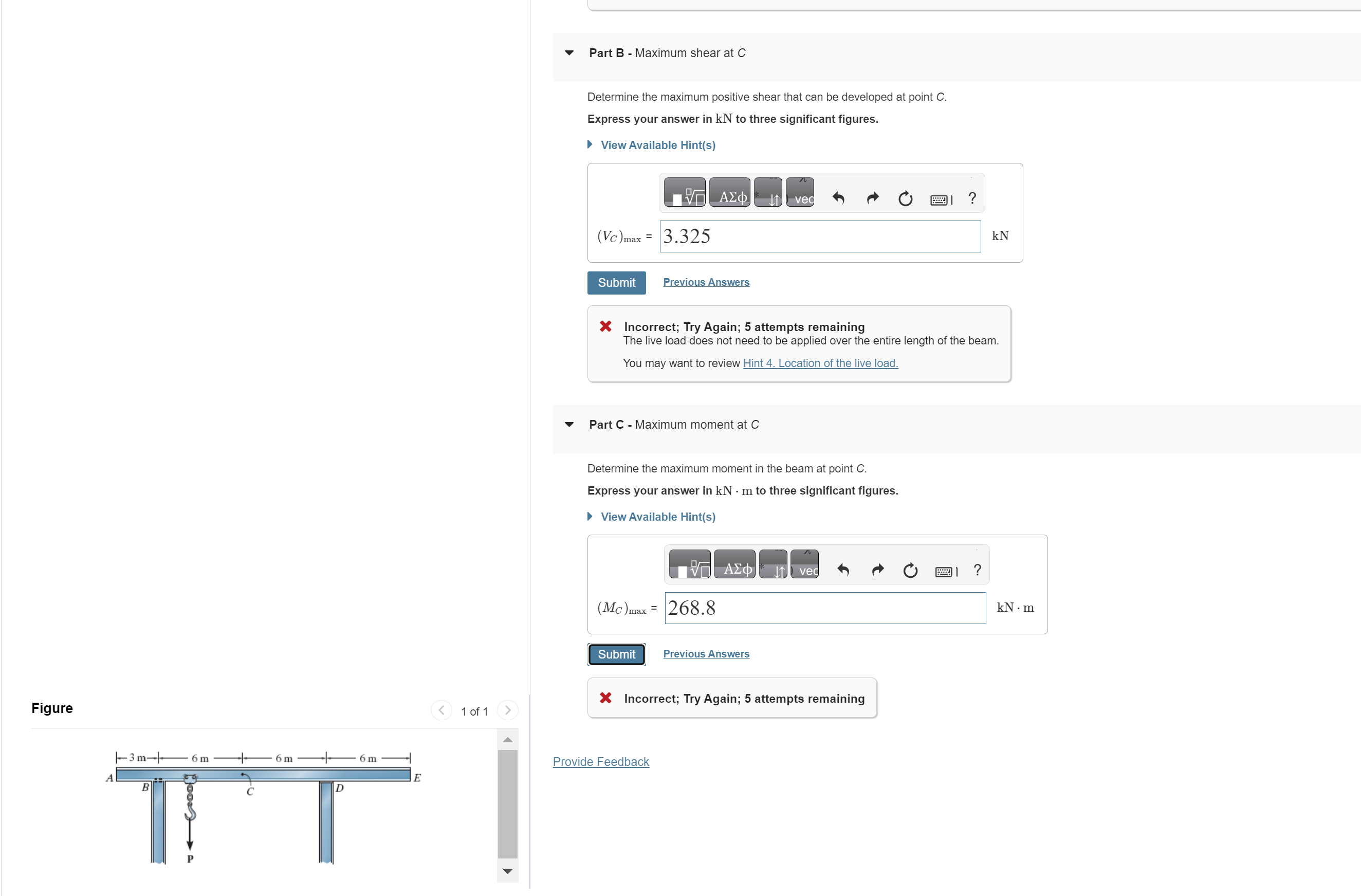
Provide Feedback The beam shown in Figure is used to support a hoist that transfers large items to various points underneath it The max load the hoist can move is The beam has a weight of and is subjected to a
uniform live load of Assume the hoist has negligible size and weight, and can travel the entire length of the beam. Also, assume is a pin and is a roller. Use this information to answer Parts A though C below.
Learning Goal:
To find the maximum reaction, shear, and moment at specified points in a beam that is
subjected to moving loads. This tutorial will use influence lines to find these maximum values
Influence lines are constructed using a dimensionless unit load. Therefore, the value of the
function for any concentrated force can be found by multiplying the ordinate of the influence
line at the position by the magnitude of The location of a concentrated load that will
produce a maximum value of a function reaction shear, or moment corresponds to the
maximum influence ordinate.
Influence lines can also be used to find values of a beam that is subjected to a distributed
loading. The value of a function caused by a uniform distributed load is equal to the area
under the influence line multiplied by the intensity of the uniform load. For maximum positive
or negative reaction, shear, or moment, a distributed live load should cover the regions of the
beam where the sign of the influence is positive or negative Furthermore, from the influence
line, one can determine the location of a live load that will produce the maximum value of a
function.
Part A Maximum reaction at
Determine the maximum positive vertical reaction at support
Express your answer in kN to three significant figures.
View Available Hints
Part B Maximum shear at
Determine the maximum positive shear that can be developed at point
Express your answer in kN to three significant figures.
View Available Hints
Previous Answers
X Incorrect; Try Again; One attempt remaining
Part C Maximum moment at
Determine the maximum moment in the beam at point
Express your answer in to three significant figures.
View Available Hints
Step by Step Solution
There are 3 Steps involved in it
1 Expert Approved Answer
Step: 1 Unlock

Question Has Been Solved by an Expert!
Get step-by-step solutions from verified subject matter experts
Step: 2 Unlock
Step: 3 Unlock
 Study Help