







Question: Part B OPTIONS ARE MINIMIZE OR MAXIMIZE, RETURN OR PRICE A business student has $2,500 available from a summer job and has identified three potential
Part B OPTIONS ARE MINIMIZE OR MAXIMIZE, RETURN OR PRICE
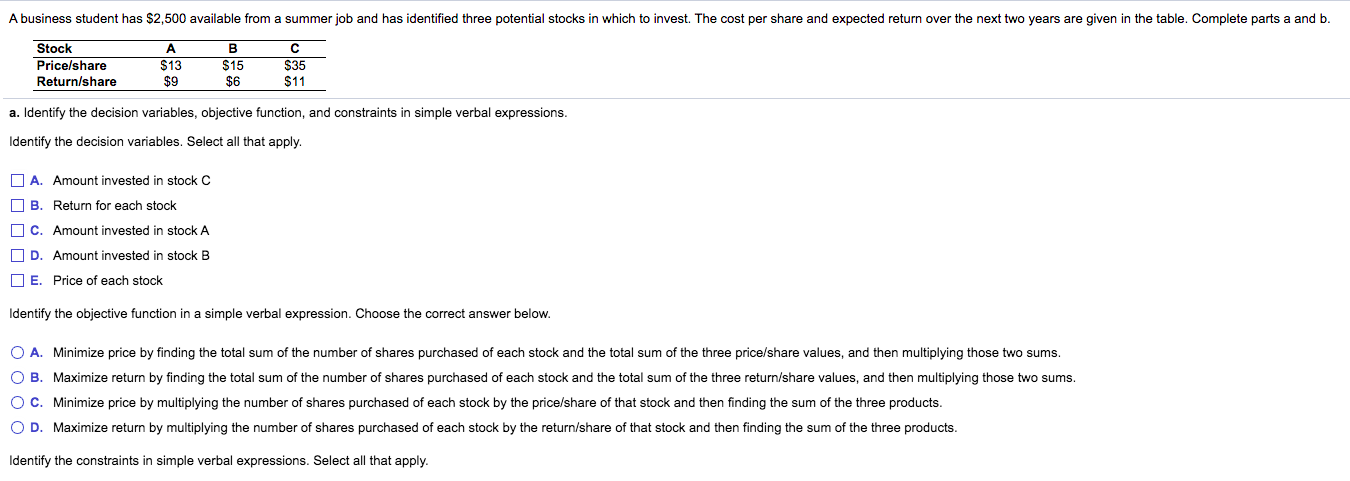
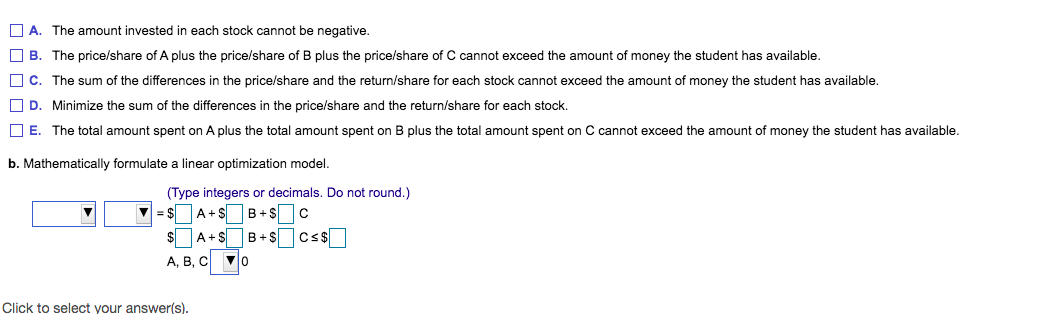
A business student has $2,500 available from a summer job and has identified three potential stocks in which to invest. The cost per share and expected return over the next two years are given in the table. Complete parts a and b. Stock Price/share Return/share $13 $9 B $15 $6 $35 $11 a. Identify the decision variables, objective function, and constraints in simple verbal expressions. Identify the decision variables. Select all that apply. O A. Amount invested in stock C OB. Return for each stock O c. Amount invested in stock A I D. Amount invested in stock B O E. Price of each stock Identify the objective function in a simple verbal expression. Choose the correct answer below. O A. Minimize price by finding the total sum of the number of shares purchased of each stock and the total sum of the three price/share values, and then multiplying those two sums. O B. Maximize return by finding the total sum of the number of shares purchased of each stock and the total sum of the three return/share values, and then multiplying those two sums. OC. Minimize price by multiplying the number of shares purchased of each stock by the price/share of that stock and then finding the sum of the three products. OD. Maximize return by multiplying the number of shares purchased of each stock by the return/share of that stock and then finding the sum of the three products. Identify the constraints in simple verbal expressions. Select all that apply. A. The amount invested in each stock cannot be negative. B. The price/share of A plus the price/share of B plus the price/share of C cannot exceed the amount of money the student has available. C. The sum of the differences in the price/share and the return/share for each stock cannot exceed the amount of money the student has available. ID. Minimize the sum of the differences in the price/share and the return/share for each stock. O E. The total amount spent on A plus the total amount spent on B plus the total amount spent on C cannot exceed the amount of money the student has available. b. Mathematically formulate a linear optimization model. (Type integers or decimals. Do not round.) A+ SI B+ SC $ A+ B+$c$ A, B, C vo Click to select your answer(s)Step by Step Solution
There are 3 Steps involved in it
1 Expert Approved Answer
Step: 1 Unlock

Question Has Been Solved by an Expert!
Get step-by-step solutions from verified subject matter experts
Step: 2 Unlock
Step: 3 Unlock
 Study Help