







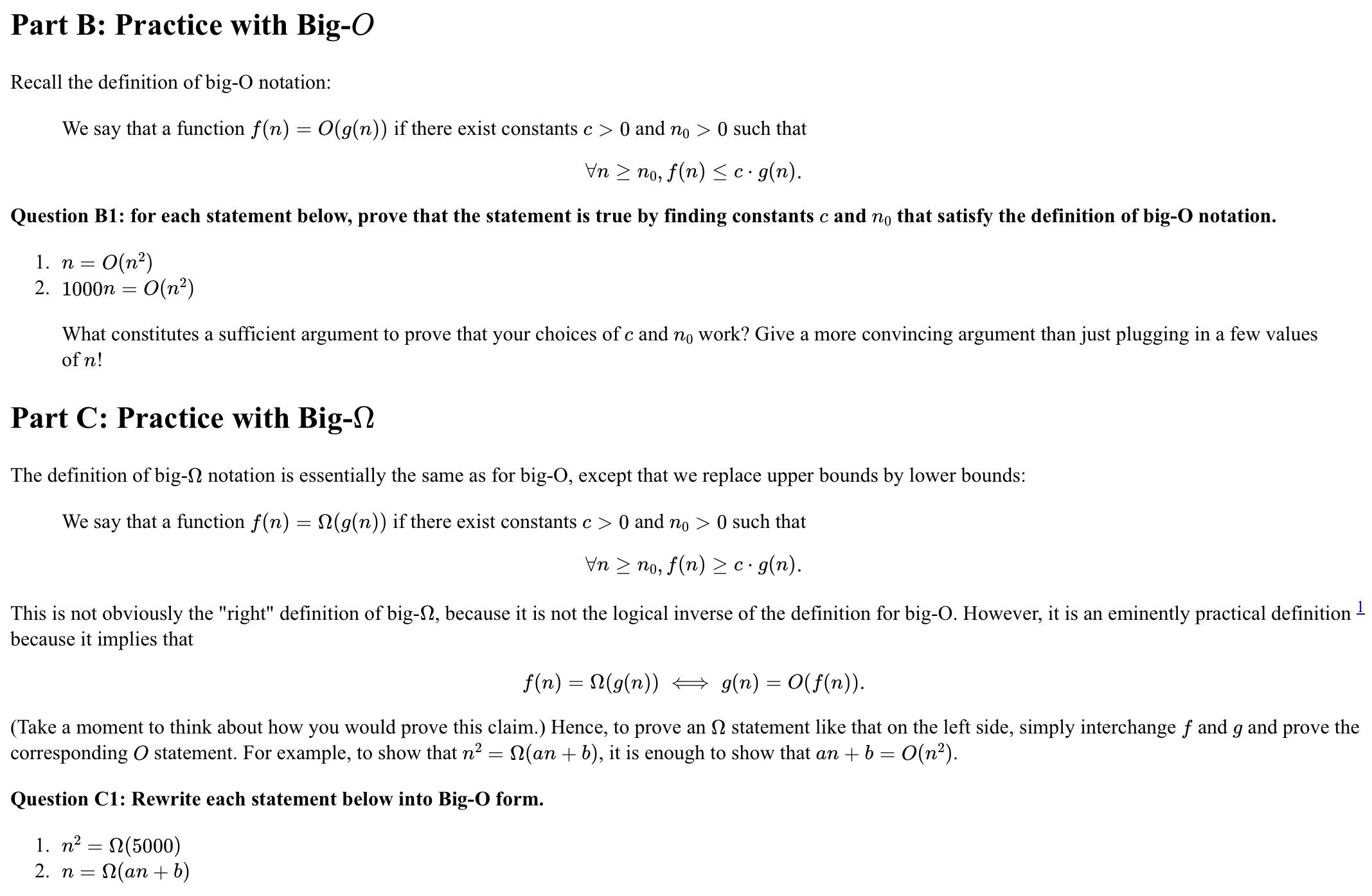
Question: Part B: Practice with Big - O Recall the definition of big - O notation: We say that a function f ( n ) =
Part B: Practice with Big
Recall the definition of bigO notation:
We say that a function if there exist constants and such that
AAn
Question B: for each statement below, prove that the statement is true by finding constants and that satisfy the definition of bigO notation.
What constitutes a sufficient argument to prove that your choices of and work? Give a more convincing argument than just plugging in a few values of
Part C: Practice with Big
The definition of big notation is essentially the same as for bigO except that we replace upper bounds by lower bounds:
We say that a function if there exist constants and such that
AAn
This is not obviously the "right" definition of big because it is not the logical inverse of the definition for bigO However, it is an eminently practical definition because it implies that
Take a moment to think about how you would prove this claim. Hence, to prove an statement like that on the left side, simply interchange and and prove the corresponding statement. For example, to show that it is enough to show that
Question C: Rewrite each statement below into BigO form.
Step by Step Solution
There are 3 Steps involved in it
1 Expert Approved Answer
Step: 1 Unlock

Question Has Been Solved by an Expert!
Get step-by-step solutions from verified subject matter experts
Step: 2 Unlock
Step: 3 Unlock
 Study Help