







Question: Part B. Pricing Strategies _ . . . (l) Third-degree Price Discriminations (segmenting): a type of direct price discrimination in which a firm charges different
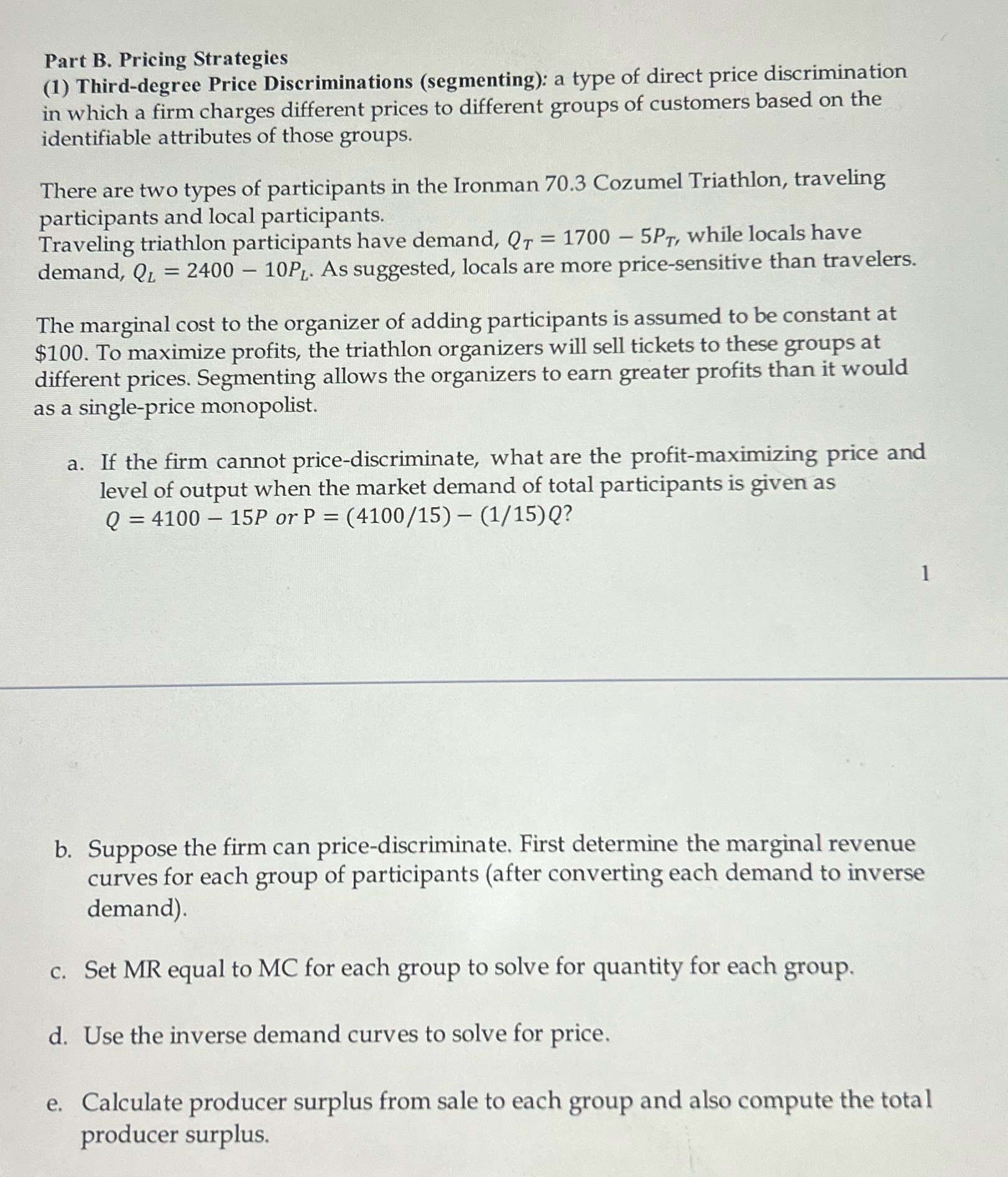
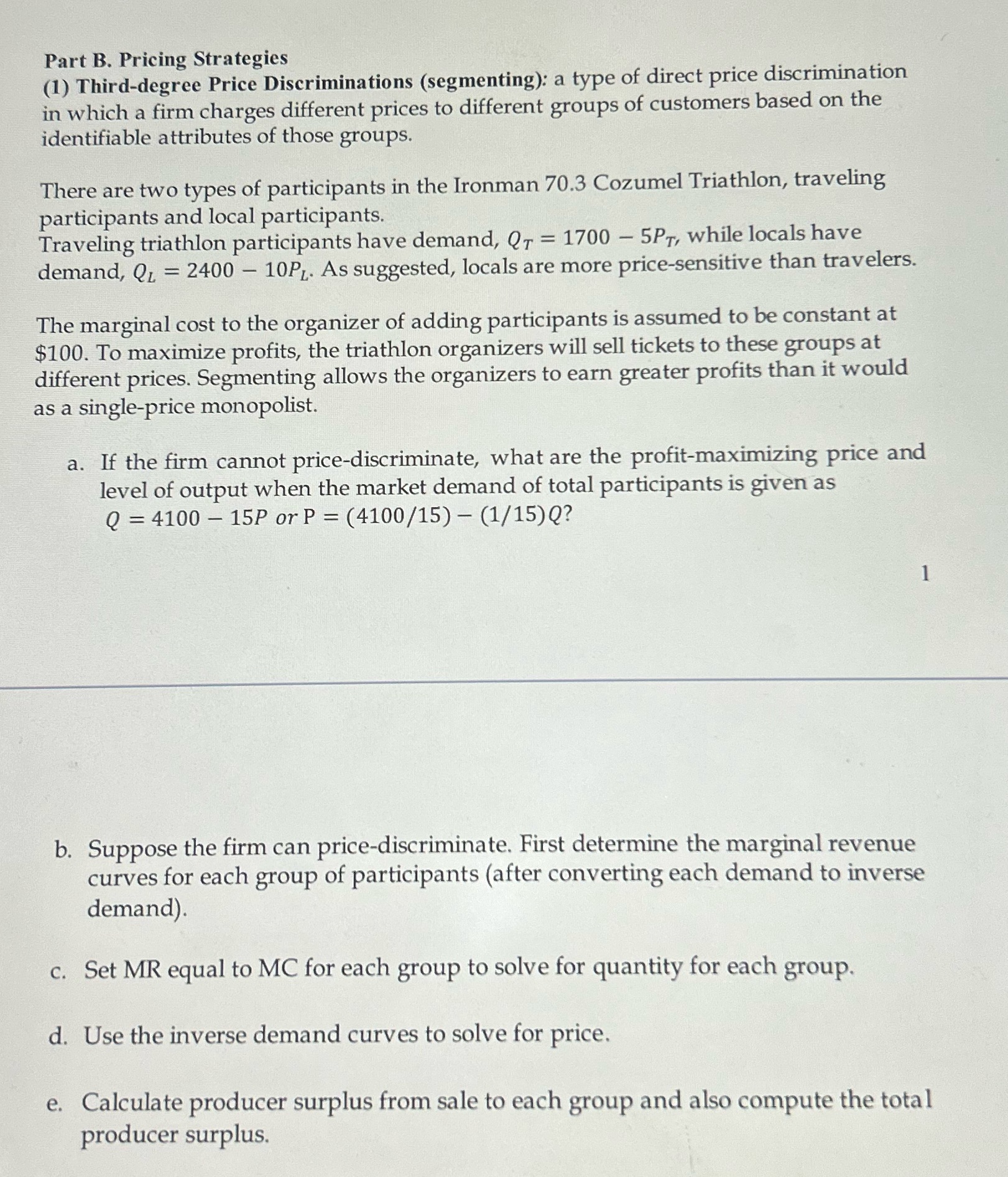
Part B. Pricing Strategies _ . . . (l) Third-degree Price Discriminations (segmenting): a type of direct price discrimination in which a firm charges different prices to different groups of customers based on the identifiable attributes of those groups. There are two types of participants in the Ironman 70.3 Cozumel Triathlon, traveling participants and local participants. Traveling triathlon participants have demand, QT = 1700 SP7, while locals have demand, 0,; = 24-00 10PL. As suggested, locals are more price-sensitive than travelers. The marginal cost to the organizer of adding participants is assumed to be constant at $100. To maximize profits, the triathlon organizers will sell tickets to these groups at different prices. Segmenting allows the organizers to earn greater prots than it would as a single-price monopolist. a. If the firm cannot price-discriminate, what are the profit-maximizing price and level of output when the market demand of total participants is given as Q = 4100 15P orP = (4100/15) (1/1S)Q? b. Suppose the firm can price-discriminate. First determine the marginal revenue curves for each group of participants (after converting each demand to inverse demand). c. Set MR equal to MC for each group to solve for quantity for each group. d. Use the inverse demand curves to solve for price. e. Calculate producer surplus from sale to each group and also compute the total producer surplus
Step by Step Solution
There are 3 Steps involved in it

Get step-by-step solutions from verified subject matter experts
 Study Help