







Question: PART B - Solve the following problems from Lecture 6 Problem 6.1 Athin biconvex lens (n=1.7) has a front surface power of +6.00D and a
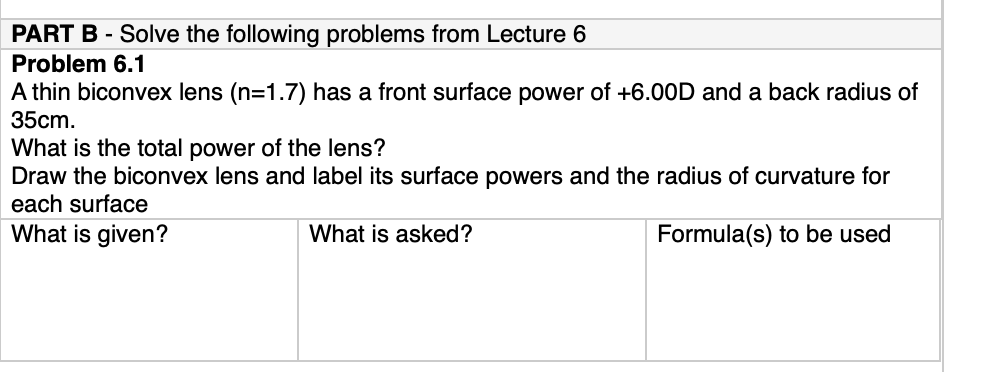
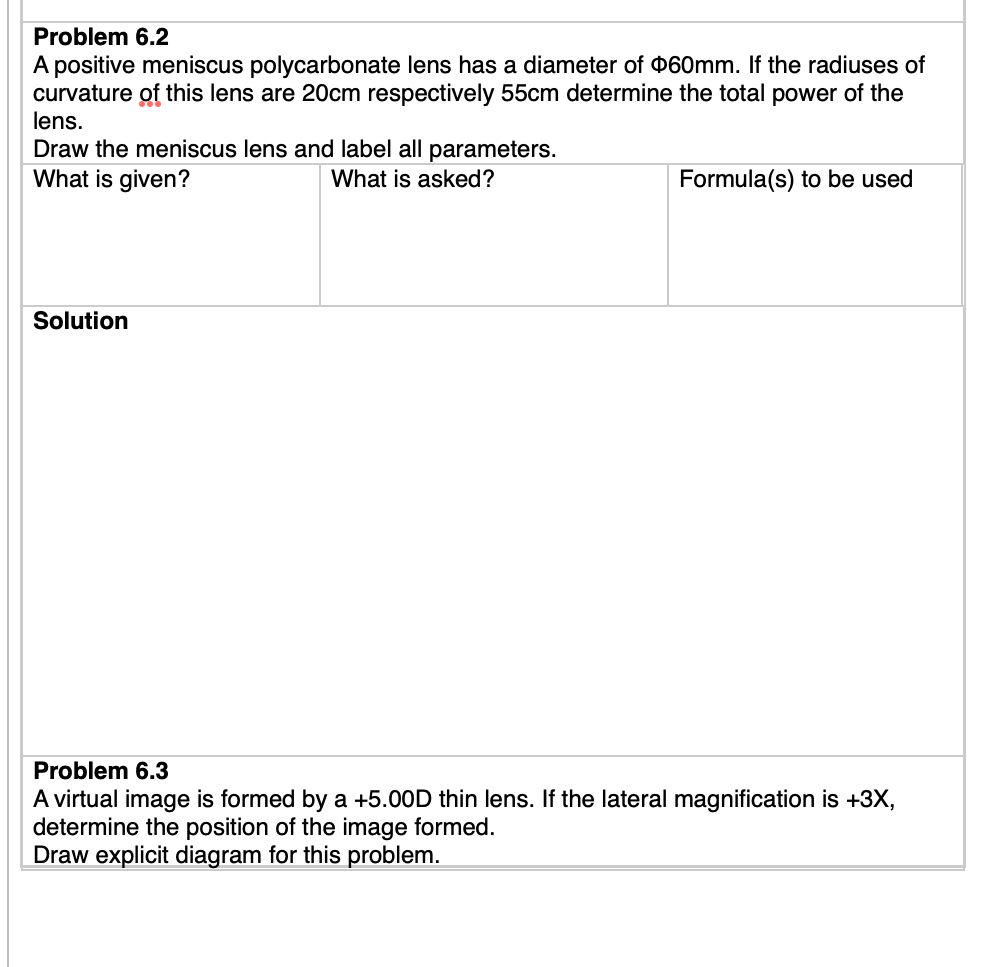
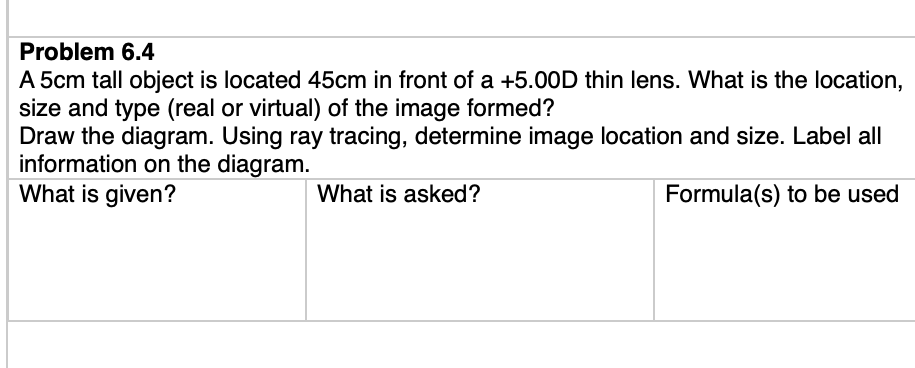
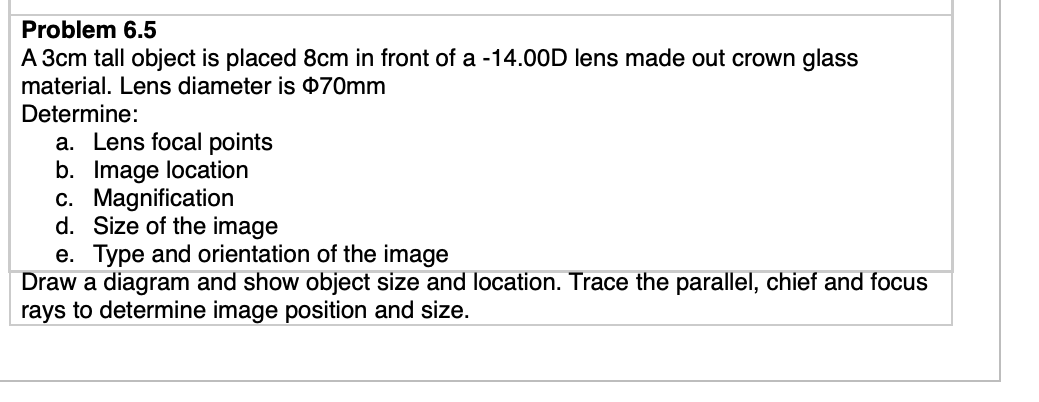
PART B - Solve the following problems from Lecture 6 Problem 6.1 Athin biconvex lens (n=1.7) has a front surface power of +6.00D and a back radius of 35cm. What is the total power of the lens? Draw the biconvex lens and label its surface powers and the radius of curvature for each surface What is given? What is asked? Formula(s) to be used Problem 6.2 A positive meniscus polycarbonate lens has a diameter of $60mm. If the radiuses of curvature of this lens are 20cm respectively 55cm determine the total power of the lens. Draw the meniscus lens and label all parameters. What is given? What is asked? Formula(s) to be used Solution Problem 6.3 A virtual image is formed by a +5.00D thin lens. If the lateral magnification is +3X, determine the position of the image formed. Draw explicit diagram for this problem.Problem 6.4 A 50m ta|| object is located 45cm in front of a +5.00D thin lens. What is the location, size and type (real or virtual) of the image formed? Draw the diagram. Using ray tracing, determine image location and size. Label all information on the diagram. What is given? What is asked? Formula{s) to be used Problem 6.5 ASCm tall object is placed 8cm in front of a -14.00D lens made out crown glass material. Lens diameter is 70mm Determine: a. Lens focal points b. Image location c. Magnification C]. Size of the image e. Type and orientation of the image Draw a diagram and show object size and location. Trace the parallel, chief and focus rays to determine image position and size
Step by Step Solution
There are 3 Steps involved in it

Get step-by-step solutions from verified subject matter experts
 Study Help