







Question: Part B - Write the KCL equations Once you have identified the essential nodes, you must choose one of the essential nodes as the reference
Part B Write the KCL equations
Once you have identified the essential nodes, you must choose one of the essential nodes as the reference node. This node is often the essential node that connects the greatest number of branches. If all of the essential nodes connect the same number of branches, the reference node is often the essential node at the bottom of the circuit. It is important to note that the choice of the reference node has no effect on the values of the voltage drops and currents for the circuit's components, so any essential node can be identified as the reference node.
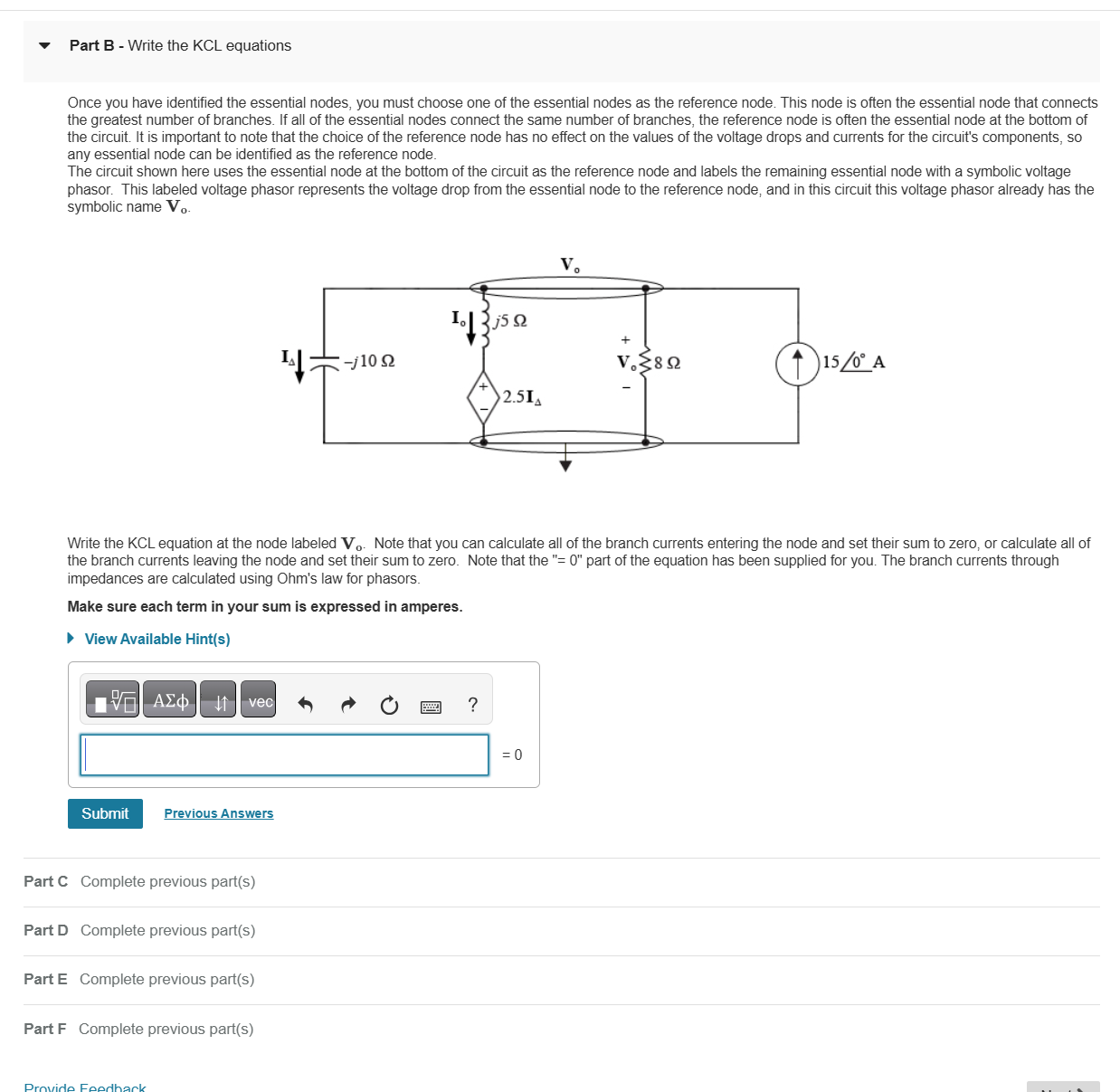
The circuit shown here uses the essential node at the bottom of the circuit as the reference node and labels the remaining essential node with a symbolic voltage phasor. This labeled voltage phasor represents the voltage drop from the essential node to the reference node, and in this circuit this voltage phasor already has the symbolic name mathbfVtext o
Write the KCL equation at the node labeled mathbfVmathbfo Note that you can calculate all of the branch currents entering the node and set their sum to zero, or calculate all of the branch currents leaving the node and set their sum to zero. Note that the part of the equation has been supplied for you. The branch currents through impedances are calculated using Ohm's law for phasors.
Make sure each term in your sum is expressed in amperes.
View Available Hints
Previous Answers
Part C Complete previous parts
Part D Complete previous parts
Part E Complete previous parts
Part F Complete previous parts
Step by Step Solution
There are 3 Steps involved in it
1 Expert Approved Answer
Step: 1 Unlock

Question Has Been Solved by an Expert!
Get step-by-step solutions from verified subject matter experts
Step: 2 Unlock
Step: 3 Unlock
 Study Help