



Question: Part C Choose the correct plot of x versus 1/m2 with the correct equation of the best-line fit. Apply the static equilibrium equation z=0 with
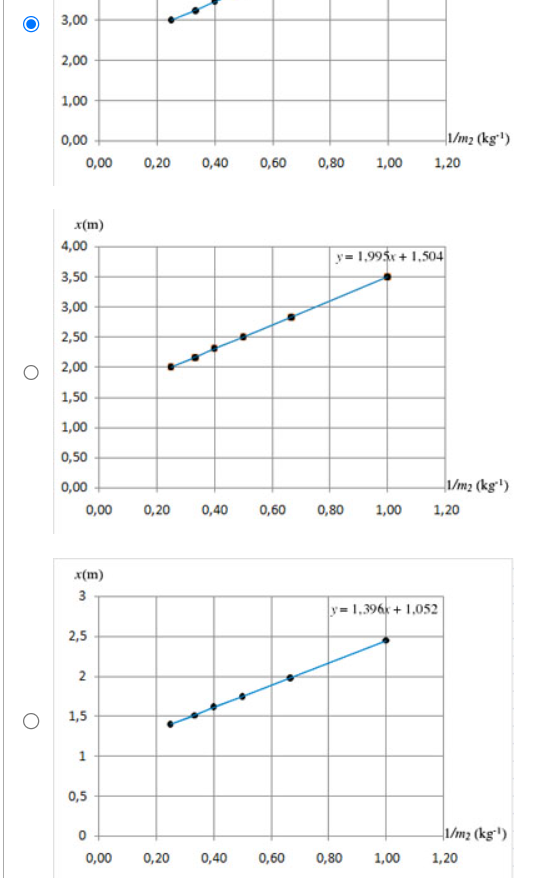
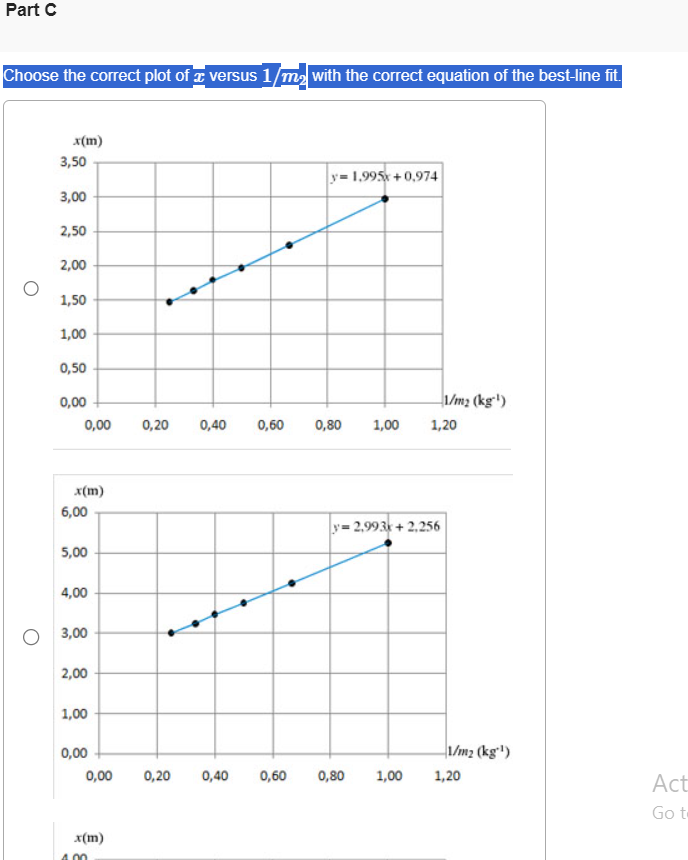
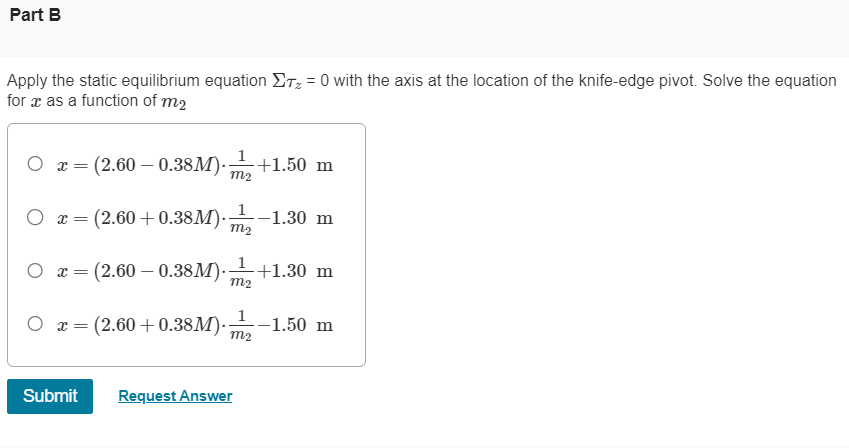
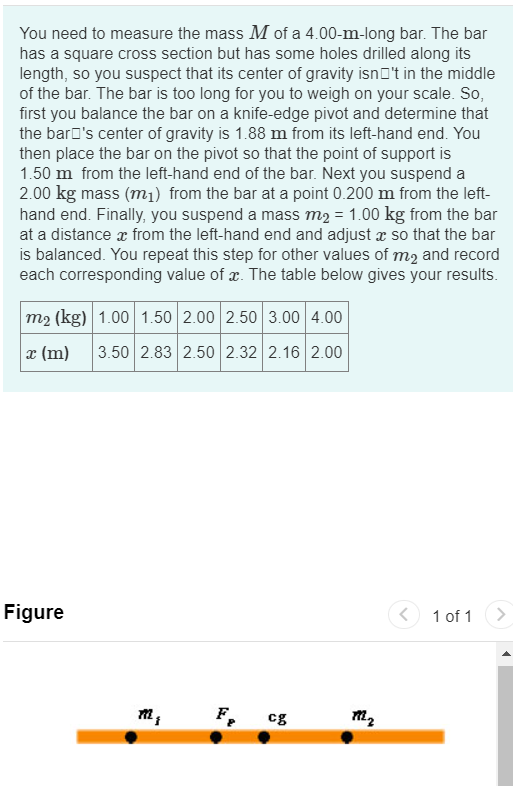
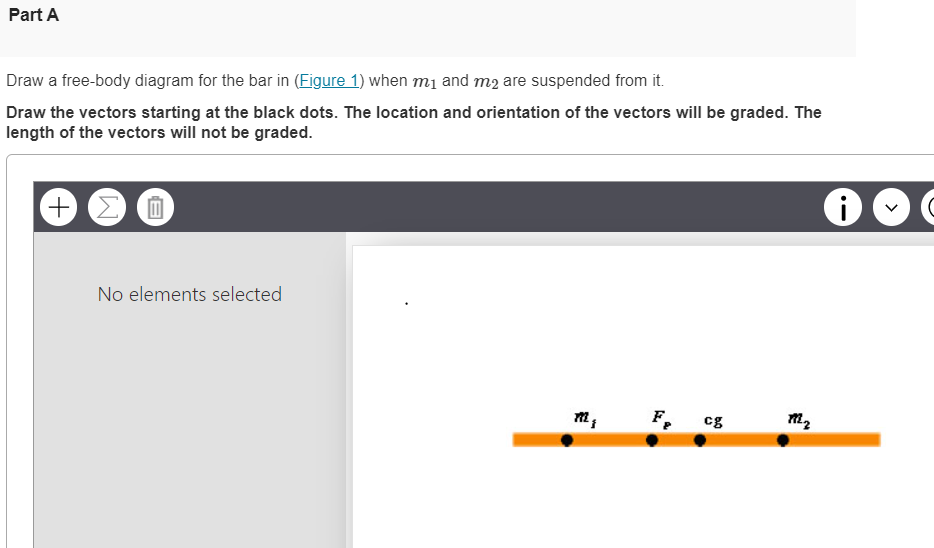
Part C Choose the correct plot of x versus 1/m2 with the correct equation of the best-line fit. Apply the static equilibrium equation z=0 with the axis at the location of the knife-edge pivot. Solve the equation for x as a function of m2 x=(2.600.38M)m21+1.50mx=(2.60+0.38M)m211.30mx=(2.600.38M)m21+1.30mx=(2.60+0.38M)m211.50m You need to measure the mass M of a 4.00m-long bar. The bar has a square cross section but has some holes drilled along its length, so you suspect that its center of gravity isn 't in the middle of the bar. The bar is too long for you to weigh on your scale. So, first you balance the bar on a knife-edge pivot and determine that the bar 's center of gravity is 1.88m from its left-hand end. You then place the bar on the pivot so that the point of support is 1.50m from the left-hand end of the bar. Next you suspend a 2.00kg mass (m1) from the bar at a point 0.200m from the lefthand end. Finally, you suspend a mass m2=1.00kg from the bar at a distance x from the left-hand end and adjust x so that the bar is balanced. You repeat this step for other values of m2 and record each corresponding value of x. The table below gives your results. Draw a free-body diagram for the bar in (Figure 1) when m1 and m2 are suspended from it. Draw the vectors starting at the black dots. The location and orientation of the vectors will be graded. The length of the vectors will not be graded. Part C Choose the correct plot of x versus 1/m2 with the correct equation of the best-line fit. Apply the static equilibrium equation z=0 with the axis at the location of the knife-edge pivot. Solve the equation for x as a function of m2 x=(2.600.38M)m21+1.50mx=(2.60+0.38M)m211.30mx=(2.600.38M)m21+1.30mx=(2.60+0.38M)m211.50m You need to measure the mass M of a 4.00m-long bar. The bar has a square cross section but has some holes drilled along its length, so you suspect that its center of gravity isn 't in the middle of the bar. The bar is too long for you to weigh on your scale. So, first you balance the bar on a knife-edge pivot and determine that the bar 's center of gravity is 1.88m from its left-hand end. You then place the bar on the pivot so that the point of support is 1.50m from the left-hand end of the bar. Next you suspend a 2.00kg mass (m1) from the bar at a point 0.200m from the lefthand end. Finally, you suspend a mass m2=1.00kg from the bar at a distance x from the left-hand end and adjust x so that the bar is balanced. You repeat this step for other values of m2 and record each corresponding value of x. The table below gives your results. Draw a free-body diagram for the bar in (Figure 1) when m1 and m2 are suspended from it. Draw the vectors starting at the black dots. The location and orientation of the vectors will be graded. The length of the vectors will not be graded
Step by Step Solution
There are 3 Steps involved in it

Get step-by-step solutions from verified subject matter experts